49 works in this view — arrow keys or swipe to move between them.
Dance in Art · 1834
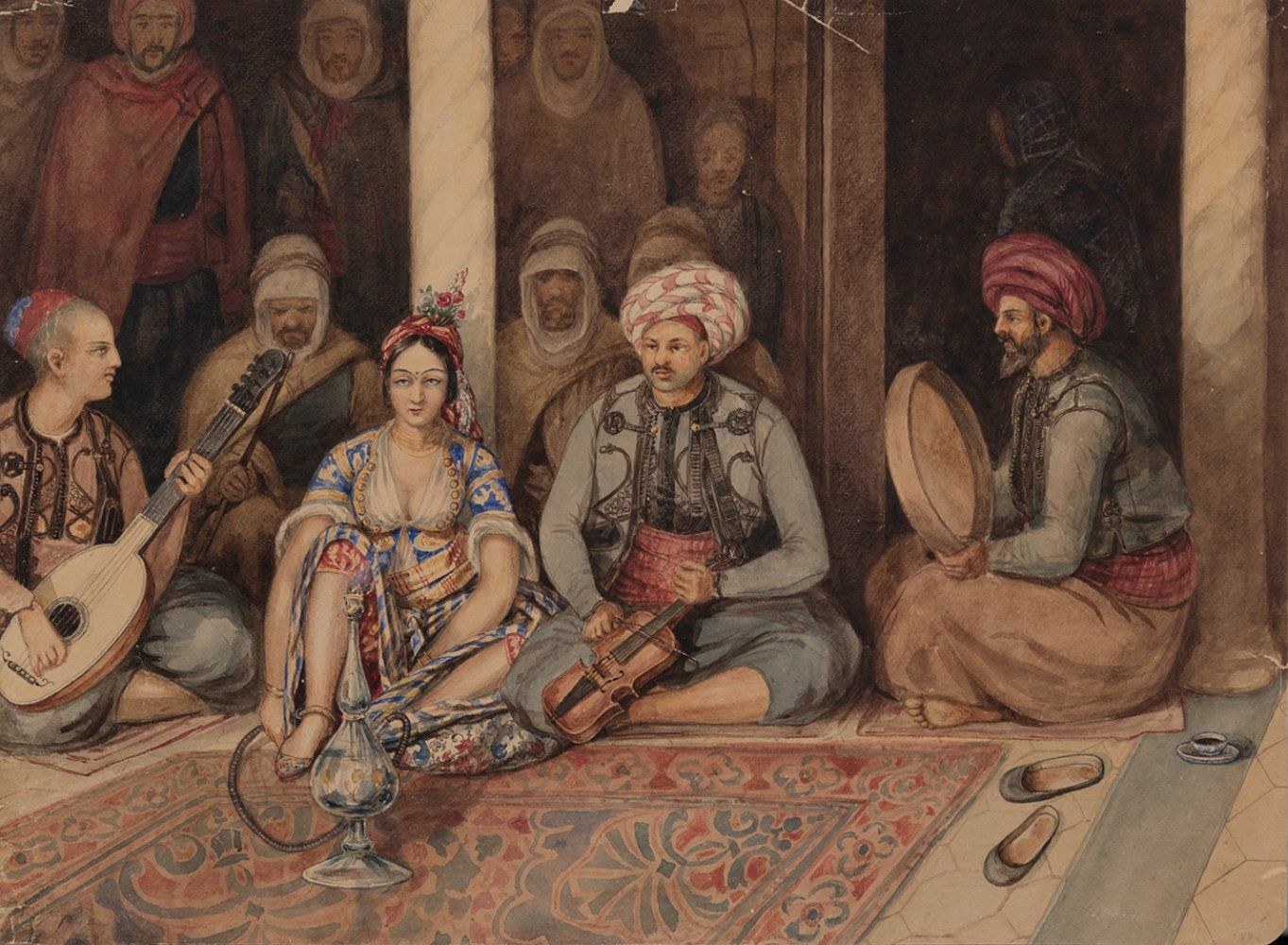
After the dance. Dancer with three Arab musicians in Algiers, 1834
Olivier Bro de Coméres
- Medium:
- Oil Painting
- Era:
- Mid 1800s (Polka Era)
- Source:
- Wikimedia Commons
- Rights:
- Public domain — free to use, share and adapt.
- Recorded as:
- Public Domain
For dance historians, this painting documents the historical relationship between European visual culture and North African music-making practices during colonization, showing how dance and music were represented (and likely misrepresented) to European audiences. The work raises questions about ethnographic authenticity, the eroticization of female performers in colonial contexts, and how European artists understood non-Western movement and musicality.
What you are looking at
Five figures are gathered indoors in what appears to be a domestic or palace interior, seated on an ornate carpet with geometric and floral patterns. The space is defined by tall cream-colored columns or pilasters and a dark background suggesting deep interior space. In the background, several additional figures in head coverings stand as witnesses or attendants. The foreground is dominated by the central group: a woman in elaborate dress sits prominent among four men in Middle Eastern attire. The woman wears a richly patterned costume with blue embroidered panels, a red coral-colored headdress with jeweled ornament, and light linen undergarments; her pose is relaxed and recumbent. To her left, a man in tan and brown robes holds a stringed instrument (likely an oud or similar lute). Next to him sits another musician holding what appears to be a violin or similar bowed string instrument. To the woman's right, a man in grey-blue robes with a red-wrapped turban holds a large frame drum. On the far left, another musician in embroidered tan garments holds a stringed plucked instrument. A glass vessel, possibly for wine or coffee, sits on the carpet. The painting is executed in warm ochres, tans, reds, and earth tones, with careful attention to textile patterns and the subtle modeling of faces and hands.
The dancing
The woman reclines in a posture of ease and leisure, her body weight supported by cushioning implied beneath the carpet, her gaze directed toward the musicians. The men sit upright, their postures formal and purposeful as performers. The string players hold their instruments in active playing position—one with the oud elevated, the other with the violin held to the shoulder. The drummer's frame drum is held vertically on his lap. There is no physical contact between the figures; the woman and musicians are arranged in loose proximity rather than in partnered dance hold. The overall composition emphasizes looking and listening rather than movement or partner connection.
The dance depicted
This is not a depiction of dance in the European ballroom sense, but rather a portrait of musical entertainment and courtship ritual in early 19th-century Algeria. The title "After the dance" suggests this captures a moment of repose following dancing, or a pause in a musical evening. The woman's recumbent posture, her central placement, and her ornamented dress indicate she is the focus of entertainment and attention—likely a performer or a woman of status being entertained by musicians. The ensemble of instruments (oud, violin, frame drum, and possibly another stringed instrument) suggests North African Arabic music-making of the Ottoman period. Whether this depicts actual movement or a posed moment of musical reception cannot be determined from the static composition alone, but the attention to her body position and the musicians' engagement suggests knowledge of Maghrebi social music practices.
How it was made
This is an oil painting, as indicated by the catalogue record and confirmed by the soft, translucent handling of light and color visible in the image. The technique allows for careful modeling of the figure's face and hands, subtle rendering of textile patterns and embroidery, and the atmospheric recession of the background figures. The warm palette and glazing suggest the work was created for a European audience unfamiliar with North African interior life, using oil paint's capacity to render exotic materials—silks, embroidered textiles, jewelry—with convincing material specificity. The painting's scale and finish indicate it was intended as a finished exhibition work rather than a sketch, suggesting it circulated among European collectors interested in Orientalist scenes.
About this work
This oil painting depicts a moment in an Algerian household during the French colonial period, showing a European artist's interpretation of North African social music-making and courtship ritual. The work sits at the intersection of Orientalist painting, ethnographic documentation, and imaginative reconstruction of "exotic" leisure. The title "After the dance" invites the viewer to imagine a preceding moment of movement, even as the painting itself presents a static scene of musical entertainment. The work is evidence of early 19th-century European fascination with North African interiors, social practices, and bodies, filtered through the conventions of academic Orientalism.
How to look at it
Attend to the woman's body position and gaze—she is recumbent and observant rather than actively performing dance. Look at how the painter has arranged the musicians around her in a semi-circle, establishing her as the focus of their attention and the painting's attention. Notice the careful rendering of her costume details (the embroidered panels, the jeweled headdress, the coral-silk wrap) against the more austere dress of the male musicians, suggesting her status or role as a woman being entertained. The title's claim that this is "after the dance" asks the viewer to imaginatively reconstruct a preceding moment of movement that the static painting itself withholds.
The artist
Olivier Bro de Comères was a French painter working in the mid-19th century, part of the wave of European artists drawn to North Africa following the French conquest of Algeria in 1830. Like other Orientalist painters of the period, he worked from observation, sketches, and imagination to create scenes of interior life, harems, and musical entertainment for European sale. His practice represents the colonial visual archive—artists embedded in or traveling through colonized territories producing images for European consumption.
The period
This work dates to 1834, two years after the French invasion of Algeria and the beginning of French colonial rule. European Orientalism was at its height; artists and writers were intensely fascinated by the "Orient" as a site of exoticism, leisure, and difference. In dance history, this period coincides with the Romantic era in European ballet (the 1830s saw the premiere of works like *La Sylphide* in 1832), during which European dance incorporated "exotic" themes and movements imagined to be Oriental. The painting participates in this broader cultural moment of imagining and appropriating North African and Middle Eastern bodies and practices for European consumption.
Where it lives
The work is recorded as an oil painting dated 1834 by Olivier Bro de Comères, held in an unspecified collection. The image comes via Wikimedia Commons, suggesting it may be in a public collection, though the current location is not confirmed in the catalogue record.
Questions about this work
Is this actually a dance scene?
Not in the active sense—no figures are shown moving. The title "After the dance" suggests the painting captures a moment of repose or musical entertainment following dancing, or invites the viewer to imagine a preceding dance. The static composition emphasizes music-making, courtship, and leisure rather than choreography or movement.
Who is the woman in the center?
The painting does not identify her. Based on her central placement, elaborate costume, and the musicians' attention to her, she may be a performer, a woman of status, or an imagined figure representing European fantasies about North African women. The work reflects Orientalist conventions of depicting women as objects of display and consumption.
What instruments are being played?
The ensemble includes a lute-like instrument (likely an oud), a bowed string instrument (possibly a violin or rebab), and a frame drum (likely a bendir or tar). These are consistent with North African and Ottoman-period Arabic music traditions, suggesting the painter had some ethnographic awareness, though the scene may be a Romantic reconstruction rather than documentary.
When and where was this painted?
The work is dated 1834 and titled as depicting Algiers. This is two years after the French invasion of Algeria, when European artists and soldiers were beginning to document colonial territories. The painting reflects the early moment of European Orientalism applied to the newly conquered colony.
More dance artwork