49 works in this view — arrow keys or swipe to move between them.
Dance in Art · 1850
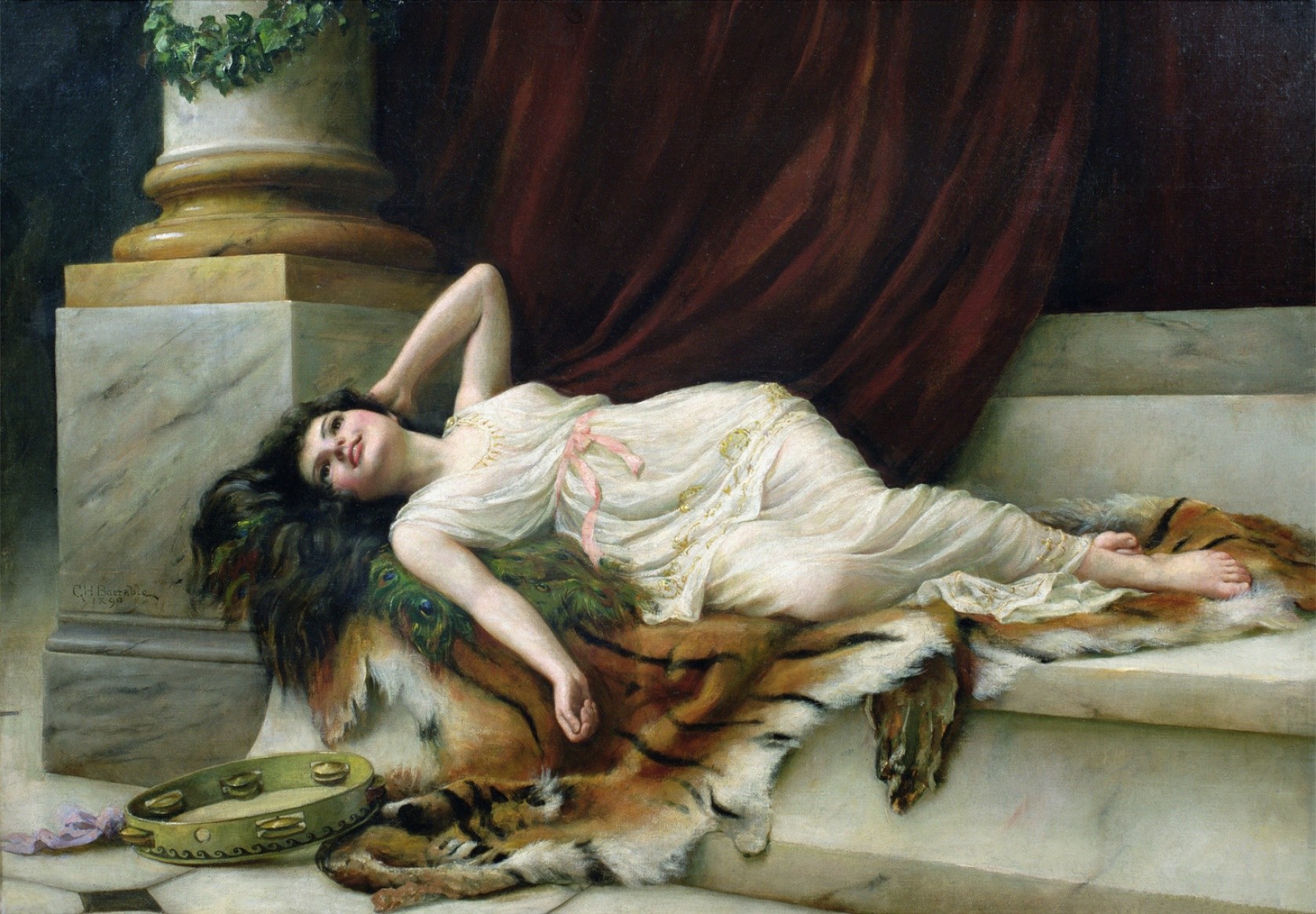
George Hamilton Barrable - After the Dance
George Hamilton Barrable
- Medium:
- Oil Painting
- Era:
- Mid 1800s (Polka Era)
- Source:
- Wikimedia Commons
- Rights:
- Public domain — free to use, share and adapt.
- Recorded as:
- Public Domain
The work is important as evidence of how Victorian artists used "dance" as a signifier of exoticism and sensuality without necessarily depicting actual choreography. It shows the orientalist imagination of the era, in which reference to Eastern dancing women conjured decadence and luxury rather than a real practice. For historians of orientalism and Victorian visual culture, it is more significant than for historians of dance itself.
What you are looking at
A reclining woman in a white diaphanous dress occupies the center of a richly appointed interior. She reclines languorously on a marble bench or dais, her body turned toward the viewer, one leg extended and the other bent at the knee. Her dress is gossamer and delicately draped, with pink ribbon detail at the bodice. A large feline—either a lion or tiger—rests its head near her lap and torso; she reaches down to touch or stroke the animal with one hand. Behind her stands an Ionic column topped with a marble capital and potted greenery; heavy burgundy drapery falls in rich folds behind. A decorative bronze or brass object, possibly a shield or piece of armor, lies on the floor to the lower left. The lighting is warm and theatrical, with strong contrast between the luminous white of her dress and the shadowy background. The overall mood is one of languid luxury and exoticism.
The dancing
The woman's body is entirely passive and supported—she does not stand or move. Her torso is supine with the head turned slightly upward and back; her right leg is extended while the left bends naturally. Her arms hang loosely, one reaching down to the animal. This is not a dancer's posture or frame. The animal dominates the physical interaction, and her engagement is tactile and intimate rather than locomotive.
The dance depicted
This is not a depiction of dance. The woman is at rest, reclining rather than moving. While the title "After the Dance" suggests a narrative moment following exertion or performance, nothing in the image shows dance itself—no turned-out legs, no lifted carriage, no active arm positions, no sense of motion or rhythm. The work documents a post-dance state of repose or indulgence, not the dance event itself. The exotic setting and the presence of the large cat suggest a fantastical or orientalist scenario rather than a ballroom or performance context.
How it was made
Oil painting on canvas. The technique demonstrates high finish and smooth blending, particularly in the rendering of skin tones, the translucent fabric of the dress, and the animal's musculature. The work shows the academic painting tradition of mid-19th-century Britain, with careful attention to detail, rich color, and narrative content. The medium allowed the artist to create a large, commanding figural composition suitable for exhibition and private collection.
About this work
This is an orientalist fantasy by the Victorian painter George Hamilton Barrable, depicting an idealized moment of leisure and exotic romance rather than dance itself. The title's reference to dance may be biographical—establishing that this is the aftermath of a performance—but the work belongs in a dance gallery only if we read the title as claiming a connection. The painting exemplifies the Victorian fascination with harem scenes, animal encounters, and languid female bodies. It sits at the margins of dance imagery, documenting not movement but the fantasy world associated with orientalist performance.
How to look at it
Attend to the deliberate passivity of the woman's body and the absence of any suggestion of movement. The artist has frozen not a moment of dance but of rest and gratification. Notice the interplay of skin, fabric, and fur—all soft, tactile surfaces rendered in oil paint. The composition pulls the viewer's gaze down toward the woman and the animal, emphasizing luxury and intimacy. The historical moment is post-movement, post-performance, which is what the title signals. The painting invites voyeurism rather than an understanding of how dance actually works.
The artist
George Hamilton Barrable (1811–1894) was a British painter specializing in orientalist and historical subjects. He exhibited regularly at the Royal Academy and was part of the broad 19th-century movement toward orientalist fantasy and exotic narrative painting. His work is characteristic of mid-Victorian taste for large, richly decorated canvases depicting imagined scenes of Eastern harems, romance, and luxury—worlds accessible to British viewers only through paint and imagination.
The period
The work dates to 1850, during the height of Victorian orientalism. This period saw intense British imperial presence in the Middle East and India, which generated enormous appetite for painted fantasies of Eastern eroticism, wealth, and sensuality. In art, "dance" became shorthand for these exoticized fantasies. In actual performance, Eastern-inspired dancing was becoming fashionable on European stages, but Barrable's painting documents the fantasy rather than the reality. The marble interior, classical column, and luxurious textiles all point to a wealthy British audience's desires and anxieties.
Where it lives
The source is Wikimedia Commons. The holding collection is not recorded. The work is an oil painting dated 1850.
Questions about this work
Why is this work in a gallery about dance?
The title references dance, and the work documents the fantasy world associated with orientalist dance performance in Victorian culture. However, the painting itself does not show dance—it shows a moment of repose that the title frames as following a dance event. It is included as evidence of how "dance" functioned symbolically in 19th-century art, signaling exoticism and sensuality without depicting actual choreography or movement.
What is the relationship between the woman and the animal?
The feline is most likely a lion or tiger. The relationship is intimate and tactile; the woman strokes or touches the animal while at rest. In Victorian orientalism, such scenes conflated the exotic landscape, the sexualized female body, and dangerous wildlife into a single fantasy of luxury and domination. The encounter is imaginary rather than historical.
Is this painting recognizable as a specific well-known work?
The work is characteristic of Barrable's orientalist paintings but is not widely reproduced or famous. It appears in Victorian exhibition catalogues and art historical surveys of orientalism but is not a signature or canonical work.
More dance artwork