49 works in this view — arrow keys or swipe to move between them.
Dance in Art · 1898
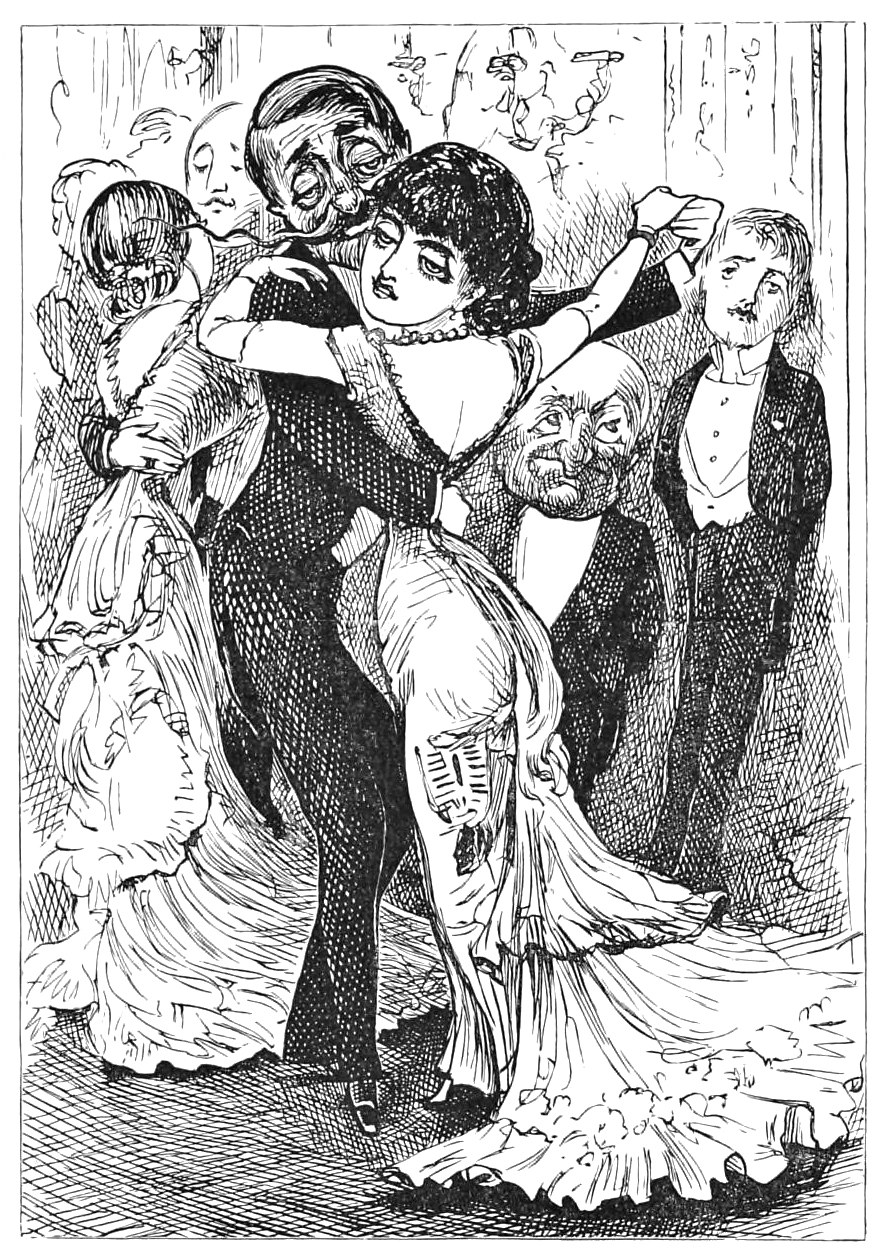
A Legend of Camelot, du Maurier, 1898 djvu pg 163b
George du Maurier
- Medium:
- Oil Painting
- Era:
- Late 1800s (Victorian Ballroom)
- Source:
- Wikimedia Commons
- Rights:
- Public domain — free to use, share and adapt.
- Recorded as:
- Public Domain
This work is important for understanding how dance and social interaction were represented in late-Victorian visual culture. It shows dance not as an isolated technical or theatrical practice but as an intimate social performance embedded in ritual and courtship, central to the visual narrative of the novel. For historians of ballroom dance and gender in the 19th century, the image offers concrete evidence of how contemporaries visualized the moment of dancing—as a focal point of attention, a display of feminine grace, and a social event structured by the male gaze.
What you are looking at
A crowded indoor social scene in which a fashionably dressed woman in a dark, form-fitting gown with pearl necklace stands at the center, her body angled and arms raised in a graceful, animated pose. She is surrounded by six or seven men in evening dress (tailcoats and white shirts), their faces expressing delight and attention. The composition is dense and theatrical: some figures press close, gesturing toward the central woman, while others occupy the background. The setting appears to be a ballroom or reception room, suggested by the vertical architectural lines in the background and the formal gathering. The drawing style is detailed line work with cross-hatching for shadow, creating strong contrasts between light and dark areas. The woman's posture and the rapt attention of the men suggest a moment of entertainment or demonstration—perhaps the woman is about to dance, is dancing, or has just completed a particularly impressive movement.
The dancing
The central female figure stands with her weight shifted, one arm raised and extended, the other positioned across her body, creating an open, expressive frame. Her head is tilted slightly downward with a composed, almost inward expression. The men surrounding her display varied poses—some leaning in, some with arms half-raised in gesticulation, their faces animated with interest or amusement. The spacing is intimate but not symmetrical; bodies overlap and angles are varied, suggesting a candid rather than formally positioned moment. No clear closed ballroom hold is visible; instead the arrangement is loose and social.
The dance depicted
The image most likely depicts a social dance scene or a moment of entertainment within a ballroom setting, though the specific dance form is not clearly identifiable from posture or hold alone. The woman's raised arm and animated stance could suggest she is performing or demonstrating a dance move—possibly a waltz, galop, or another popular late-19th-century ballroom dance—but the surrounding crowd and her contained, inward expression make it equally possible she is being observed or admired in a social rather than strictly choreographic moment. The date (1898) and formal dress place this firmly in the Victorian ballroom era, consistent with the catalogue's genre label.
How it was made
This is a line engraving or etching, executed with fine pen work and cross-hatching to create tonal depth. The technique is characteristic of book or magazine illustration of the late 19th century, allowing for reproducibility and circulation in printed form. The controlled, expressive line work conveys both the physical gesture of the figures and the social atmosphere—the density of marks around the woman and the more open lines elsewhere guide the viewer's eye and create a sense of energy and focus. The medium and style place this as editorial illustration, likely from a novel or serialized periodical.
About this work
This is an illustration from George du Maurier's *A Legend of Camelot* (1898), depicting a moment of social dance or entertainment in a Victorian ballroom. The work exemplifies the conventions of late-19th-century society illustration: a formally dressed crowd, a central female figure as the focus of attention, and careful attention to the social dynamics of the drawing room. The image captures not merely a dance but the theatre of ballroom society—the performance of grace, the observation of beauty, and the interplay of gender and social ritual that defined the era. Du Maurier was celebrated for his ability to render social comedy and psychological nuance in crowded scenes; this illustration demonstrates his skill at capturing both individual character and collective mood.
How to look at it
Attend first to the central woman's posture and expression: she is neither stiffly posed nor in mid-leap, but rather in a moment of composed, almost meditative grace—suggesting a controlled, refined movement rather than exuberant expression. Notice how du Maurier's line work creates a halo of attention around her: the crowded, active marks suggest the men's focus and animation, while her figure is rendered with slightly more restraint, emphasizing stillness and inwardness. The vertical lines of the architecture frame and contain the scene, emphasizing the formality of the setting. The illustration captures not the technical execution of a step but the social meaning of the moment—the woman as an object of aesthetic attention within a ritual of display and desire.
The artist
George du Maurier (1834–1896) was a French-born British artist and novelist best known for his satirical illustrations of Victorian and Edwardian society. He worked extensively for *Punch* magazine and illustrated numerous novels, becoming one of the most recognizable illustrators of his era. His drawing style combined precise social observation with fluent, expressive line work; he was celebrated for capturing the psychology and social comedy of drawing-room scenes. His own novels, including *Trilby* (1894) and *The Martian* (1897), were illustrated by his hand and became bestsellers. *A Legend of Camelot* was published in 1898, two years after his death, and represents the mature style of his illustrative practice.
The period
The 1890s were the height of the Victorian ballroom era, in which waltz, quadrille, and galop dominated elite social dance. The formal drawing room and the orchestrated dance were central to courtship, social hierarchy, and the performance of gentility. In visual art, the ballroom scene was a popular subject for illustration and painting, allowing artists to explore themes of social interaction, gender, and desire within the constraints of propriety. Du Maurier's illustrations in particular captured the psychological undercurrents of these scenes—the tension between social convention and individual feeling, between observation and participation. At the same time, Arthurian romance (the novel's subject) was experiencing a major revival in late-Victorian literature and visual culture, intersecting with contemporary society through costume and setting.
Where it lives
This illustration comes from *A Legend of Camelot*, a novel published in 1898 and illustrated by George du Maurier. The source record identifies this as page 163b from the DJVU (digital version), suggesting it is a reproduction from a digitized copy of the original publication. The work survives in the form of a mass-produced printed book illustration rather than as a unique artwork.
Dance in this work
Questions about this work
Is this actually from a Camelot story, or is it just set in Victorian times?
The novel *A Legend of Camelot* frames Arthurian material within a contemporary Victorian setting. Du Maurier's illustration style and the formal Victorian dress suggest the story engages with the Arthurian revival as a vehicle for examining contemporary society. The Arthurian legend was often used by late-Victorian writers and artists as a lens through which to explore modern life.
What is the woman doing—is she actually dancing?
The image captures an ambiguous moment: she may be dancing, about to dance, or simply being observed and admired. Her posture is graceful and purposeful, but she is surrounded and watched rather than moving freely with a partner. This ambiguity is part of du Maurier's effect—the social performance of the drawing room often blurs the line between dancing and being observed.
Why are there so many men and only one woman?
This reflects the social conventions of Victorian ballroom culture, in which women were often the focus of male attention and competition for partnership. The composition emphasizes the woman as a focal point of desire and admiration within a masculine social space—a common theme in du Maurier's illustrations of society.
Is this a waltz, a quadrille, or something else?
The image does not provide enough detail to identify a specific dance form. The woman's raised arm and animated posture are consistent with waltz or galop, both popular in the 1890s, but her isolated, observed posture and the crowd around her suggest the moment may be theatrical demonstration or social display rather than the technical execution of a partner dance.
More dance artwork