49 works in this view — arrow keys or swipe to move between them.
Dance in Art
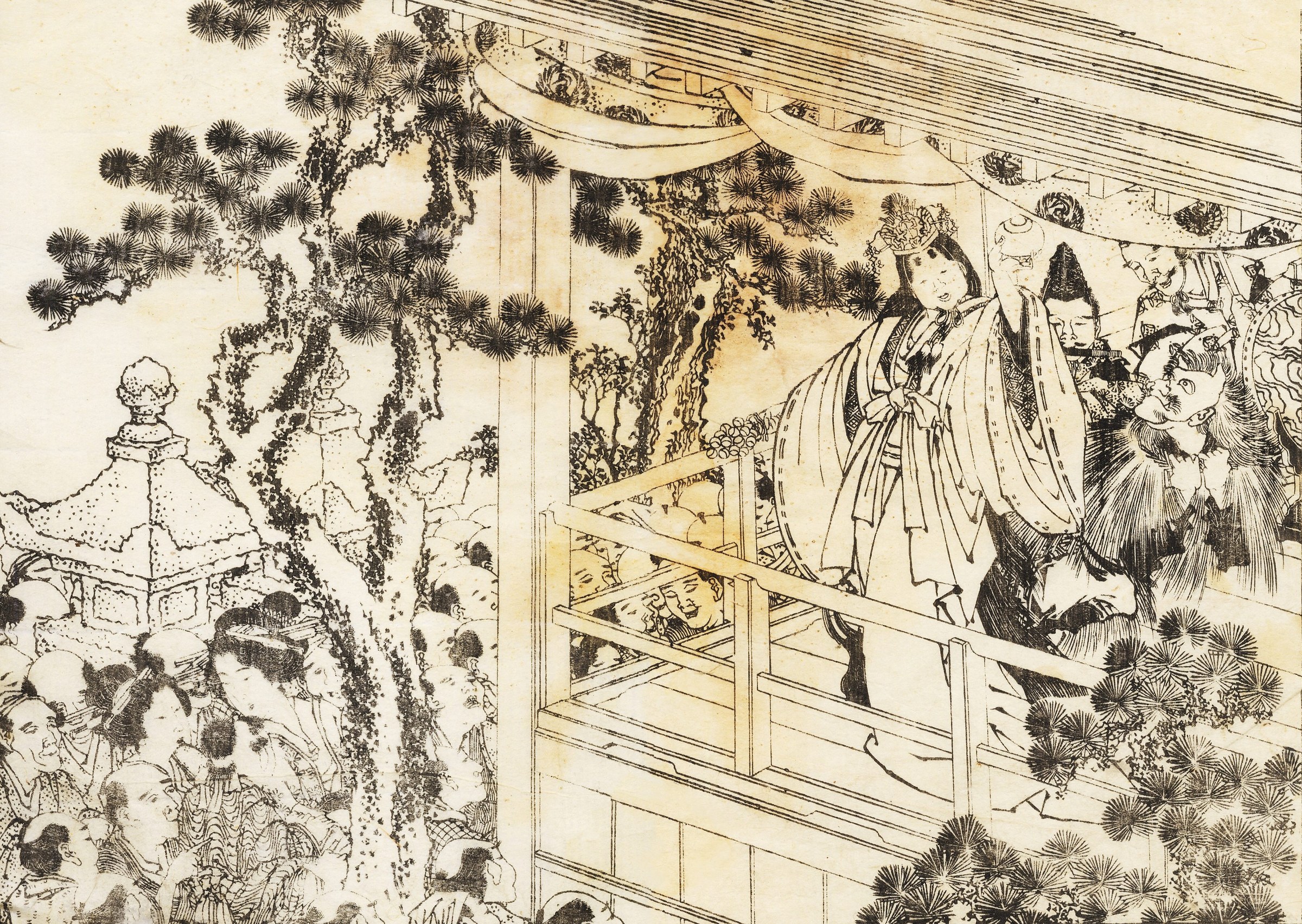
A scene of a shinto shrine dance, kagura
Unknown artist
- Medium:
- Oil Painting
- Source:
- Wikimedia Commons
- Rights:
- Public domain — free to use, share and adapt.
- Recorded as:
- Public Domain
Kagura remains a living ritual practice in Japan, yet this image documents its historical form and performance context in ways that words alone cannot convey. For dance historians, it provides rare visual evidence of the spatial arrangement, costume precision, and compositional hierarchy of shrine-based ritual performance—information that shapes our understanding of how sacred dance was integrated into Japanese religious life. The work demonstrates how visual artists engaged with dance as a subject worthy of careful, laborious documentation.
What you are looking at
A Shinto shrine ceremony unfolds across a multi-layered composition rendered in ink and oil on paper. In the foreground, a richly dressed female dancer in elaborate costume—voluminous sleeves and layered robes—performs on a raised wooden platform with geometric railings. She stands in a formal, controlled posture characteristic of ritual performance. Behind and beside her, attendants, musicians, and observers crowd the scene: some seated on the platform's steps, others standing beneath a structure with deep overhanging eaves decorated with hanging wisteria or similar climbing vines heavy with small clustered flowers. The upper portions of the image show architectural elements—horizontal wooden beams and decorative trim—suggesting an enclosed shrine building. Stone lanterns and garden elements are visible on the left. The entire composition is rendered in sepia and black ink with careful cross-hatching; the dense vegetation creates a natural frame around the ceremonial action, emphasizing both the formality of the ritual and its integration into a sacred landscape.
The dancing
The central dancer stands upright and composed, her arms positioned in a controlled manner within her sleeves, her posture reflecting restraint and ceremonial dignity rather than dynamic movement. Her weight appears stable and planted. Surrounding figures—seated musicians with instruments, standing observers, and attendants—occupy subordinate positions relative to her, their body language deferential and attentive. The composition emphasizes stillness and formal hierarchy over vigorous motion, with the dancer's body as the focal point around which all other figures orient themselves.
The dance depicted
This depicts kagura, a sacred Shinto shrine dance traditionally performed as part of ritual ceremonies to entertain and please the Shinto deities. The image captures not a moment of dynamic movement but rather the formal, stately deportment required of kagura dancers. The elaborate costume—multilayered robes with extended sleeves—is historically accurate to kagura dress. The setting confirms the sacred context: the shrine architecture, the gathered community, and the presence of musicians all support a ritual rather than entertainment context. Kagura typically emphasizes controlled, deliberate movement and spiritual presence over technical virtuosity, and the artist has captured this aesthetic through the dancer's composed stance and the reverent arrangement of observers.
How it was made
The work appears to be executed in ink on paper with oil wash or tint, creating a sepia-toned effect. The technique combines fine linear drawing—visible in architectural details and facial features—with delicate cross-hatching for shading and depth, and softer washes of color for spatial recession and atmospheric effect. This hybrid approach was common in East Asian art of certain periods and allowed for both precise documentary detail and painterly atmosphere. The careful, laborious rendering suggests the work was intended for an educated audience familiar with both shrine architecture and court or formal dress conventions.
About this work
This is a visual record of a kagura ceremony, the sacred ritual dance of Shinto Japan, captured in a moment of formal performance. The work functions as both artistic composition and ethnographic document, preserving the appearance, costume, and ceremonial context of a religious practice. The artist chose to emphasize the hieratic, controlled nature of the performance—the dancer's stillness at the center of a gathered community—rather than capturing dynamic movement. This reflects a deep understanding of kagura's spiritual purpose: the dance is an offering and invitation rather than entertainment, and its power lies in composed dignity and ritual correctness.
How to look at it
Notice how the artist positions the viewer: we are invited into the shrine space but remain slightly external, observing the ceremony as a respectful participant would. The hierarchical arrangement of figures—the dancer elevated and centered, musicians and attendants subordinate—mirrors the actual spatial and social order of the ritual. Observe the costume details: the layering of robes, the fall of fabric, the controlled positioning of the arms within the sleeves. These details, rendered with precision, convey both the beauty of formal dress and the restrictions it imposes on movement. The dense vegetation framing the scene is not merely decorative; it situates the dance within nature and the sacred landscape, integrating human ritual with spiritual geography.
The period
The image likely dates to the Edo or Meiji period, when Japanese artists increasingly documented traditional cultural practices in response to modernization and Western influence. During this era, kagura itself was undergoing gradual transformation as shrines adapted to changing social conditions while maintaining ritual continuity. The technical style—combining ink drawing with oil wash—suggests an artist working during the period of Japanese-Western artistic exchange, possibly influenced by Western naturalism while remaining committed to documenting indigenous practice. The choice to depict a sacred ritual rather than secular entertainment reflects the growing scholarly and artistic interest in preserving traditional Japanese culture during the 19th and early 20th centuries.
Where it lives
The work is held in Wikimedia Commons, indicating it is in the public domain or under a permissive license. The catalogue record provides minimal information, suggesting it may have been digitized from an archive or collection with limited documentation. No current holding institution or accession number is recorded.
Dance in this work
Questions about this work
What is kagura and how does it differ from other Japanese dance forms?
Kagura is a ritual dance performed at Shinto shrines, traditionally offered to entertain and appease Shinto deities. Unlike theatrical forms such as kabuki or noh, which evolved into entertainment for secular audiences, kagura remains fundamentally a religious practice. It emphasizes spiritual presence and ceremonial correctness over technical display. The dancer's role is to serve as a conduit for the sacred, and movement is typically controlled, deliberate, and minimal—as this image shows—rather than virtuosic or emotionally expressive.
How can we tell this is a Shinto shrine and not another kind of Japanese building?
The architecture—particularly the deep eaves, the geometric wooden railings, and the simple clean lines—is characteristic of Japanese shrine construction. The presence of stone lanterns visible on the left and the garden landscape are also typical of shrine grounds. The overall spatial organization, with the performer elevated and the gathering arranged hierarchically around her, matches the layout of shrine ceremonial spaces rather than the enclosed theatrical stages used for kabuki or noh.
Why does the dancer look so still and formal?
Kagura aesthetics value restraint, spiritual presence, and ritual correctness over dynamic movement. The dancer's composed posture reflects her role as a vessel for spiritual communication rather than a performer displaying virtuosity. The heavily layered costume also restricts movement and demands control; the extended sleeves, in particular, require dancers to move with precision and intention. This formal, controlled quality is essential to kagura's spiritual power.
More dance artwork