49 works in this view — arrow keys or swipe to move between them.
Dance in Art · 1904
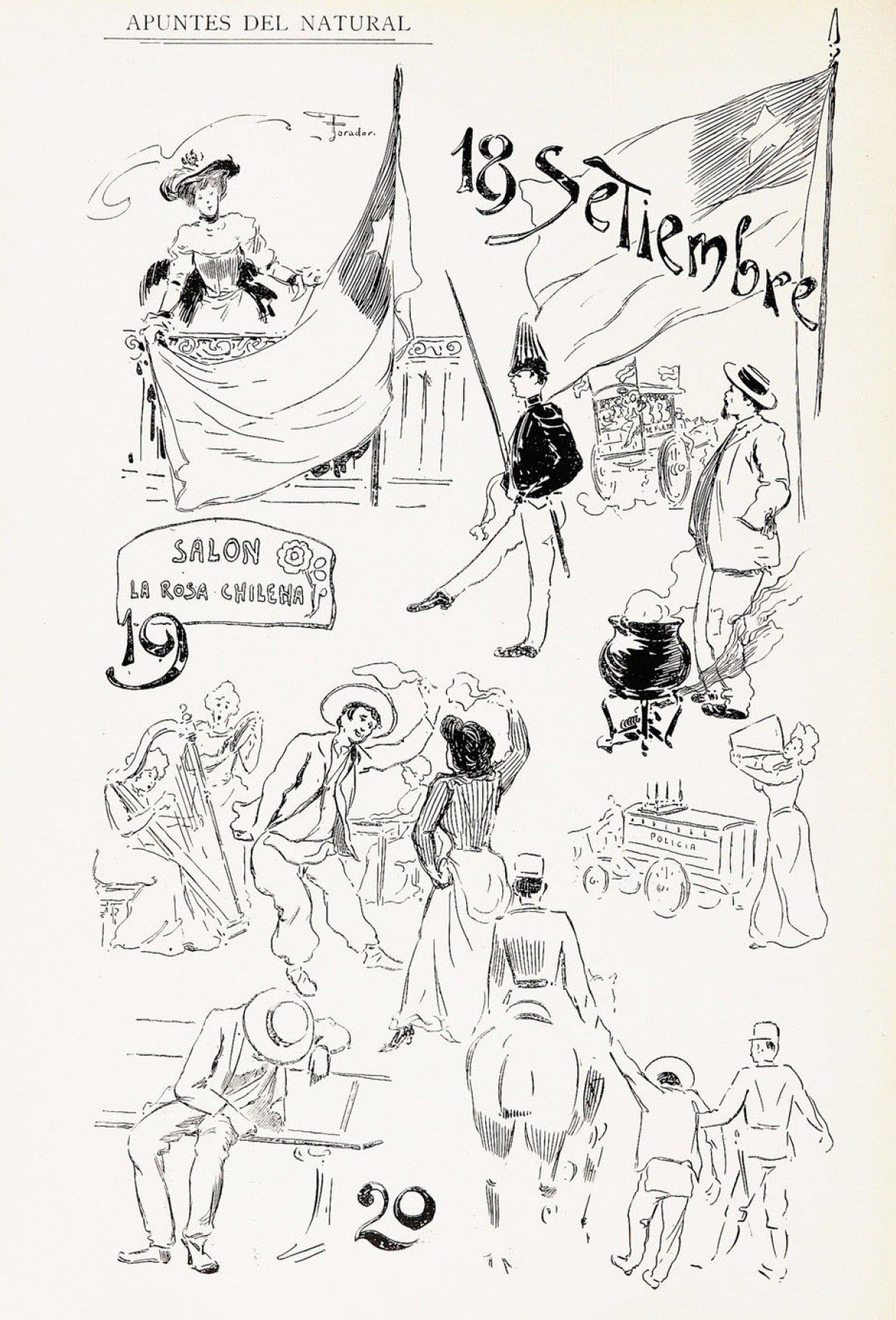
Apuntes al natural - Fiestras Patrias Chile, 1904
José Fodadori
- Medium:
- Oil Painting
- Era:
- 1900-1920 (Ragtime/Early Jazz)
- Source:
- Wikimedia Commons
- Rights:
- Public domain — free to use, share and adapt.
- Recorded as:
- Public Domain
For students of Latin American social history and visual culture, this sketch documents what ordinary people actually did during a major civic occasion—the street-level reality of celebration that formal histories often omit. The work also exemplifies the satirical tradition in Latin American journalism, showing how artists used caricature and exaggeration to comment on society and power.
What you are looking at
A lively satirical sketch of Chilean Independence Day festivities (Fiestas Patrias) in 1904, rendered in ink with loose, energetic linework. The composition swarms with figures engaged in various entertainments: at upper left, an elegantly dressed woman in an elaborate hat leans from a decorated balcony or platform, her flowing skirts and feathered accessory exaggerated for comic effect. A tall tapered structure—possibly a decorated pole or monument—rises nearby. The right side shows a flag-bearer in military dress standing beside a massive flag, while couples and individuals mill about below. Lower sections depict musicians (one seated playing an instrument), street vendors with a cart marked "POLICIA," and various revelers in period dress. The title "18 Setiembre" marks the date of Chile's national holiday, and "Salon la Rosa Chilena" appears as a venue label. Throughout, the figures are sketched with caricatural exaggeration: elongated limbs, emphatic gestures, and theatrical postures convey the boisterous, slightly chaotic spirit of public celebration.
The dancing
The bodies throughout are drawn with loose, expressive line-work that prioritizes gestural clarity over anatomical precision. Figures adopt a range of social poses: the woman on the balcony displays an elaborate, self-conscious deportment with raised arms and flowing fabric; couples below stand in relaxed proximity rather than formal closed hold; musicians are hunched over their instruments; street performers and vendors strike casual, working postures. The drawing style is sketch-like and abbreviated, allowing quick recognition of attitude and activity without detailed modeling. Limbs are elongated, and weight distribution is suggested rather than demonstrated through careful positioning.
The dance depicted
This is not primarily a dance image but rather a social documentation of a national holiday scene. While figures are shown standing, walking, and gesturing in ways that suggest informal movement and celebration, no structured dance form is depicted. The sketch captures the bustle of public festivity—street entertainment, military ceremony, socializing, and casual amusement—rather than a recognizable dance tradition. Any movement present belongs to the spontaneous repertoire of popular celebration rather than a codified style.
How it was made
The work is executed as an ink sketch or drawing on paper, employing pen or brush with considerable speed and confidence. The line-work is loose and economical, with varying weight and pressure creating rhythmic variation across the composition. This sketching technique—likely created on-site or from direct observation—was common for journalistic and satirical illustration of the period. The looseness of execution, lack of shading or tone modeling, and energetic calligraphic quality suggest this may be a preliminary study, a finished caricature for publication, or a rapid documentary sketch intended for reproduction in a periodical. The style is consistent with turn-of-the-century satirical journalism across Latin America.
About this work
This is a satirical pen sketch by the Chilean artist José Fodadori documenting the street life and public spectacle of Chile's Independence Day celebration in 1904. Rather than depicting formal dance, it captures the texture of popular celebration—the mix of military ceremony, street commerce, music-making, socializing, and genteel display that characterized a national holiday in an urban setting. The work functions as both social documentation and visual comedy, exaggerating figures and situations to poke gentle fun at the pretensions and chaos of public festivity. As a record of how bodies moved and gathered during civic celebration in the early twentieth-century Americas, it offers historians a window into the informal choreography of everyday life beyond the concert stage.
How to look at it
Attend to the variety of social postures and activities Fodadori has crowded into a single composition: the formality of the woman on the balcony contrasts with the casualness of street vendors and musicians below, creating a visual argument about hierarchy and celebration. Notice how the artist uses exaggeration—elongated limbs, emphatic gestures, theatrical angles—to convey energy and social comedy without abandoning recognizability. The loose, rapid linework itself conveys immediacy and spontaneity, as if the artist is capturing the scene as it unfolds.
The artist
José Fodadori was a Chilean illustrator and caricaturist active in the early twentieth century. He contributed observational sketches and satirical drawings to Chilean periodicals, often depicting social occasions, street life, and public events with a sharp eye for human comedy. His style—economical line, exaggerated gesture, and social commentary through visual wit—was typical of the illustrated press of his era across the Spanish-speaking Americas. Little else is currently recorded about his practice or biography.
The period
In 1904, Chile was a republic navigating the tensions between modernization, oligarchic power, and popular culture. Independence Day celebrations, held on September 18th, were moments when urban public space became a stage for the mixing of social classes and the performance of national identity. Visual journalism and caricature were explosive growth areas in the illustrated press of Latin America during this period, influenced by European satirical traditions but adapted to local circumstances. Fodadori's sketch captures this moment when the street itself became a subject of artistic attention and satire.
Where it lives
The work is catalogued as an oil painting, though visual inspection suggests it is an ink sketch or drawing on paper; this discrepancy may warrant review. It is held in an unidentified collection and was accessed via Wikimedia Commons. The catalogue record provides minimal metadata beyond title, artist name, and date.
Questions about this work
Is this a drawing or a painting?
The work appears to be an ink sketch or pen drawing on paper, executed with loose, economical linework typical of journalistic illustration. The catalogue record lists it as an oil painting, but the visual evidence—the character of the line, the absence of modeling or atmospheric perspective, the sketchy quality—suggests this may require revision. It may be that the record conflates different works or media.
What is happening in this scene?
Fodadori has sketched a cross-section of Santiago's Independence Day celebration on September 18, 1904, showing the mixture of social rituals, commerce, music-making, and socializing that characterized urban civic festivity. The military presence (the flag-bearer), the street vendors, the musicians, the elegantly dressed woman on the balcony, and the ordinary revelers together compose a portrait of how a national holiday was actually experienced and celebrated in the streets.
Why is this in a gallery of dance?
While no formal dance is depicted, the sketch records how bodies moved and gathered in public space during celebration—the informal choreography of social interaction. For historians of dance, this offers evidence of the contexts in which more formal dance took place, and the relationship between street life, popular festivity, and theatrical performance in the early twentieth-century Americas.
More dance artwork