49 works in this view — arrow keys or swipe to move between them.
Dance in Art · 1887
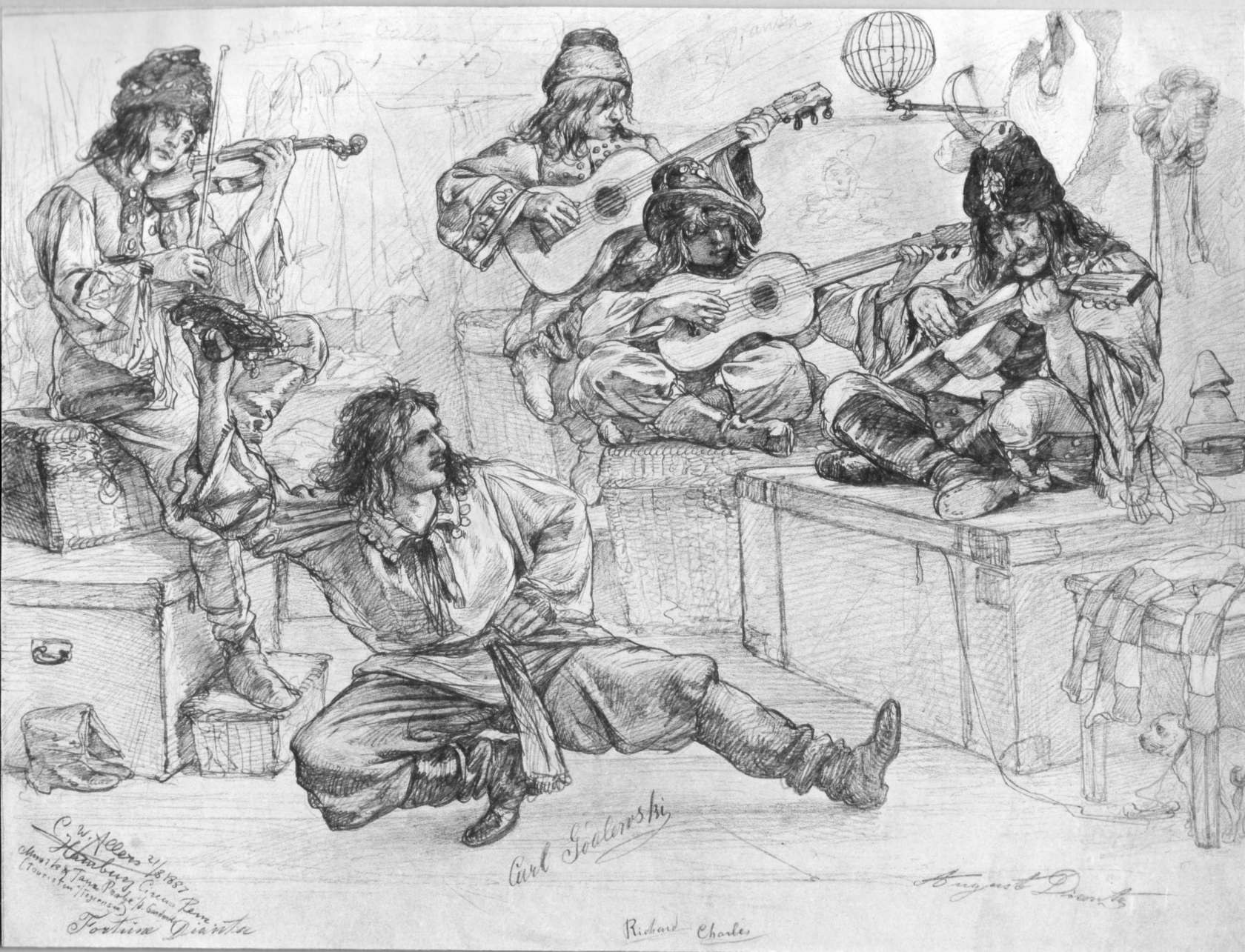
Carl Godlewski 1887 (von C.W.Allers)
Christian Wilhelm Allers
- Medium:
- Oil Painting
- Era:
- Late 1800s (Victorian Ballroom)
- Source:
- Wikimedia Commons
- Rights:
- Public domain — free to use, share and adapt.
- Recorded as:
- Public Domain
This drawing preserves a specific moment in circus performance history and names a performer—Carl Godlewski—allowing researchers to trace individual lives within the Renz Circus organization. The image reveals that circus entertainment was collaborative, musician-centered, and informal in execution, challenging the notion that all nineteenth-century performance was rigidly choreographed or rehearsed.
What you are looking at
A lively circus performance captured in vigorous pen-and-ink line work, crowded with musicians and performers in nineteenth-century dress arranged across a makeshift stage or wagon. The scene brims with movement and activity: at left, a woman in elaborate dress plays violin; at center-rear, a bearded man in a cap strums a guitar; below him, another guitarist crouches or sits; at right, a figure in ornate costume plays what appears to be a stringed instrument. In the foreground, a young man in simple clothes kneels or sits, his body angled toward the musicians. Behind and around the performers, props and fabric suggest the portable nature of circus life—rolled materials, drapery, and what may be a balloon or sphere suspended above. The composition is dense and theatrical, with overlapping figures and a sense of spontaneous, energetic performance.
The dancing
The bodies show relaxed, seated or kneeling postures suited to performance musicians rather than formal dance; no two figures stand in a unified dance frame or hold. The seated guitarist at center-front is bent forward over his instrument, weight dropped into his hip. The kneeling male figure in the foreground leans back slightly, shoulders open, suggesting either a listener or a participant between numbers. The violinist at left stands with weight shifted, arm raised in playing position. The overall impression is of a rehearsal or informal jam session rather than choreographed ensemble work.
The dance depicted
This appears to be a scene of circus life and entertainment rather than a staged dance performance. The emphasis falls on the musicians and the social energy of communal music-making, likely in the context of the Renz Circus, a prominent European traveling circus of the late nineteenth century. If dance occurs here, it would be social dancing or entertainment to live music rather than theatrical or concert dance. The inscription names Carl Godlewski, suggesting he may be one of the identifiable performers; Godlewski was known as a circus performer and musician. The image documents the world of circus performance and the musicians who made it lively.
How it was made
This is a pen-and-ink drawing—likely an etching or engraving based on the fine parallel hatching and precise linework—executed with considerable fluid energy. The catalogue record states 'Oil Painting,' but the image is unmistakably a linear drawing technique, not oil paint; this is a material contradiction to flag. The technique allows rapid, expressive line and tonal modeling through cross-hatching, suited to journalistic or illustrative purposes. The style and subject suggest this may be a sketch or print after a live circus performance, capturing immediacy and movement through linear economy rather than pigment.
About this work
This drawing documents a moment of circus performance in the late nineteenth century, likely depicting musicians and entertainers of the Renz Circus. Rather than a formal choreographed dance, it captures the informal social energy of a traveling circus's musical performance—the interplay of guitars, violin, and the gathering of performers in a portable stage setting. The work is a valuable record of circus life, performance conditions, and the blend of music and entertainment that made such spectacles popular across Europe. For scholars of circus history and performance culture, it offers concrete visual evidence of how musicians and performers worked together in touring circuses.
How to look at it
Focus on the specificity of the dress and setting: the handmade quality of the stage, the modest but ornate costumes, the casual seated postures that nevertheless suggest attentiveness and engagement. The artist has chosen to capture a pause or informal moment between numbers rather than a climactic gesture, emphasizing the human scale and backstage reality of circus life. Notice how the overlapping figures and energetic line suggest the crowded, slightly chaotic energy of a portable performance space.
The artist
Christian Wilhelm Allers (1857–1915) was a German illustrator and graphic artist known for theater and circus scenes. He worked as a contributing artist to publications and created numerous studies of contemporary entertainment and street life. His practice focused on capturing the immediacy and energy of live performance through skilled draftsmanship, often using pen, ink, and lithographic techniques to document performers, audiences, and backstage life.
The period
The late nineteenth century saw a surge in circus popularity across Europe, with major traveling circuses like Renz touring extensively. Circus performance was a blend of acrobatics, music, spectacle, and social entertainment, drawing audiences across class boundaries. Simultaneously, illustrators and printmakers documented contemporary life with increasing immediacy; the sketch or study from live performance became a valued form. Dance in circus contexts was often embedded in ensemble numbers or as part of broader entertainments rather than existing as a separate concert art form.
Where it lives
The work is held in Wikimedia Commons. The inscription and naming of Carl Godlewski suggests it was created as a documented record of a specific performance or troupe, possibly for a newspaper, journal, or artist's portfolio.
Questions about this work
Is this a painting or a drawing?
It is a pen-and-ink drawing, most likely an etching or engraving, executed with fine hatching and line. The catalogue record incorrectly identifies it as an oil painting. The linear technique was typical of illustrative and journalistic practice in the late nineteenth century.
Who was Carl Godlewski?
Carl Godlewski is named in the inscription and is identified as a Renz Circus performer. He is one of the entertainers depicted in this scene. Beyond this identification, specific biographical details are not established from the image alone.
Why is this relevant to dance history?
This work documents circus performance and entertainment culture at a moment when dance existed within broader performance spectacles, often embedded in musical and acrobatic numbers rather than as a separate concert form. It shows how musicians and performers collaborated to create traveling entertainment.
More dance artwork