49 works in this view — arrow keys or swipe to move between them.
Dance in Art · 1976
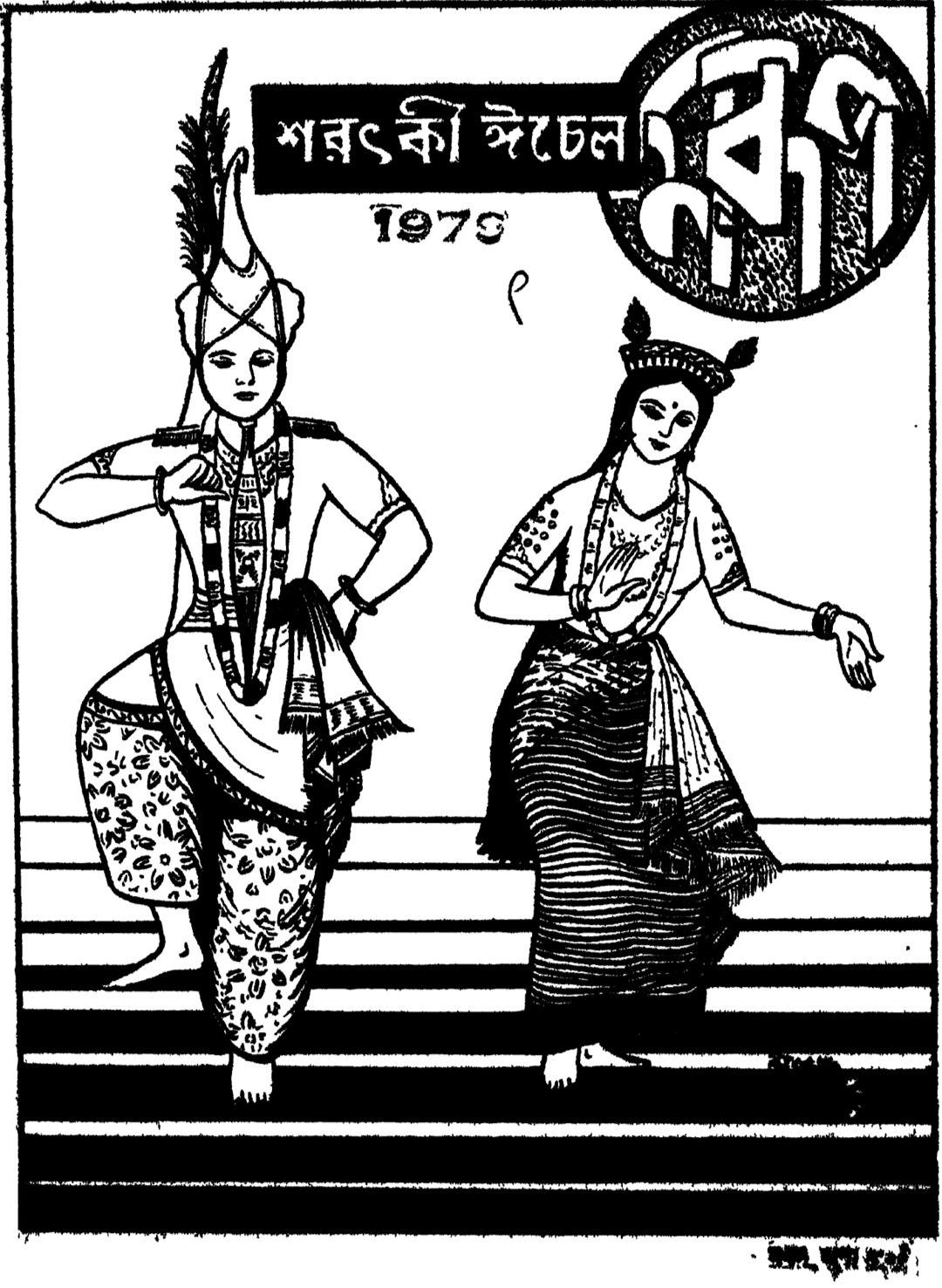
Depiction of Khamba-Thoibi Jagoi (ancient Meitei classical dance of Khamba & Thoibi) - in "Saratki Echel" - Modern Meitei language monthly magazine - in Bengali script - published by "Marup, Manipur"
Original author : Unknown
- Medium:
- Oil Painting
- Source:
- Wikimedia Commons
- Rights:
- Public domain — free to use, share and adapt.
- Recorded as:
- CC0
This work documents a classical Indian dance form at a moment when Manipuri classical dance was gaining renewed institutional recognition and when such forms were being actively preserved and popularized through vernacular print media. The choice to publish in Meitei script and language, rather than in English or Hindi, signals a deliberate effort to assert Meitei cultural identity and to address a local educated readership invested in classical heritage. For dancers and historians, it offers evidence of how costumes, postures, and canonical forms were codified and transmitted outside of formal institutional dance training.
What you are looking at
Two figures in elaborate traditional Meitei dress perform against a plain background in this stark black-and-white line drawing. The figure on the left wears a tall pleated crown (maphao), a decorated short tunic with crossed chest ornaments, patterned lower garments with floral or geometric designs, and holds one arm bent at the elbow in a controlled gesture while the other rests at the side. The figure on the right wears a similar but less elaborate crowned headdress, a decorated short-sleeved tunic, and a wrapped lower garment (mekhela) with horizontal linear patterns; both figures stand with knees slightly bent and weight distributed across both feet. The composition is frontal and symmetrical, presenting the dancers as facing slightly toward each other in what appears to be a formal pose rather than captured mid-movement. The setting is a simple platform or stage indicated by horizontal lines at the base, and the entire work is rendered in crisp black line with minimal shading, suggesting a documentary or archival illustration rather than an expressive artistic rendering.
The dancing
Both dancers maintain an upright posture with a subtle forward inclination from the hips. The left figure (male, identified as Khamba by tradition) extends one arm with the elbow bent at approximately 90 degrees, palm inward, while the other arm hangs naturally; the right figure (female, Thoibi) mirrors a more restrained arm position, both hands positioned at hip or waist height. The bent-knee stance and controlled upper-body carriage suggest a grounded, centered quality typical of classical Indian dance forms. The precise, bilateral symmetry of the composition and the formal facing positions indicate this is a presentation of the dance's foundational posture or mudra rather than a narrative moment of interaction.
The dance depicted
This is a depiction of Khamba-Thoibi Jagoi (also Khamba-Thoibi Jagat), a classical duet form from Manipur (Kangleipak), in the northeastern Indian state now known as Manipur. The Khamba-Thoibi narrative, drawn from classical Meitei literature, traditionally tells the story of courtship and romance between the characters Khamba and Thoibi, and the dance form is characterized by lyrical, graceful movements and intimate spatial relationships between the dancers. The image documents the formal dress and posture associated with the classical presentation of this form, though it does not capture the dynamic flow or the interplay between the two dancers that defines the dance in performance. The publication in a Meitei-language cultural magazine in 1976 confirms this as a work of cultural documentation during a period of renewed attention to classical Manipuri forms.
How it was made
This is a black-and-white line drawing, most likely a woodcut or engraving, created for reproduction in a monthly magazine. The bold outlines, high contrast, and absence of tonal shading are characteristic of print media designed for legibility in newsprint or magazine publication. The technique is economical and direct: line defines form, and decorative patterns in the costume are rendered through parallel hatching, crosshatching, and repetitive marks. Such work circulated to a Meitei-reading audience and served an educational or archival function, documenting classical dance costume and posture for a vernacular readership engaged with cultural preservation.
About this work
This is a documentary illustration of two dancers in the classical Khamba-Thoibi Jagoi form from Manipur, published in a Meitei-language cultural magazine in 1976. The work is neither a moment of dynamic performance nor an expressive artwork, but rather a formal portrait of the dancers' dress and foundational posture—a record of how this classical form was understood and presented at a specific historical moment. The image circulated among Meitei speakers and intellectuals concerned with preserving and promoting classical dance forms during a period when such cultural documentation was politically and socially charged; it belongs in a gallery of dance imagery as evidence of how classical Asian dance was archived and made visible to its own communities through print culture.
How to look at it
Look first at the posture and the arm positions: the slight forward inclination from the hips, the controlled bend in the knees, and the precise hand and arm placements tell you this is a codified classical form, not a vernacular or social dance. The symmetry of the composition and the frontal presentation suggest this is a canonical or 'correct' way to stand, rather than a moment of dynamic interaction. Notice how the costume is rendered—the tall pleated crown, the short tunic, the wrapped lower garment—these are specific to Meitei classical dance and appear identical in structure across both dancers, allowing for gender differentiation through subtle variations. The linear style and high contrast are conventions of print reproduction designed for clarity and legibility in magazine publication, and this documentary approach is itself a historical fact: the artwork is not trying to capture the feeling of performance, but rather to record and standardize the visible form.
The period
In the 1970s, Manipuri classical dance was undergoing a significant revival and institutionalization in India. The form had been suppressed or marginalized during the colonial period and the early years of Indian independence, and by the 1960s and 1970s, cultural activists, scholars, and performers were engaged in systematic documentation, standardization, and promotion of classical Manipuri dance as part of a broader nationalist and regional cultural project. The publication of dance illustrations in vernacular-language magazines was part of this effort; such works reached educated urban readers in Manipur itself and helped establish canonical presentations of classical forms. Simultaneously, Indian classical dance more broadly was being elevated within the national cultural hierarchy, and Manipuri forms—distinct from the better-known Bharatanatyam and Kathak—were gaining scholarly and institutional attention.
Where it lives
This image was published in 'Saratki Echel,' a monthly magazine in Meitei language (written in Bengali script) produced by Marup publishers in Manipur. The work circulated as a cultural and educational document within a Meitei-speaking readership in 1976, and is now available through public digital repositories including Wikimedia Commons.
Dance in this work
Questions about this work
Is this a painting or a print?
The catalogue record states 'Oil Painting,' but the image itself appears to be a black-and-white line drawing made for magazine reproduction—likely a woodcut, engraving, or drawn illustration designed to be reproduced in print. The high contrast, bold outlines, and economical use of line are all characteristic of print media rather than oil painting. The reproduction medium and context (a monthly magazine) suggest this was created as a print illustration.
What do the costumes tell us about the dance form?
The tall pleated crown (maphao), short tunic with chest ornaments, and wrapped lower garment (mekhela) are specific to Manipuri classical dance costume. The elaborate decoration and formality of the dress indicate this is a classical court or theatrical form, not a social or folk dance. The near-identical structure of the costumes across both dancers, with gender differentiated through subtle variations in decoration and how the garment is worn, reflects the classical paired-duet structure of the Khamba-Thoibi form.
Why is this published in Meitei language and script?
Publishing in Meitei language and Bengali script was a deliberate assertion of Meitei cultural identity and a way to address educated readers within Manipur itself, rather than a pan-Indian or English-speaking audience. In the 1970s, such publications were part of cultural preservation and regional pride movements. It made classical dance knowledge accessible and culturally affirmed within the Meitei-speaking community.
What is the Khamba-Thoibi story?
Khamba and Thoibi are characters from classical Meitei literature, often understood as lovers or romantic figures. The Khamba-Thoibi Jagoi (or Jagat) is a lyrical classical duet form that dramatizes themes of courtship, longing, and emotional connection. The dance is characterized by graceful, flowing movements and intimate spatial relationships, and the narrative and emotional content are conveyed through gesture, expression, and the interplay between the two dancers.
More dance artwork