49 works in this view — arrow keys or swipe to move between them.
Dance in Art · 1790
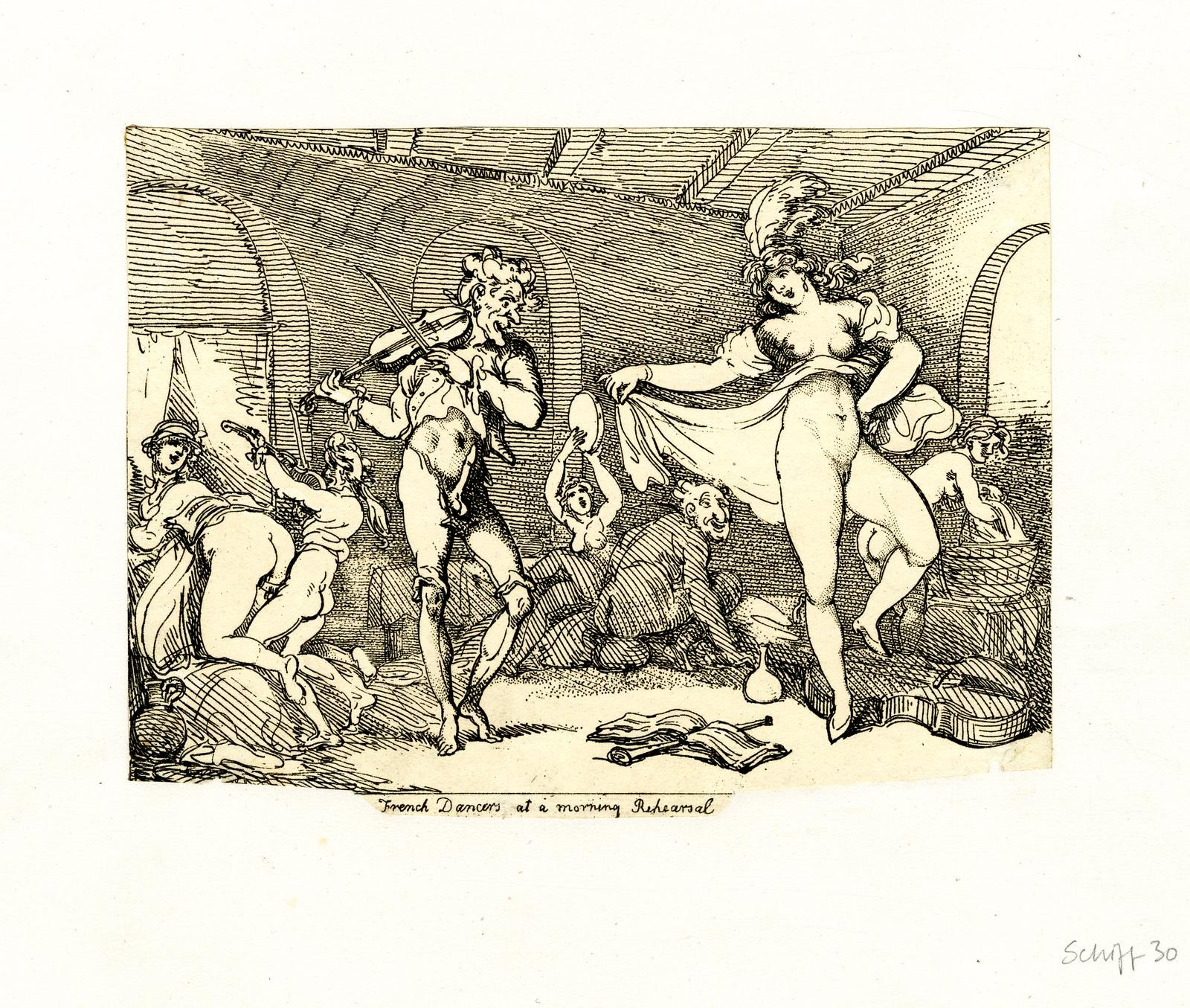
French dancers at a morning rehearsal (BM 1977,U.547)
Unknown artist
- Medium:
- Etching
- Era:
- 1700s (Enlightenment/Minuet Era)
- Source:
- Wikimedia Commons
- Rights:
- Public domain — free to use, share and adapt.
- Recorded as:
- Public Domain
This work is valuable as evidence of how theatrical and balletic culture was represented, mocked, and consumed through popular print in the late 18th century. It reveals contemporary anxieties about the body, propriety, and the association of dance (especially French dance) with sexual excess and disorder. For historians of dance imagery and satire, it documents the genres and tropes available for representing performers—mockery through crude embodiment rather than serious documentation.
What you are looking at
An etching depicting a chaotic interior scene of apparent theatrical or balletic rehearsal in a low-ceilinged room with barrel-vaulted ceiling and arched doorways. Multiple nude and partially clothed figures are scattered throughout the composition in various states of activity—some dancing, some playing instruments (violin, tambourine), and others engaged in crude or defecatory acts. The central female figure wears only a feathered headdress and plays tambourine; to her right stands a clothed male violinist beside a dancing woman whose skirts are pulled up to her waist; another couple at right appears to be copulating; a further scene shows a nude male figure defecating into a pot. At right, a woman washes clothing in a tub. The composition is dense and crowded, rendered in fine parallel hatching lines characteristic of 18th-century etching technique, with stipple used for tonal modulation. The floor is scattered with abandoned clothing and props.
The dancing
The bodies are rendered with anatomical attention but in poses of abandon and disorder rather than trained position. Weight distribution is loose and asymmetrical; limbs sprawl rather than extend in controlled line. The woman at right with raised skirts leans into movement without turnout or frame. None of the figures maintain the closed holds or upright carriage of formal dance training. The multiple figures—at least six to eight human forms—are arranged without spatial coherence or compositional hierarchy, as if frozen mid-chaos rather than mid-performance.
The dance depicted
The title claims this depicts French dancers at rehearsal, but the scene resists straightforward identification as any specific dance form. The raised skirts and abandon suggest burlesque or low theatrical entertainment rather than ballet proper. If this is meant to represent a dance rehearsal at all, it depicts something outside the formal ballet vocabulary—perhaps an improvised or sexually charged theatrical performance, or a satirical commentary on theatrical pretension. The musical accompaniment (violin, tambourine) could suggest folk or popular dance, but the overall composition appears designed to scandalize rather than document actual practice. The work may be satirical or erotic allegory rather than documentary.
How it was made
Etching with stipple, a technique allowing fine linear detail and tonal variation through parallel lines and dotted texture. This permitted both narrative clarity and suggestive obscurity—the busy hatching can render flesh and shadow ambiguously. Etching was a printmaking medium of relatively wide circulation in the 18th century, far cheaper and more portable than oil painting, allowing for rapid distribution of satirical or obscene imagery. The technique's association with prints meant such works reached a broader and more commercially-driven audience than fine art, and the medium was well-suited to serial or narrative subject matter.
About this work
This is a satirical or erotic print from the late 18th century, likely French, depicting a scene of theatrical or balletic rehearsal as an excuse for representing multiple nude or partially clothed figures in states of abandon and crude sexual activity. The print claims to show 'French dancers at a morning rehearsal,' but the composition appears designed to parody or mock theatrical pretension by conflating dance, music-making, and bodily excess in a chaotic domestic or theatrical space. The work sits at the intersection of art print, satire, erotic image, and commentary on theatrical culture—it is not a straightforward documentary record of how dance was practiced, but rather a transgressive or comic commentary on the supposed propriety of theatrical performance.
How to look at it
The viewer should note the deliberate chaos of the composition—no single focal point, no hierarchy of attention, figures scattered and overlapping in ways that prevent any sense of ordered rehearsal or disciplined practice. The artist has chosen not a moment of graceful movement but of grotesque disorder. The feathered headdress on the central nude female figure is the only marker of theatrical costume; the rest is either nudity or the everyday clothing strewn on the floor. This is not documentary; it is mockery through exaggeration of the gap between the pretensions of theatrical culture and the crude reality of bodies.
The period
In the late 18th century, ballet was undergoing transformation: the formal court dances of the baroque and rococo were yielding to a more expressive, narrative-driven theatrical ballet, yet ballet remained closely associated with aristocratic values and propriety. Simultaneously, popular theatrical forms—pantomime, commedia dell'arte, burlesque—offered cheaper, rowdier entertainment. Satirical prints flourished in this period as a medium for social and moral commentary, and French culture (dance, theater, manners) was a frequent target of both French and British satire. The tension between the pretensions of 'French' refinement and the bodily reality of performers is a recurring theme in 18th-century prints and literature.
Where it lives
Held by the British Museum (BM 1977,U.547). This is a single etching from the 18th century, sourced via Wikimedia Commons. The accession number and date suggest acquisition in the 20th century into the BM's print collection.
Questions about this work
Is this actually showing a real dance rehearsal?
Probably not in any formal sense. The title may be sincere or ironic—the composition is too chaotic and crude to resemble documented accounts of ballet training. It is more likely a satirical commentary on theatrical culture, using the premise of a 'rehearsal' as cover for depicting nude figures and bodily excess. The work parodies rather than documents.
What dance style is being shown?
None, clearly. If anything, the work satirizes the gap between formal dance training and crude bodily reality. The abandon and disorder rule out any association with the disciplined ballet or court dance of the period. It may be intended as mockery of popular or low theatrical forms.
Why include defecation and sexual acts in a 'dance' scene?
The work is satirical or moralistic. By associating dance and theater with base bodily functions and disorder, the print may be critiquing theatrical pretension, attacking French manners, or simply creating transgressive spectacle for paying viewers. Such imagery was marketable in 18th-century print culture as scandalous or obscene entertainment.
Who made this and why is the artist unknown?
The artist is unrecorded in the catalogue. Many 18th-century prints were made anonymously or pseudonymously, especially erotic or satirical work. Attribution would require stylistic or archival research beyond what the current record provides.
More dance artwork