49 works in this view — arrow keys or swipe to move between them.
Dance in Art · 1892
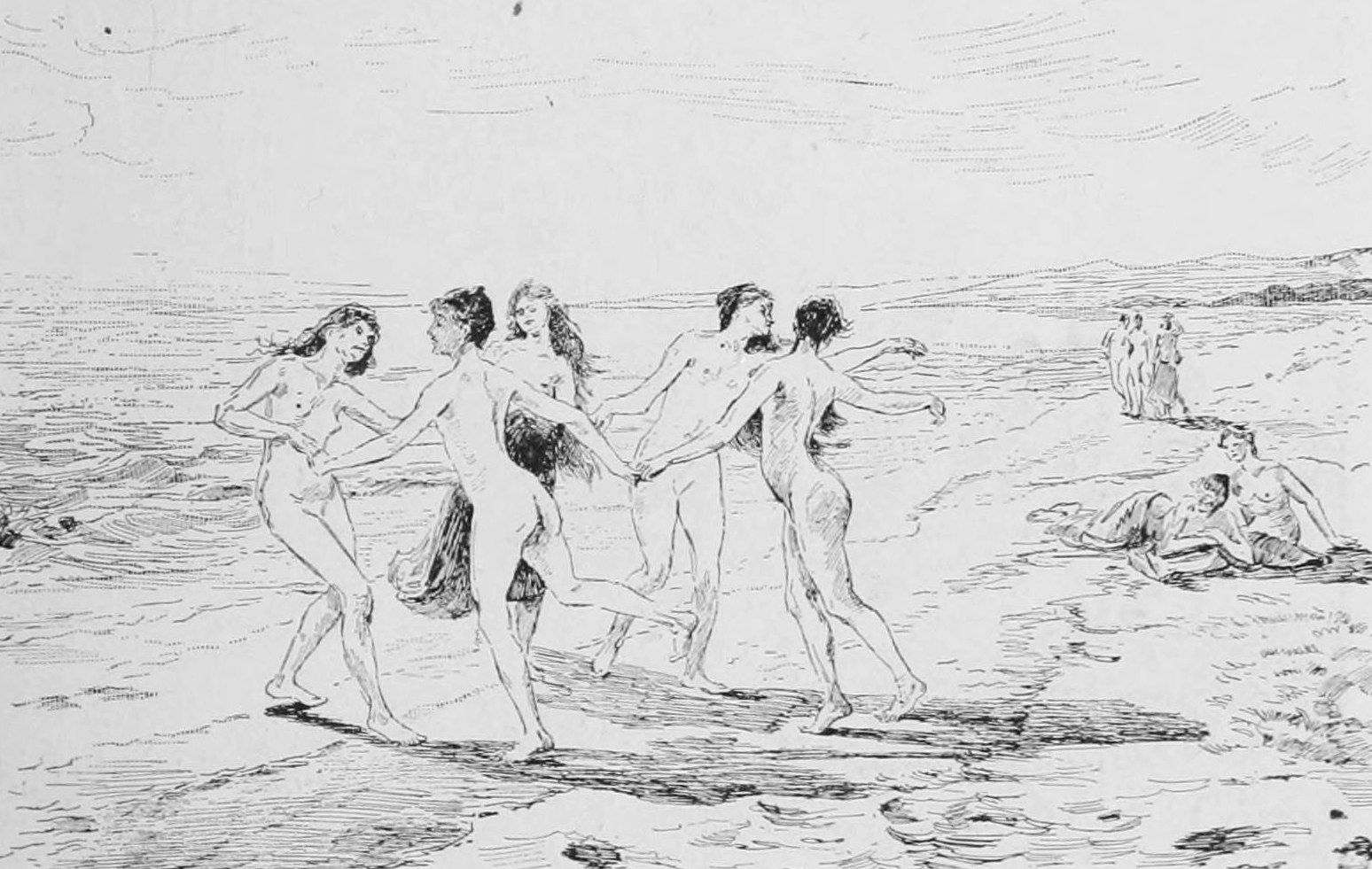
HC Collin - Au Bord de la Mer - 1892
Raphaël Collin
- Medium:
- Oil Painting
- Era:
- Late 1800s (Victorian Ballroom)
- Source:
- Wikimedia Commons
- Rights:
- Public domain — free to use, share and adapt.
- Recorded as:
- Public Domain
The work captures the 19th-century fascination with depicting movement through the lens of classical mythology, offering insight into how academic artists understood grace, the female body, and dance when not constrained by ballroom convention. For historians of dance imagery, it illustrates the persistent gap between idealized, allegorical depictions of movement and the actual choreography of the period.
What you are looking at
Five nude or partially draped female figures dance or move together on a beach, their bodies arranged in a loose chain or procession along the shoreline. The women are rendered in fine linear detail characteristic of 19th-century printmaking, their forms modeled through parallel hatching lines. The composition reads from left to right: the leftmost figure leans back with one arm extended, the next three move forward in connected motion with arms linked or gesturing, and the rightmost figure reaches outward. The beach stretches behind them in horizontal bands of texture suggesting sand and shallow water; distant figures—some clothed, some nude—are barely indicated in the middle ground and far shore. The sky occupies the upper third, rendered entirely in parallel lines that suggest movement or atmosphere. The whole work has the delicate, finely-worked appearance of a copperplate engraving or etching, with no color.
The dancing
The five central dancers are connected through arm contact and spatial proximity rather than through a formal ballroom hold. Their bodies lean, twist, and reach rather than maintain upright frame; weight shifts fluidly from figure to figure in what reads as a spontaneous or playful progression. The leftmost dancer angles backward with apparent weightlessness; the next three advance with linked arms in a looser, more naturalistic grouping than academic dance would prescribe. Arm gestures are graceful and extended rather than restrained. The lack of rigid posture or closed partnership positions suggests movement closer to frieze-like procession or Bacchanalian revel than to formal choreography.
The dance depicted
This appears to depict a Romantic-era imagining of antique revelry or nymph-like movement rather than any contemporary ballroom dance. The nude or semi-draped bodies, the beach setting, and the procession composition invoke classical or mythological subject matter—Nereid dances, Diana's nymphs, or Bacchanalian scenes—a common trope in 19th-century academic art. The movement is free-form, gestural, and suggestive of abandon rather than technique; it reads as allegory or fantasy rather than representation of a dance actually performed. No specific dance style can be identified from the image, though the composition belongs to the Romantic tradition of depicting idealized, classically-inspired movement.
How it was made
This is a copperplate engraving or possibly an etching, executed with fine parallel lines and cross-hatching to model form and create tonal gradation. The technique allows for high detail in anatomy and drapery and produces a print that could be widely circulated and collected. The absence of color and the reliance on line and tone were standard for reproductive prints of this period and suggests the work was intended for middle-class or educated audiences familiar with classical subject matter. The refined linear style and small scale imply a gallery or collection print rather than a popular broadside.
About this work
This engraving depicts five female figures in idealized, loosely connected movement on a beach, rendered in the Romantic academic tradition that used mythological and classical settings as vehicles for depicting the human body in motion. The work belongs to a 19th-century genre of allegorical or fantasy scenes that borrowed the vocabulary of classical art while engaging contemporary aesthetic preoccupations with grace, beauty, and naturalistic (or seemingly naturalistic) movement. Though titled as a seaside scene—Au Bord de la Mer—it is best understood as an imaginative composition evoking antique revels or nymph-like freedom rather than as a representation of an actual social or theatrical dance. It sits at the intersection of neoclassical subject matter, Romantic aesthetics, and the print culture that made such images available to a broad educated audience.
How to look at it
Observe how the artist connects the five figures through a chain of linked arms and leaning bodies rather than through synchronized steps or formal position. Notice the contrast between the fine, delicate line work and the freer, more gestural quality of the movement suggested in the poses and spatial arrangement. The horizontal composition and the procession format—moving left to right across the beach—owe more to classical relief sculpture than to contemporary social dance. The distant figures on the shore are barely defined, emphasizing the focus on the central group's fluid, almost weightless interaction.
The artist
Raphaël Collin (1850–1916) was a French academic painter and printmaker trained in the classical tradition. He was known for historical and allegorical compositions, many featuring the human figure in graceful or dramatic movement. His work bridges 19th-century academic neoclassicism and emerging fin-de-siècle aesthetics. Collin exhibited widely in Paris and was respected for his technical skill in both painting and printmaking; his prints circulated among collectors of reproductive graphics.
The period
In the 1890s, academic European art remained invested in classical and mythological subjects even as modern life increasingly became the subject of art. The Romantic tradition of depicting idealized bodies in antique settings persisted alongside Realism and emerging Modernism. The beach as a site of leisure and pleasure was becoming more prominent in visual culture, though typically clothed; the nude or semi-draped figure remained the domain of classical or allegorical reference. In dance itself, the 1890s saw the rise of Romantic revival aesthetics in ballet and the beginnings of modern dance, though popular ballroom dance remained rigidly formal.
Where it lives
The work is known from Wikimedia Commons, where it is catalogued under the artist's name and dated to 1892. No holding collection is specified. The source and current location are not recorded in the available catalogue data.
Questions about this work
Is this a real dance from the 1890s?
No. The composition is an imaginative, allegorical scene inspired by classical mythology rather than a representation of any social or theatrical dance of the period. The nude or draped bodies, the beach setting, and the loose, gestural movement all signal that this is an academic artist's fantasy of antique freedom, not a dance that was actually performed.
What technique is this made with?
This is a copperplate engraving or etching, a fine-line printmaking technique that allowed for high-quality reproduction and wide distribution. The parallel hatching and cross-hatching create tone and model the figures, and the technique was ideal for educated collectors of prints in the 19th century.
Why are the figures nude or semi-draped?
In academic 19th-century art, the nude or partially draped female body was reserved almost exclusively for classical, mythological, or historical subjects. By depicting these figures without contemporary dress, the artist signals that they are allegorical or fantastical beings—nymphs or revelers from antiquity—rather than modern women.
More dance artwork