49 works in this view — arrow keys or swipe to move between them.
Dance in Art · 1976
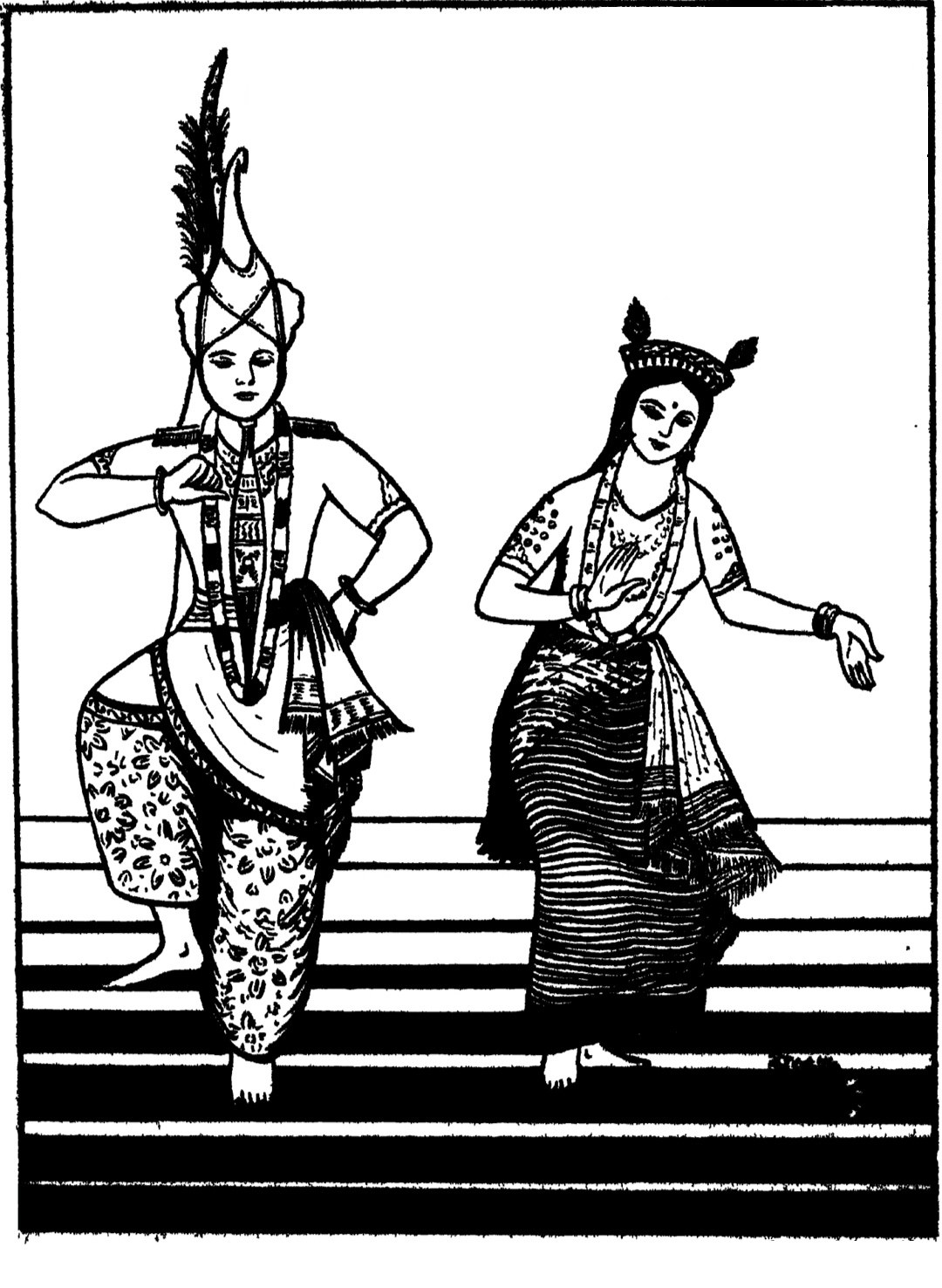
Illustration of Khamba-Thoibi Jagoi (ancient Meitei classical dance of Khuman Royal Scion Khamba & Moirang Princess Thoibi) - Cultural heritage of ancient Keke Moilang (Kege Moirang) Kingdom of early
Original author : Unknown
- Medium:
- Oil Painting
- Source:
- Wikimedia Commons
- Rights:
- Public domain — free to use, share and adapt.
- Recorded as:
- CC0
Khamba-Thoibi Jagoi is a living classical tradition with roots in medieval Meitei court culture, and illustrated documentation of its performance practice—particularly its codified hand gestures, posture, and costume—is essential for transmission and reconstruction. This 1976 publication represents an important moment in which regional classical dance was being actively recorded and circulated within the community through modern media, a practice that preceded many global documentation initiatives.
What you are looking at
Two figures stand on a stepped platform against a plain background, posed in formal classical dance positions. The figure on the left wears an elaborate costume: a tall headdress with a single upright feather, an ornate breastplate with geometric patterning, a short draped skirt decorated with floral motifs, and patterned tight leggings. The right figure wears a fitted dress with dot-patterned sleeves, a dark skirt with horizontal striations, a decorative hip sash, and a jeweled headdress with side ornaments. Both figures have serene, forward-facing expressions and hold their bodies in upright, dignified poses. The left figure has one arm raised across the torso in a controlled gesture; the right figure's arms are extended with palms facing outward in a sustained, graceful frame. The composition presents them as equal partners in a formal, codified dance moment.
The dancing
Both dancers maintain an upright, noble carriage with minimal weight shift—bodies centered over the hips in what appears to be a standing position. The left dancer's raised arm is held with controlled placement across the body; the right dancer's extended arms suggest a frame that opens toward an audience or partner. Neither dancer appears to be in motion; instead, they occupy a pose state that conveys balance, symmetry, and hierarchical formality. The positioning suggests a moment of greeting, courtship, or presentation rather than a dynamic traveling step.
The dance depicted
This illustration depicts Khamba-Thoibi Jagoi, a classical court dance of the Meitei/Manipuri tradition that dramatizes the legendary romance between the princely Khamba and Princess Thoibi of Moirang. The costumes are consistent with Manipuri classical dress and headdresses (makhela and ornamental topknots), and the formal, restrained upper-body movement with hand gestures aligns with the classical Manipuri vocabulary, in which emotion and narrative are conveyed through precise hand positions (mudras) and facial expression rather than large spatial travel. The image captures an encounter or duet moment in which the dancers present themselves to each other with courtly formality.
How it was made
This is a black-and-white line drawing or engraving, likely a reproduction from a printed magazine as the catalogue record indicates (Saratki Echel monthly). The medium allows for fine detail in costume ornamentation—the patterning on leggings, the dot-work on sleeves, the feather plumage—while the clean line work and high contrast make the image legible in newsprint. The drawing style is representational and documentary rather than artistic interpretation, suggesting its primary function was educational or archival: to record and circulate knowledge of Meitei classical dance for a contemporary Manipuri-language readership.
About this work
This is a documentary illustration of Khamba-Thoibi Jagoi, one of the classical dance-dramas of the Meitei people of Manipur (northeast India). It was published in a modern Manipuri-language magazine in 1976 as part of efforts to document and preserve the cultural heritage of the ancient Kangleipak (Manipur) kingdom. The image shows two costumed dancers in a formal duet pose, their ornate dress and dignified bearing indicating a moment of courtship or formal encounter within the legendary narrative. For scholars of South Asian classical dance, this work is valuable as a dated record of mid-twentieth-century Manipuri dance costuming and presentation; for the Manipuri community, it represents a moment of cultural documentation during a period of modernization and social change.
How to look at it
Attend to the costume detail, which encodes Meitei courtly identity: the feathered headdress (makhela), the geometric and floral patterning on garments, the ornamental breastplate. Notice how both dancers are presented frontally and symmetrically, conveying equality and formality rather than narrative action—the artist has chosen to freeze a moment of presentation or greeting rather than a leap or traveling step. The hand positions, particularly the raised arm on the left and the open-palm frame on the right, are likely precise mudras (codified gestures) carrying meaning within the Manipuri vocabulary; the image is as much about recording these gestural conventions as about capturing physical movement.
The artist
The artist is unknown. The illustration was published in Saratki Echel, a monthly magazine in modern Meitei language (written in Bengali script) published in Manipur. The magazine's role was to document and celebrate Meitei cultural heritage, including dance, literature, and history, for a contemporary Manipuri readership during a period of active cultural preservation and modernization.
The period
In the 1970s, classical dance traditions across South Asia were undergoing significant documentation and revival. In Manipur, the post-independence period saw efforts to codify and preserve ancient court dances including Khamba-Thoibi Jagoi, which had been performed in royal courts for centuries but faced discontinuity due to social and political upheaval. Simultaneously, regional-language media was expanding, making illustrated cultural documentation accessible to urban, educated audiences. This image reflects that dual movement: the reassertion of Meitei classical tradition as a marker of regional identity, and the use of modern print media to carry that tradition forward.
Where it lives
The work was published in Saratki Echel, a monthly magazine in Meitei language (Manipuri) written in Bengali script, produced in Manipur. It is listed as appearing in a Wikipedia Commons source. The original holding collection is not recorded.
Dance in this work
Questions about this work
Who were Khamba and Thoibi?
They are legendary figures from Meitei (Manipuri) folklore, with Khamba typically portrayed as a royal scion of the Khuman dynasty and Thoibi as a princess of Moirang. Their story—often a romance or tragic encounter—has been central to classical Meitei dance for centuries and is performed in the court dance drama Khamba-Thoibi Jagoi. Different versions of the narrative exist across oral and written traditions.
Is this the same as Manipuri dance?
Khamba-Thoibi Jagoi is one form of classical Manipuri dance, which is the primary classical dance tradition of Manipur (a state in northeast India). Manipuri is characterized by fluid upper-body movement, precise hand mudras, and lyrical expression, often performed to Manipuri classical music. It differs significantly from the other major South Indian classical traditions such as Bharatanatyam or Kathak.
What do the hand positions mean?
The raised arm and extended open palms visible in this image are likely specific mudras (hand gestures) that carry coded meaning within the Manipuri tradition. In Manipuri dance, mudras work together with facial expression and body position to convey emotion, narrative, and character. Without knowing the specific moment in the Khamba-Thoibi narrative this image represents, we cannot decode the exact meanings, but the precision and symmetry of the positions suggest they are conventional rather than improvised.
Why was this illustration published in 1976?
The 1970s were a period of active cultural preservation and documentation across India, including efforts to record and circulate classical regional dance traditions through modern media. Publishing this image in a popular Manipuri-language magazine made knowledge of Khamba-Thoibi Jagoi and its performance practice accessible to educated urban readers in Manipur, supporting cultural continuity during a period of social modernization.
More dance artwork