44 works in this view — arrow keys or swipe to move between them.
Dance in Art · 1925
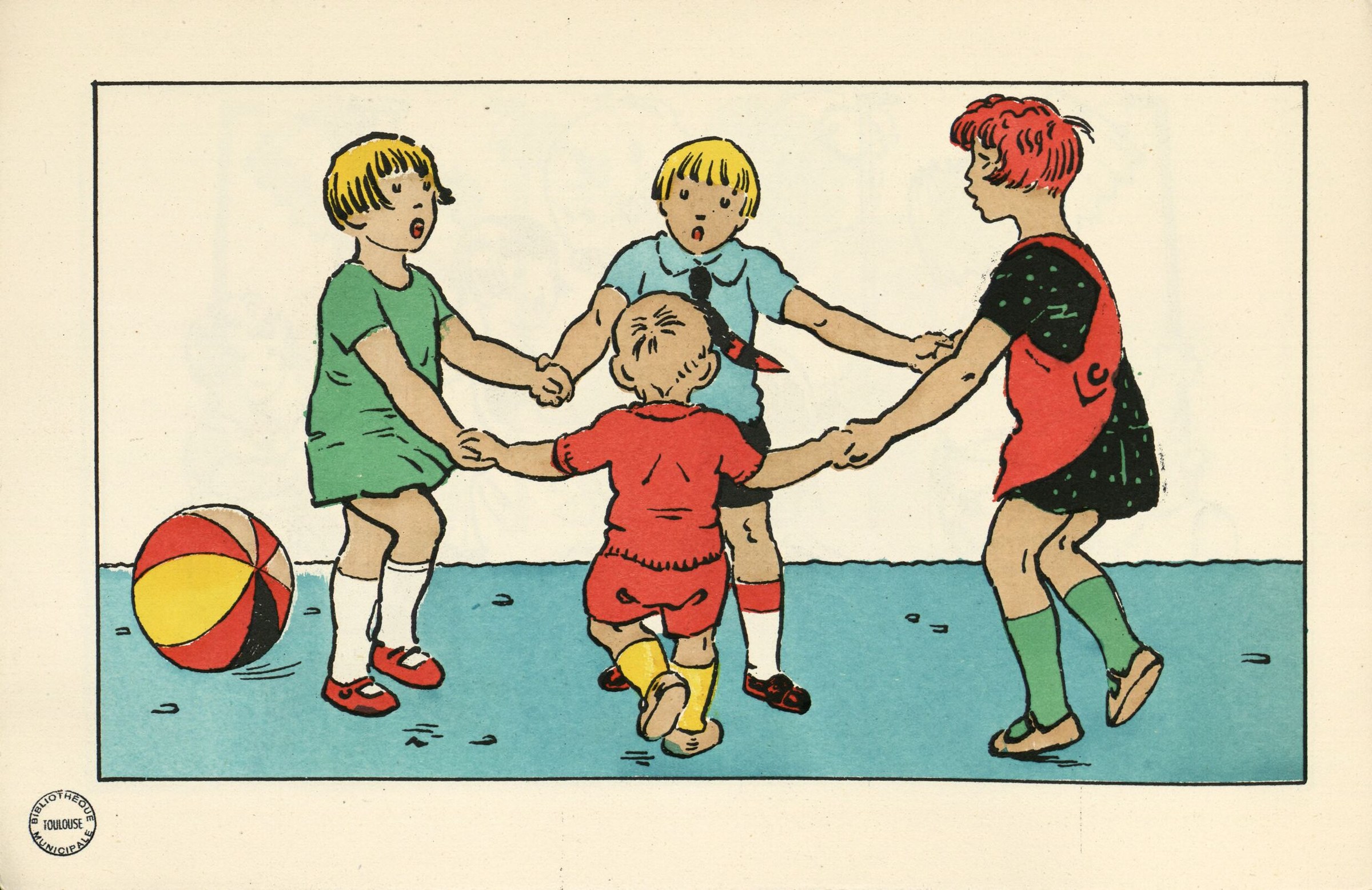
Jeux d'enfants - Ill. Jean Matet - btv1b10573576q (10 of 12)
Matet, Jean. Fonction indéterminée
- Medium:
- Oil Painting
- Era:
- 1920-1950 (Swing Era)
- Source:
- Wikimedia Commons
- Rights:
- Public domain — free to use, share and adapt.
- Recorded as:
- Public Domain
Circle games were a pedagogical tool and a folk form, taught to children as both social practice and physical training. This image documents how dance appeared in children's lives not as art but as play—unselfconscious, outdoors, collective. For anyone studying childhood, folk movement, or the visual culture of interwar Europe, it is a primary source.
What you are looking at
Four children play together in what appears to be a seasoned outdoor space—the ground is rendered in pale blue-green suggesting sand or a play yard. A child in red stands centrally, held by the hands of three companions: one in green on the left, one in blue-grey at center-back, and one in red with a dark patterned skirt on the right. A beach ball—red, yellow, and black in panels—rests on the ground to the left. The children's expressions are open-mouthed, suggesting laughter or song. The illustration is rendered in watercolor or gouache with bold outlines in the style of early 20th-century children's book art, with flat color and minimal shading. The composition captures a moment of unselfconscious play, the four figures arranged in a rough circle, their bodies angled toward each other.
The dancing
The central child in red is supported on either side, hands grasped by companions, weight balanced and feet planted. The three supporting figures form a loose ring, their free arms extended or held to complete the circle. The postures are upright and grounded, with no hint of elevation or extension—these are standing figures in a simple hand-hold formation. The artist has captured the essential gesture of circle play: the grip and the turn, the mutual support and equality of position.
The dance depicted
This depicts a children's circle game, most likely a variant of *Saute-mouton* (leapfrog) or another children's ronde—the French catalogue keywords name both explicitly. The ronde, or ring dance, was a foundational play-form in European childhood, performed without music or formal instruction, simply as a social bonding and movement game. The hand-hold, the circular arrangement, and the presence of laughter all confirm the ronde structure: players stand in a circle holding hands, typically moving in one direction while singing or chanting. The presence of the beach ball and outdoor setting suggest this is summer play, informal and joyful rather than a staged or choreographed performance.
How it was made
The work is gouache or watercolor with ink outlining, a technique well-suited to children's book illustration of the 1920s. The flat color planes, bold line work, and limited palette (red, green, blue, yellow, flesh tones, black) are characteristic of commercial art production for the mass-market picture book or periodical. The technique allowed rapid reproduction and warm, accessible illustration for young audiences. The style suggests this was part of a larger illustrated sequence or series—the catalogue reference to an ensemble (*RsAlis000*, *RsAlis003*) supports this.
About this work
This is an illustration from a 1920s French children's book or picture series, titled *Jeux d'enfants* (Children's Games). It documents a moment of outdoor play—a circle game in which four children hold hands and move together. The work sits at the intersection of social history, children's culture, and visual pedagogy: it both depicts how children actually played and shaped expectations and models of childhood play for its young readers. The ronde or circle game was foundational to early 20th-century child-rearing philosophy, valued for its socializing effects and its connection to folk tradition. This image survives as evidence of how dance and movement were understood not as specialist performance but as the natural language of children's play.
How to look at it
Notice the hand-hold: the grip is the essential element. Watch how the artist has positioned the arms to show both the connection and the weight—each child is supported by and supporting the others. The open mouths and upturned faces signal joy and vocalization, suggesting these children are singing or calling out as they move. The beach ball in the corner grounds the scene in summer leisure, but the real action is the circle itself—the social form made visible.
The artist
Jean Matet's practice is not well documented in accessible records. The work appears in the Bibliothèque Nationale de France collection as part of a larger ensemble of children's book illustrations from the 1920s, suggesting he was a professional illustrator working in the commercial children's publishing market in Paris during the Swing Era. The style is consistent with the graphic vocabulary of French children's magazines and picture books of the period.
The period
In the 1920s, childhood play was being studied and systematized by educators, psychologists, and dance reformers across Europe. The folk ronde was simultaneously being recovered as a national cultural form and instrumentalized as a tool for child development. In France, the ronde was taught in schools as part of physical education and social formation, linked to both nationalist pedagogy and progressive child-centered education. This illustration sits at that intersection: it shows play as natural and joyful while also positioning the circle game as a worthwhile subject for careful visual documentation and reproduction.
Where it lives
The work is held in the Bibliothèque Nationale de France and is accessible through Wikimedia Commons. It forms part of a larger documentary ensemble (*RsAlis000*, *RsAlis003*) cataloguing children's games, clothing, and social practices in interwar France.
Dance in this work
Questions about this work
What game are these children playing?
They are playing a ronde, or circle game—a foundational form of children's play in early 20th-century Europe. Players stand in a circle, hold hands, and move together while singing or chanting. The catalogue notes reference *Saute-mouton* (leapfrog) as a related game. These were typically outdoor, unsupervised play, though they were also formalized in schools as part of physical education.
Why does this image matter for dance history?
It documents how movement and dance appeared in ordinary childhood rather than in theatrical or formalized contexts. The ronde was a foundational social and kinetic practice, learned through play rather than instruction, and valued by educators for its role in child development. This image is evidence of how dance lived in everyday life.
What is the style of the illustration?
It is gouache or watercolor with ink line, a standard technique for children's book and magazine illustration in the 1920s. The flat color, bold outlines, and simple forms made it well-suited to mass reproduction. The style is typical of French commercial art for children during the interwar period.
More dance artwork