33 works in this view — arrow keys or swipe to move between them.
Dance in Art · 1820
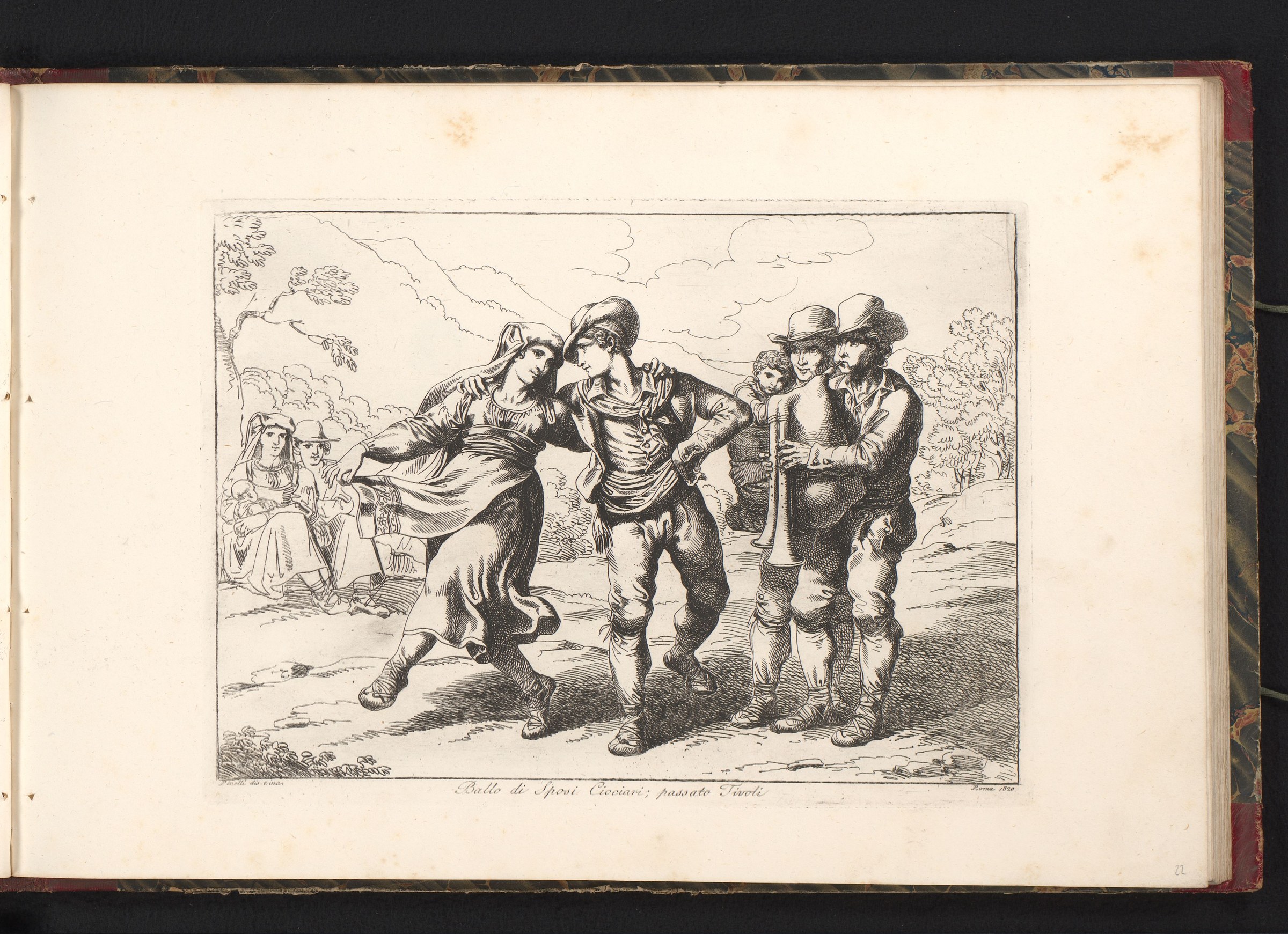
Jong bruidspaar dansend, BI-1943-222-22
Unknown (Rijksmuseum collection)
- Medium:
- Ink
- Era:
- Early 1800s (Waltz Revolution)
- Source:
- Wikimedia Commons
- Rights:
- Public domain — free to use, share and adapt.
- Recorded as:
- CC0
This work is among the few surviving visual records of Ciociari wedding dance tradition, a regional form now largely lost. For dance historians and ethnographers, the engraving's precise rendering of the dancers' bodies and hold—the backward arch, the supporting frame, the relationship between partners—provides concrete evidence of how this folk tradition was performed and valued at a moment when regional dance cultures were beginning to be systematically documented. The work shows a crucial historical moment: when European artists began to treat peasant and folk dancers as subjects worthy of serious representation, not as exotic curiosities but as skilled practitioners of their own traditions.
What you are looking at
A young bridal couple dances at the center of a landscape populated with rural figures from the Ciociaria region near Rome. The bride, dressed in a full white gown with a veil or headdress, leans backward in an elegant arc while her partner, in dark fitted breeches and jacket, supports her weight and moves with decisive energy. To the right, a bagpiper plays while a man holds a small child; to the left, a seated family watches from the shelter of trees. The composition is framed by rocky hills and vegetation, with clouds sketched above. The engraving captures a moment of celebration—a folk wedding dance frozen mid-movement, with the couple occupying the visual and social center of the scene.
The dancing
The bride's body is arched dramatically backward, her right arm extended, creating a sweeping line from her torso through her fingertips. The groom supports her firmly, his posture stable and grounded, suggesting strength and control. Both dancers are upright and mobile rather than in a closed ballroom hold; the groom's left arm appears to guide her, while her left hand may rest on his shoulder. The bride's skirts sweep outward with the momentum of the movement. The spatial relationship between the dancers—separated slightly but deeply connected through the supporting arm—suggests a partner dance of moderate formality, neither a waltz's close embrace nor a folk quadrille's processional distance.
The dance depicted
This is a regional Italian folk wedding dance from the Ciociaria district, a rural area southeast of Rome known for strong dance traditions. The engraving's inscription—*Ballo di Sposi Ciociari; passato Tivoli*—translates as "Ball of Ciociari Spouses; near Tivoli," identifying both the dance type and the geographic origin. The dramatic backward arch of the bride and the partner's steadying hold suggest a dance style emphasizing verticality and trust—characteristics of southern Italian folk forms, though the specific Ciociari wedding dance tradition is now poorly documented. The presence of a bagpiper (likely a *zampogna*) confirms the regional instrumentation. This is social dance, ceremonial in purpose, performed for and among the community rather than as theatrical entertainment.
How it was made
This is an engraving on paper, created through the intaglio process in which an image is incised into a metal plate, inked, and printed. The fine parallel lines (hatching) and precise linear marks visible throughout demonstrate the control engraving allowed; the artist rendered drapery, musculature, facial features, and landscape with delicate definition. Engravings were the primary means of circulating images of costume and dance in early 19th-century Europe, enabling multiple impressions to be bound into albums or sold individually. The technical precision and finish suggest this work was part of a more ambitious publishing project—likely the series titled *Nuova raccolta di cinquanta costumi de contorni di Roma* ("New Collection of Fifty Costumes from the Environs of Rome"), a costume anthology aimed at educated urban audiences curious about regional life.
About this work
This engraving documents a Ciociari folk wedding dance from the Lazio region of Italy, captured in the early 19th century as part of a larger ethnographic costume series. It shows a bride and groom in mid-movement, the bride arched backward in a gesture of trust and celebration, supported by her partner while community members—family, musicians, spectators—inhabit the landscape around them. The work sits at the intersection of dance documentation and picturesque travel art: it records a specific regional tradition while presenting it through the compositional and technical conventions of European salon engraving.
The image preserves a moment when folk wedding dances were recognized as worthy subjects for serious artistic attention. Rather than caricature or nostalgic fantasy, the engraver treats the dancers with dignity, capturing both the physical sophistication of the movement and the social fabric in which it occurs—the musicians, the witnessing family, the natural setting that grounds the celebration in place.
How to look at it
Attend first to the bride's body: the depth of her backward arch, the extension of her arm, and the vulnerability of that posture—it is only possible because her partner's grip is secure and his posture stable. Note the groom's weight, his feet, his steady frame: this is a partnership dance, not a display. The presence of the bagpiper immediately grounds the dance in its regional and musical context; the family watching from the left suggests this is not a performance for outsiders but a community celebration. The engraver chose to freeze the moment of maximum extension and trust, not a moment of passage or transition. This choice emphasizes the dance as a physical and social statement—the bride giving herself to the support of her partner, witnessed and celebrated by her community.
The period
The early 19th century saw a surge in interest in regional folk cultures across Europe, driven by Romanticism and nascent ethnographic curiosity. In Italy, this took the form of costume albums and travel narratives documenting the dress, dances, and customs of rural districts. The Ciociaria, with its distinctive peasant costume and strong local traditions, was a favored subject. At the same time, the waltz and other ballroom forms were transforming European social dance, making folk and regional traditions appear increasingly archaic to urban audiences. This engraving was created at a moment when such traditions could still be observed but were already becoming subjects of historical preservation rather than living everyday practice.
The work also reflects the early 19th-century fashion for picturesque landscape and genre scenes in printmaking. Rather than isolating the dancers against a blank background, the engraver situated them in a naturalistic, rocky landscape populated with other figures, following the compositional logic of sentimental or ethnographic genre prints aimed at middle-class collectors.
Where it lives
The work is housed in the Rijksmuseum (accession BI-1943-222-22) and is part of the collection *Kostuumprenten met figuren uit Rome en omgeving* ("Costume Prints with Figures from Rome and Surroundings"), which itself belongs to the larger series *Nuova raccolta di cinquanta costumi de contorni di Roma*. This was a commercial costume anthology, likely issued in parts or bound volumes, aimed at European audiences interested in the ethnographic and sartorial customs of Italy.
Dance in this work
Questions about this work
What region is this dance from and what was it called?
This is a wedding dance from the Ciociaria, a rural district in Lazio south of Rome. The inscription calls it *Ballo di Sposi Ciociari*—the Ciociari Spouses' Ball or wedding dance. Ciociaria is famous for distinctive peasant costume and strong local traditions, though detailed documentation of the specific choreography of this dance is now scarce. The presence of the bagpiper (*zampogna*) confirms the regional instrumentation.
Why is the bride arched backward like that?
The dramatic backward arch serves multiple purposes: it is a technical element of the dance itself, creating a striking visual line and requiring the groom's confident support; it expresses trust and celebration; and it creates aesthetic drama for the viewer. In the context of a wedding, the posture also communicates the bride's vulnerability and the groom's strength—cultural values of the time. The engraver chose to capture the moment of deepest trust and most elegant extension.
Is this a 'folk dance' or a 'ballroom dance'?
It is folk dance—a regional tradition performed in community and ceremonial contexts. However, the early 19th-century moment of this engraving is one when folk traditions and ballroom forms were becoming increasingly distinct. The influence of ballroom dance (the waltz, quadrille) was spreading; folk dances like this were increasingly viewed as archaic or regional curiosities by urban society. This print captures that transition—it treats folk tradition seriously, but also marks it as exotic and historically distinctive.
Who made this print and when?
The artist is not named in the surviving record, though the work is dated (the catalogue does not specify the year, though the series was published in the early 19th century, likely 1820s or 1830s). It was part of a commercial costume anthology aimed at European audiences interested in regional Italian traditions. The precision of the engraving and the ethnographic detail suggest a trained artist working for a publishing house rather than a folk documentarian.
More dance artwork