49 works in this view — arrow keys or swipe to move between them.
Dance in Art
Lei (PSF)
Pearson Scott Foresman
- Medium:
- Oil Painting
- Source:
- Wikimedia Commons
- Rights:
- Public domain — free to use, share and adapt.
- Recorded as:
- Public Domain
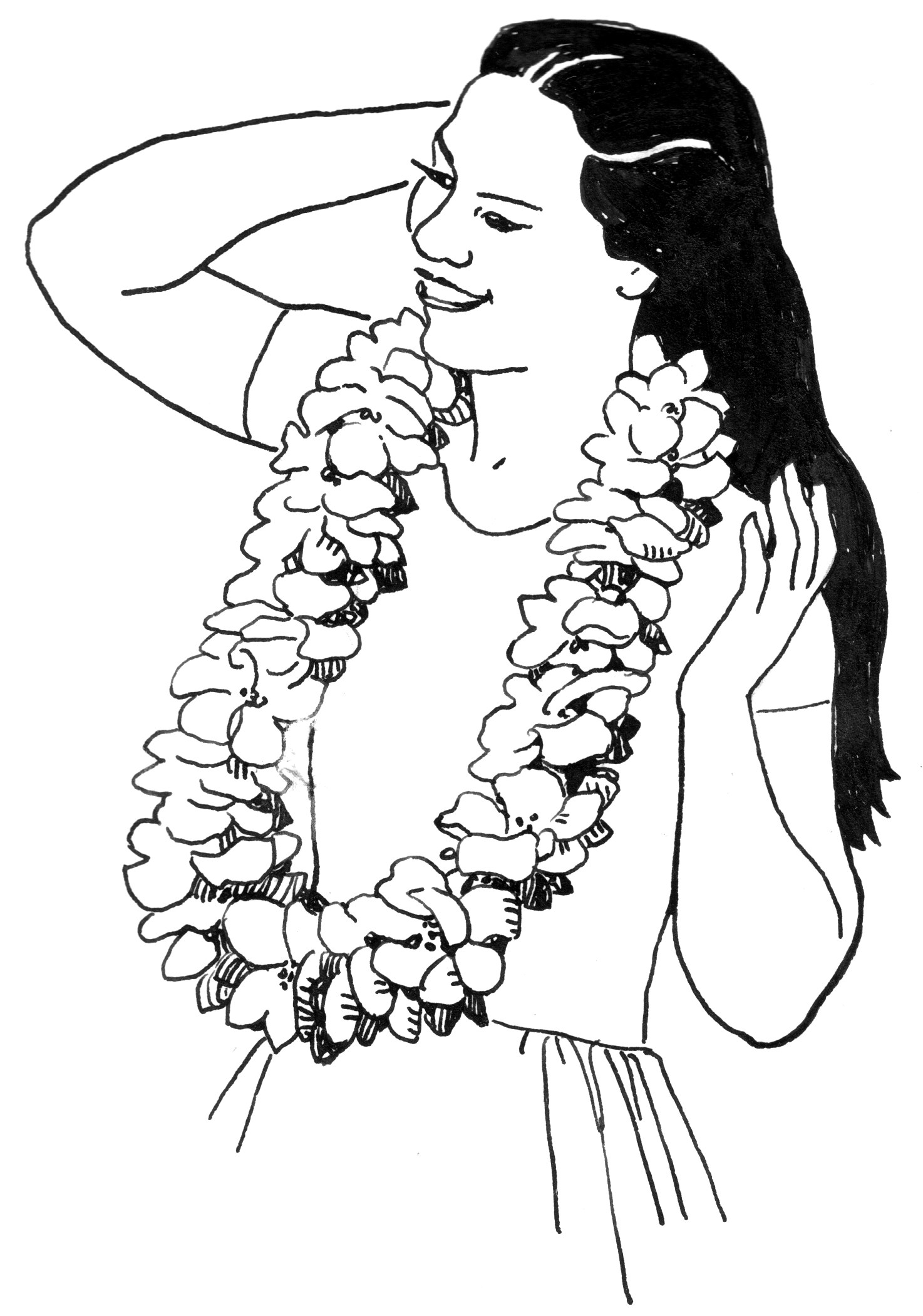
This image is a document of how Hawaiian culture, including dance and lei-wearing practices, was visualized and taught to American audiences in the mid-twentieth century. It shows both the visual reality of Hawaiian adornment and the aesthetic conventions—flatness, exoticism, ethnographic pose—through which American institutions made Hawaiian dance and dress legible to non-Hawaiian viewers.
What you are looking at
A single figure in profile faces left, posed in a moment of graceful repose. She wears long dark hair swept back from her face, and is dressed in a light, draped garment that leaves her shoulders and arms bare. Most striking is the elaborate lei that drapes across her chest and down both sides of her body—a generous garland of flowers rendered in outline, each bloom carefully articulated. Her left arm is raised and bent, hand near her head in a relaxed, contemplative gesture. Her right arm rests lower. The figure stands against a plain white ground with no setting or context beyond her own form. The style is linear and graphic rather than painterly, with bold black shading used sparingly to define the hair and create volume in the lei.
The dancing
A single standing figure in a pose of repose rather than active movement. The raised left arm and hand-to-head gesture suggest a moment of thought or a display pose—the kind a dancer or lei-wearer might hold for presentation. The body is upright but relaxed, the weight evenly distributed. The elaborate lei is the focus: it frames the body, hangs in generous loops, and appears to be both a garment and a sculptural element that transforms the figure's silhouette.
The dance depicted
This appears to document Hawaiian lei culture and dress rather than to depict an active dance. Lei are integral to Hawaiian hula, worn as hip garlands (lei hula) and lei po'o (head garlands), and they feature prominently in both sacred hula kahiko and social hula auana. The pose suggests a moment of adornment or presentation—the kind of stillness that precedes or frames movement. Without active choreographic gesture or the presence of other dancers, the image cannot be securely identified as depicting a specific hula style, but the lei and Hawaiian dress place it firmly within Hawaiian dance culture.
How it was made
A line drawing or engraving with selective black shading, executed with an economical, graphic style. The technique relies on outline and stippled or hatched shading rather than modeling in tone. This approach—clear, readable, and reproducible—suggests a commercial or educational illustration rather than fine art. The record identifies it as an oil painting, but the visual evidence points toward a graphic work such as an engraving, lithograph, or printed illustration. The technique was well suited to mid-twentieth-century publishing and educational materials.
About this work
This is a portrait study of a Hawaiian woman in lei, rendered in a linear graphic style that emphasizes the sculptural beauty of the garland itself. The work documents Hawaiian adornment and dress culture at a moment when that culture was being absorbed into American commercial and educational imagery. The figure's stillness and the isolation of her form on a white ground suggest that this is a study of costume and appearance rather than an action scene—yet lei are inseparable from hula, and the image implicitly frames Hawaiian dress as belonging to dance contexts.
The work sits at the intersection of ethnographic documentation, commercial illustration, and the visual subordination of Hawaiian culture to American educational frameworks. The Pearson Scott Foresman attribution suggests this image was created for or circulated through the American school system, where Hawaiian dance and culture were presented to mainland children as exotic, picturesque subjects of study.
How to look at it
Look first at the lei: the artist has rendered each flower individually, creating a visual rhythm that transforms the garland into the composition's true subject. The figure herself is almost secondary to the lei's ornamental presence. Notice the stillness and the formal pose—this is not a dancer in motion but a figure displaying adornment, suggesting that the work is about costume and appearance rather than movement. The profile view and raised arm are conventions of ethnographic illustration, a way of presenting the figure for study and admiration without narrative context.
The artist
Pearson Scott Foresman was an American education and publishing company active from the early twentieth century onward, best known for school textbooks and educational materials. The company commissioned and published illustrations for use in American classrooms, making this work part of a vast archive of educational imagery designed to introduce American schoolchildren to world cultures. The work reflects the visual practices and cultural assumptions of mainstream American education in the mid-twentieth century.
The period
This work emerges from an era when Hawaiian culture was being actively incorporated into American popular culture and education. The mid-twentieth century saw the rise of 'Waikiki' tourism, the commercialization of hula as a tourist attraction, and the inclusion of Hawaiian content in American school curricula. At the same time, Hawaiian dancers and cultural practitioners were engaged in efforts to preserve and revitalize hula kahiko and other traditional practices, responding to decades of suppression during the colonial period. This image represents the mainstream American educational gaze on Hawaiian culture—respectful in intent but fundamentally extractive in approach.
Where it lives
Sourced from Wikimedia Commons. The work is attributed to Pearson Scott Foresman, an American educational publishing company, indicating that this was likely created for or used in school textbooks or educational materials distributed in American classrooms.
Dance in this work
Questions about this work
Is this showing hula?
The work depicts Hawaiian dress and lei, which are central to hula practice, but it does not show active choreography or movement. It is a portrait study of adornment and appearance rather than a dance scene. Lei are worn in both hula kahiko (traditional) and hula auana (social), so the image documents a key element of Hawaiian dance culture even though no dance is being performed.
Why is the lei so emphasized?
The lei is the visual focal point because it is both culturally and aesthetically significant in Hawaiian dress. For dancers, lei carry spiritual and symbolic meaning and are essential costume elements. The artist has rendered the lei in meticulous detail, turning the garland itself into a major formal element of the composition.
What does the medium tell us about how this work was used?
The graphic, linear style and the Pearson Scott Foresman attribution suggest this was an educational illustration for American schoolchildren. The clarity and simplicity of the rendering made it easy to print and reproduce in textbooks, making Hawaiian culture available to mass audiences while also shaping how that culture was understood and imagined.
More dance artwork