49 works in this view — arrow keys or swipe to move between them.
Dance in Art · 1919
Mr. Punch's history of the Great War p169
H. M. Bateman
- Medium:
- Oil Painting
- Era:
- 1900-1920 (Ragtime/Early Jazz)
- Source:
- Wikimedia Commons
- Rights:
- Public domain — free to use, share and adapt.
- Recorded as:
- Public Domain
This work documents the role of spontaneous social dancing and entertainment in maintaining morale among military personnel during the First World War—a social history of dance that extends beyond theatrical or competitive contexts. It reveals contemporary attitudes toward naval life, hierarchy, and the role of collective celebration in managing the pressures of war, and shows how cartoonists of the period understood dance and physical play as a subject worthy of editorial attention.
What you are looking at
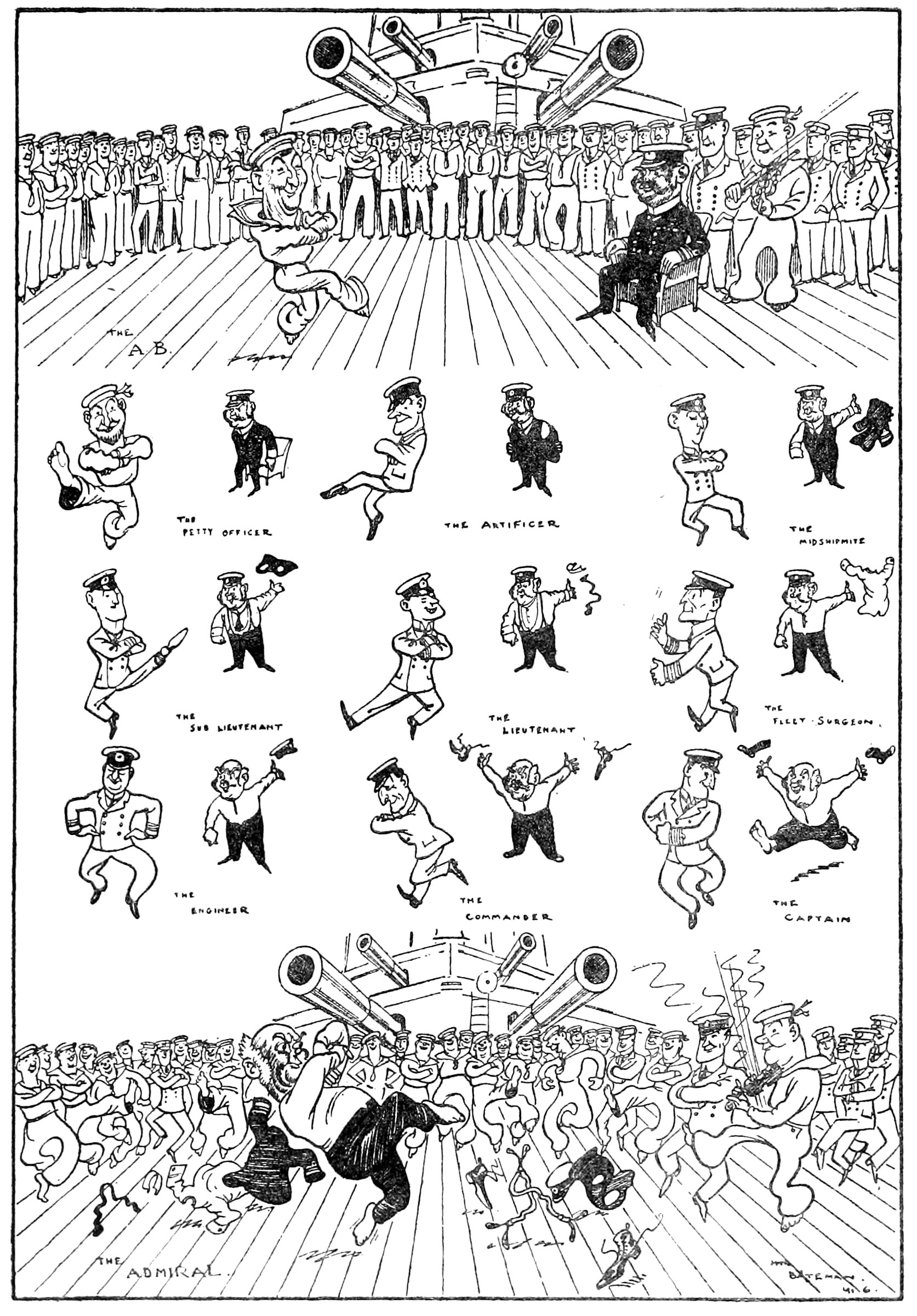
This is a satirical illustration from a wartime publication, divided into two halves showing naval personnel entertaining themselves on the deck of a ship. The upper panel depicts a formal assembly: dozens of sailors in white uniforms stand in orderly formation around the perimeter of the deck, framing the action. In the center, a figure in dark dress (likely an officer or dignitary) sits elevated in a chair, facing two sailors who perform acrobatic capers and comic routines. The lower panel shows the same scene descended into riotous celebration: the formal lines have dissolved into a chaotic crowd of dancing, leaping sailors packed densely across the deck, their bodies in wild attitudes of exertion and joy. The ship's superstructure—with its distinctive smokestacks and radio masts—looms above both scenes, establishing the vessel as the setting. The contrast between military discipline and anarchic release is the work's central joke.
The dancing
The performers in the upper panel strike exaggerated comic poses: loose-limbed, energetic attitudes suggesting music-hall entertainment rather than trained dance. Their arms and legs are extended in broad gestures of buffoonery. In the lower panel, the sailors leap, kick, and cavort with explosive energy—bodies airborne, arms raised, legs splayed—in attitudes of uncontrolled abandon. The formations shift from orderly geometry (the standing ring) to a dense, kinetic tangle. Weight appears entirely committed to vertical impulse and comic effect rather than any formal technique.
The dance depicted
This is not a depiction of structured dance but of communal celebration and entertainment among military personnel during wartime. The upper panel suggests shipboard vaudeville—sailors performing comic turns and acrobatic tricks for their shipmates. The lower panel depicts spontaneous, jubilant social dancing or horseplay: the kind of exuberant release that might follow a victory announcement or shore leave. The energy is vernacular and unschooled, the emphasis on collective joy and masculine camaraderie. The work documents a social practice—entertainment and dancing as morale-building among naval crews—rather than any particular dance style or technique.
How it was made
This is a pen-and-ink cartoon or illustration, likely reproduced in print. The linework is confident and economical, with selective cross-hatching for shadow and tone. The technique allowed rapid production and mass circulation in a publication. The style is characteristic of early-20th-century newspaper and magazine cartooning: exaggeration of anatomy and gesture for comic effect, economy of line, and clear readability at small scale. The division into two sequential panels and the narrative contrast between them suggest comic-strip conventions, though this appears to be a single editorial or feature illustration rather than part of a serial.
About this work
This is a wartime cartoon satirizing naval life aboard a military vessel, showing the contrast between formal military order and the uninhibited joy of sailors at leisure. The work captures a particular moment in early-20th-century military culture: the recognition that morale depended on entertainment and release, and that the rigid hierarchies of naval discipline could be temporarily suspended for celebration. The illustration belongs in a dance history collection not because it documents technique or style, but because it records how social dancing and performance functioned as a vital cultural practice within a specific community. It shows dance as a response to the psychological and social strain of military life during wartime.
How to look at it
Notice the deliberate contrast between the two panels: the upper shows the formal apparatus of command and spectatorship, the lower shows the breakdown of order into exuberant chaos. The artist has frozen multiple moments and bodies mid-movement to create a sense of kinetic explosion. Observe the variety of attitudes and the density of the crowd in the lower panel—no two figures occupy the same pose or height, creating visual rhythm and suggesting continuous motion even in a static image. The seated officer in the upper panel, observing the entertainment, anchors the scene as a representation of an actual social occasion aboard a real vessel.
The artist
H. M. Bateman (1887–1970) was a celebrated British cartoonist and illustrator, known for his witty, energetically drawn scenes of social comedy and military life. He contributed regularly to *Punch* magazine and illustrated numerous books. His style—exaggerated, kinetic, and character-driven—made him ideal for wartime publications seeking to balance patriotic messaging with humor and social observation. He had a gift for capturing the absurdity and camaraderie of military service without sacrificing the dignity of those depicted.
The period
This illustration appears in *Mr. Punch's History of the Great War*, published in 1919 as the First World War concluded. The collection gathered editorial cartoons and illustrations from *Punch* magazine documenting the war years. The war had transformed attitudes toward entertainment and morale: military authorities came to recognize that recreational activities, music, and dancing were not frivolous but essential to troop morale and psychological resilience. Shipboard entertainment, concert parties, and spontaneous celebration became common features of military life, documented in photographs, films, and illustrations. The visual culture of the period shows increasing interest in capturing the informal, human side of military service alongside the formal and heroic.
Where it lives
This work is reproduced from *Mr. Punch's History of the Great War*, a wartime compilation published by *Punch* magazine in 1919. The original appears to have been a page illustration within that bound volume, one of many cartoons and illustrations documenting the social and military dimensions of the war. The source is Wikimedia Commons.
Questions about this work
Is this a depiction of an actual naval tradition?
The illustration documents shipboard entertainment and celebration, which were real practices used to maintain morale. The exaggerated comic style suggests satirical commentary rather than ethnographic record, but the underlying social practice—sailors entertaining each other during off-duty hours—was genuine and widespread during the war period.
What dance styles are shown?
No formal dance style is depicted. The upper panel shows music-hall acrobatics and comic performance; the lower shows spontaneous social dancing and play. The emphasis is on exuberance and release rather than technique, suggesting vernacular celebration rather than any codified dance form.
Why is this in a dance collection?
Dance history extends beyond theatrical or competitive contexts to include social dancing, celebration, and the role of movement and entertainment in community and military life. This illustration documents how dancing functioned as a morale-building practice during wartime and reveals contemporary attitudes toward the social role of performance and physicality.
More dance artwork