49 works in this view — arrow keys or swipe to move between them.
Dance in Art · 1919
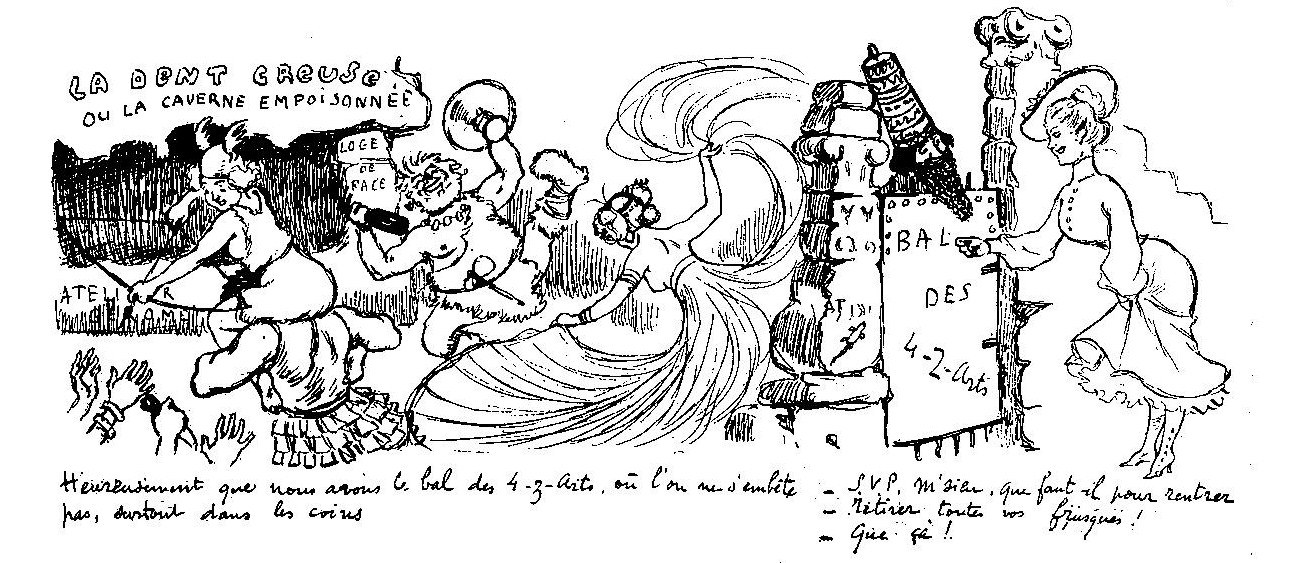
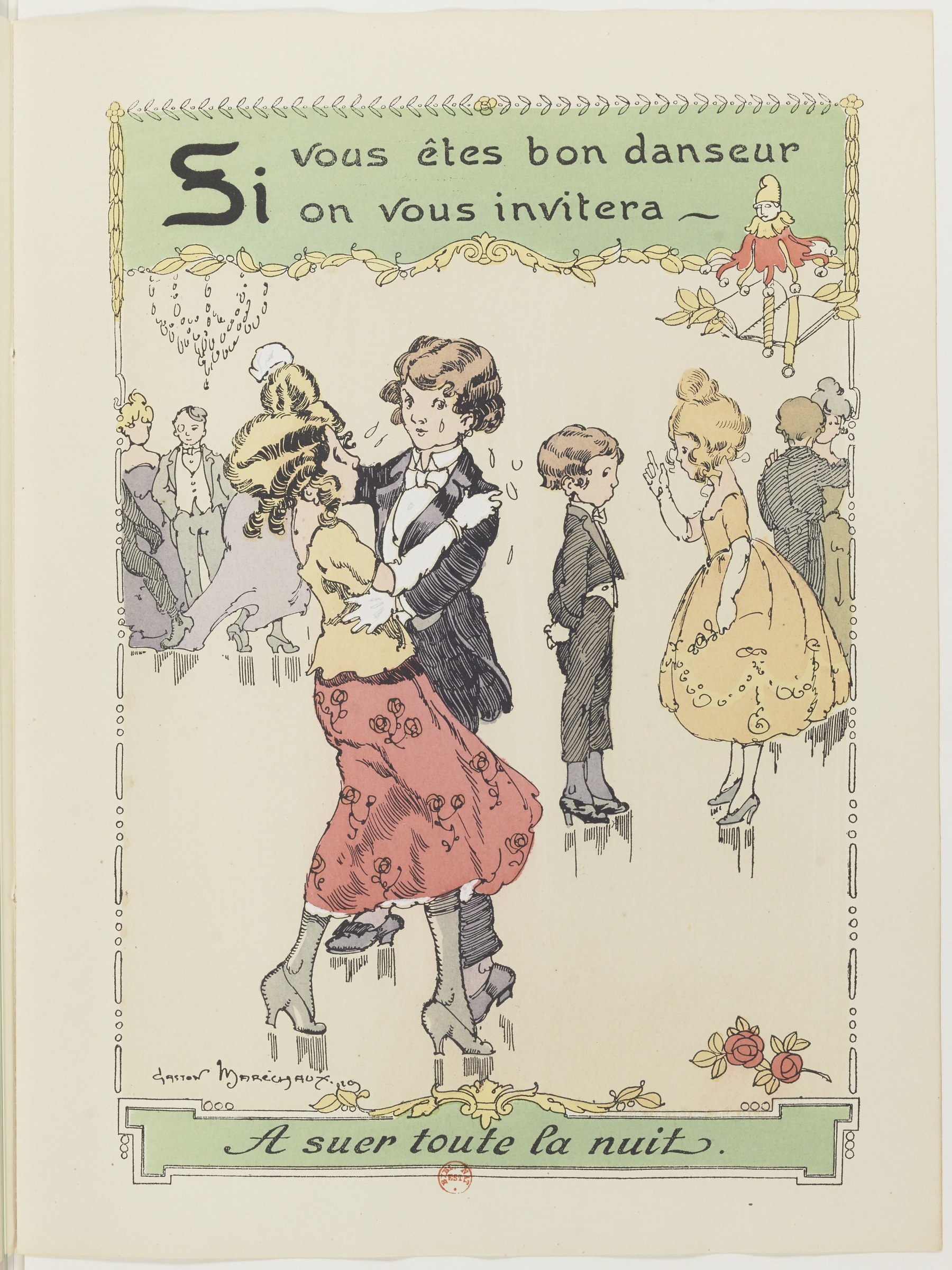
Méfiez-vous du sans cérémonie - dessins de G. Maréchaux - btv1b10508441d (08 of 16)
Maréchaux, Gaston. Illustrateur
- Medium:
- Oil Painting
- Era:
- 1900-1920 (Ragtime/Early Jazz)
- Source:
- Wikimedia Commons
- Rights:
- Public domain — free to use, share and adapt.
- Recorded as:
- Public Domain
This work preserves a disappearing historical record: how ordinary French families danced socially in their homes in the years around World War I. The detail of dress, setting, and bodily comportment offers evidence about social dancing practice outside the ballroom and music hall. For historians of childhood, gender, and social manners, Maréchaux's illustrations provide a rich visual archive that text sources alone cannot convey.
What you are looking at
A colored illustration from a children's book shows a lively domestic dance scene set indoors. In the center, a smartly dressed man in a dark suit and bowler hat holds a small dog and dances with a woman in a red skirt with floral embroidery and a cream-colored blouse. Around them, other figures observe and participate: children in various states of formality, another woman in a cream dress on the right, and shadowy figures in the background. The setting is decorated with hanging garlands and strings of beads or lights that frame the composition, creating a festive atmosphere. The title text reads "Si vous êtes bon danseur / on vous invitera — à suer toute la nuit" (If you are a good dancer / we will invite you — to sweat all night). A woman in red perches on a swing in the upper right, adding to the playful energy. The illustration uses sepia toning with selective color highlights in reds, creams, and yellows.
The dancing
The central male figure demonstrates an informal, exuberant posture: his body leans back slightly as he holds the small dog aloft in one arm while extending his other arm toward his dance partner, who faces him with her body angled in response. Her stance is upright and engaged, her skirt swaying to suggest movement. The figures around them are mostly stationary observers, though their poses suggest they are watching intently or preparing to join. The overall positioning and arm extensions suggest social, playful partnered movement rather than formal technique—the embrace is loose and the bodies are separated rather than in a closed ballroom hold.
The dance depicted
This illustration depicts social dancing in an informal, domestic setting typical of early 20th-century middle-class life. The energetic, playful nature of the movement and the humorous text suggest this is not formal ballroom dance but rather the spontaneous social dancing that would occur at private gatherings or parties. The presence of children, the dog, the swing, and the festive decorations indicate this is a family occasion or children's party where dancing is entertainment. The clothing (day dress, lounge suit, informal hats) and the interior setting support a pre-World War I or immediate postwar date and European—likely French—social context.
How it was made
This is a hand-colored illustration, likely produced as one page from a children's book or instructional work on manners and social behavior. The technique combines ink drawing with selective watercolor or gouache coloring, a common and economical method for color illustration in early 20th-century French publishing. The decorative border and ornamental elements suggest lithographic or letterpress reproduction, allowing for both text and image to be printed together. This method of production indicates a mass audience: children, parents, and etiquette-conscious families in urban and middle-class homes.
About this work
This is a page from "Méfiez-vous du sans cérémonie" (Beware of Informality), a children's or etiquette book illustrated by Gaston Maréchaux around 1919. It captures the informal, playful social dancing that characterized private gatherings in early 20th-century France—not trained dance but the exuberant movement of adults and children enjoying themselves at home. The illustration celebrates the joy and social function of dance while the title humorously warns against excessive informality. As a record of what ordinary people actually did when they danced together, rather than what professionals did on stage, it documents a form of social behavior largely absent from fine art but central to how most people experienced dance.
How to look at it
Look first at the central pair and the man's posture: his body is pitched backward, off-balance, his arm extended almost jauntily—this is not the controlled frame of a trained ballroom dancer but the spontaneous energy of someone enjoying movement without self-consciousness. Notice too that he dances while holding a dog, which signals the informality and playfulness of the occasion. The decorative frame of garlands and hanging ornaments emphasizes that this is a private, domestic moment, not a public performance. The title's warning becomes ironic: the illustration celebrates exactly the kind of unselfconscious, 'informal' joy that the cautionary text pretends to deplore.
The artist
Gaston Maréchaux was a French illustrator active in the early 20th century, specializing in satirical and instructional drawings for children's books and periodicals. His work is characterized by witty, observant line drawing combined with selective hand coloring, aimed at both humor and moral instruction. He worked within the French tradition of the illustrated children's book as a tool for teaching social behavior and etiquette to the rising middle class.
The period
In the years around 1919, social dancing in Europe was undergoing rapid change. The prewar ballroom dances (waltz, foxtrot, tango) were being codified into competitive forms, while at the same time, jazz, ragtime, and looser social dances were arriving from America and causing anxiety among traditionalists about decorum and 'informality.' Children's books and etiquette manuals of this period frequently used dance as a metaphor for proper social behavior—dancing 'well' meant both physical grace and social propriety. The text's joke about 'sweating all night' reflects anxieties about the physical exertion and loss of restraint that modern dance was seen to encourage, especially among young people.
Where it lives
This image is page 8 of a 16-page illustrated work published by Ch. Ramel & Cie, a Paris publisher, circa 1919. It was sourced from Wikimedia Commons and appears to be part of a digitized collection of French children's literature and etiquette books from the early 20th century.
Questions about this work
Is this a real dance, or just people moving around?
It is social dancing—the spontaneous, playful movement that ordinary people did at parties and family gatherings, not a named dance form with codified steps. For most people, this was what 'dancing' meant. The artist has captured the informality and joy of it, which is precisely what the book's title is joking about: the impropriety of dancing without proper restraint.
Why did people worry about dancing being 'informal' in 1919?
After World War I, new dances from America—jazz dances, ragtime steps—were spreading through Europe and were seen by traditionalists as loose, immoral, and a threat to proper behavior, especially among young women. Children's books and etiquette manuals tried to warn against excessive informality in dance and dress. This book seems to do both while actually celebrating the very informality it warns against.
Who is the artist, and what was he known for?
Gaston Maréchaux was a French illustrator specializing in satirical, witty drawings for children's books. His style combined precise ink drawing with selective hand coloring and was aimed at teaching middle-class children about manners and social behavior. His work survives mainly in these instructional books, which are now valuable historical records of early 20th-century French life and attitudes.
More dance artwork