49 works in this view — arrow keys or swipe to move between them.
Dance in Art · 1847
Ravensburg Fastnacht 1847 Tanzmusik
Unknown
- Medium:
- Oil Painting
- Era:
- Mid 1800s (Polka Era)
- Source:
- Wikimedia Commons
- Rights:
- Public domain — free to use, share and adapt.
- Recorded as:
- Public Domain
This work is vital evidence for understanding where and how ordinary Europeans danced in the mid-19th century—not in concert halls or formal ballrooms, but in taverns, announced through newspapers, during seasonal festivals. The reuse of the same woodcut image across years suggests it became a cultural shorthand for Carnival dance, making it a primary source for the visual language and social status of popular dance in this period.
What you are looking at
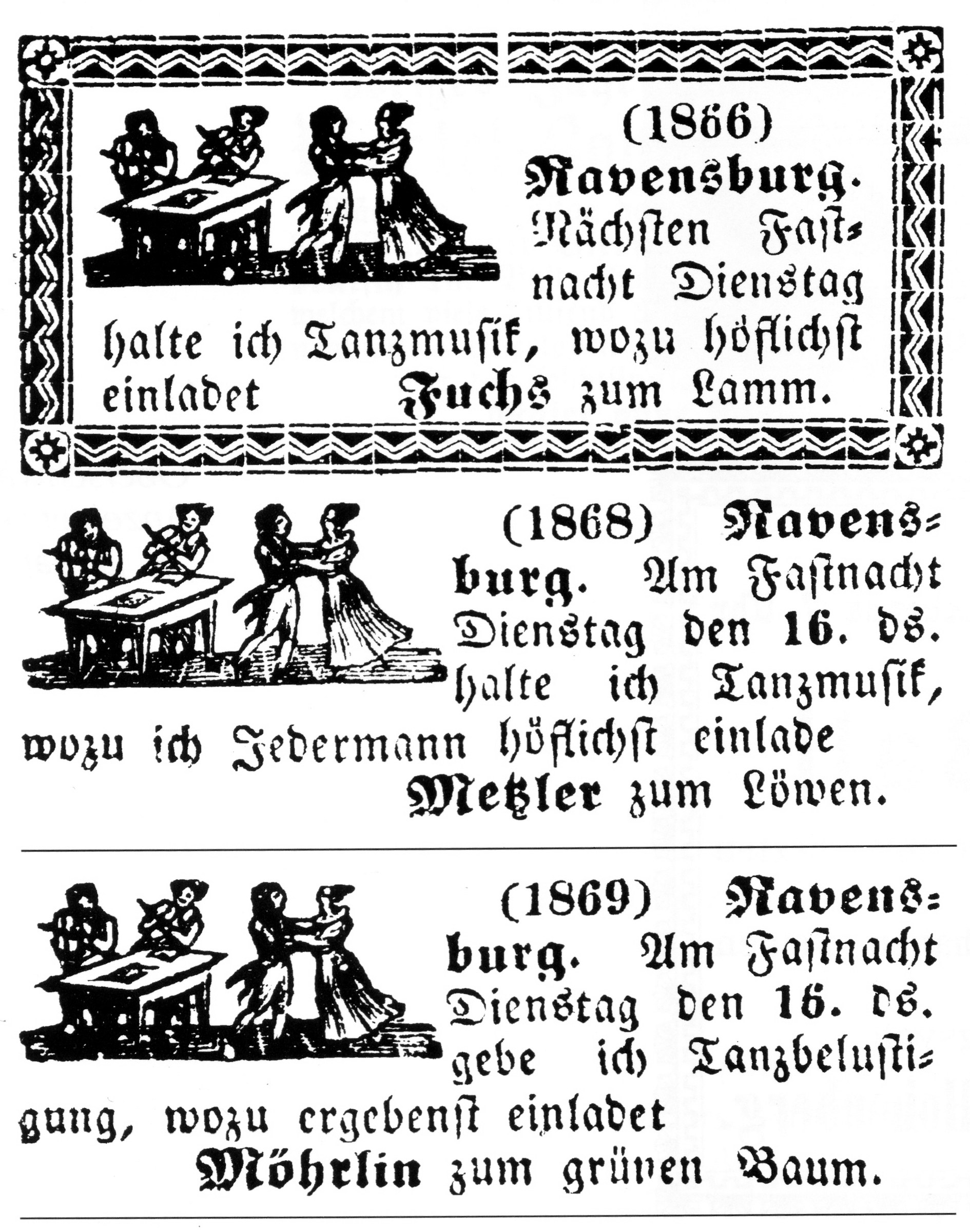
This is not a single artwork but three consecutive newspaper announcements from the Ravensburger Intelligenzblatt (Ravensburg Intelligence newspaper) spanning 1866–1869, printed in German Fraktur typeface. Each entry is framed by identical decorative borders and paired with the same woodcut illustration: a domestic scene showing three figures at leisure. The left side depicts two figures at a table (one playing cards or a game, another observing); the right shows a couple in an embrace or dance pose, the woman's full skirt billowing. The three text entries announce dance music events (Tanzmusik) held in local taverns (Gasthäuser) on consecutive Fastnacht (Carnival) Tuesdays. The 1866 entry invites readers to a dance with music at a location called "zum Lamm" (at the Lamb); the 1868 entry mentions a specific date (16 February) and a tavern keeper named Sebermann at "zum Löwen" (at the Lion); the 1869 entry again specifies the 16th and invites patrons to a "Tanzbelustigung" (dance entertainment) at "zum grünen Baum" (at the Green Tree). The repetition across three years suggests these were recurring seasonal social events advertised through the local press.
The dancing
The woodcut shows loose, informal postures rather than precise dance technique. The couple on the right stands in a relaxed embrace with the woman's body angled away from the viewer, her skirt gathered and lifted as if in motion; the man's arm circles her back. Neither figure displays the rigid posture, turned-out legs, or formal frame characteristic of ballroom technique. Their weight appears distributed casually, and the overall impression is of spontaneous, convivial movement rather than codified steps. The card-players on the left sit at ease, grounding the scene in domestic sociability rather than theatrical performance.
The dance depicted
These announcements document social dance in 19th-century German provincial taverns during Carnival season—a time when formal restrictions on public entertainment were traditionally relaxed. The dance being advertised is most likely the waltz or a regional variant (Ländler or Laendler), which dominated Carnival balls and tavern dances across German-speaking Europe in the 1860s. The informal posture of the couple, the tavern setting, and the seasonal timing all point to folk or popular social dance rather than stage dance. The inclusion of "Tanzmusik" (dance music) as the draw suggests that live music—likely a small band—was essential to the event's appeal, and that the dance itself was participatory rather than presentational.
How it was made
This is a printed document—a newspaper clipping or broadside—not an oil painting as the catalogue claims. The repeated woodcut illustration was a commercial printing technique that allowed identical images to be reprinted across multiple announcements with minimal cost, making it ideal for repeated seasonal advertising. The woodcut's linear, high-contrast style was standard for newspaper illustration in the 1860s and conveyed the scene quickly and legibly to readers. The fact that the same image was reused across three consecutive years suggests either that the announcements were templated by the printer or that the image had become a recognizable symbol for Carnival dance events in that community. This is a primary source document for the social history of dance, not a fine art object.
About this work
This is a series of three newspaper advertisements from a mid-19th-century German provincial town, announcing Carnival dance events. Each entry is identical in structure: a printed notice in Fraktur script, framed by decorative borders, paired with a small woodcut showing a couple dancing and others at leisure. The advertisements name specific taverns, dates, and sometimes hosts, making them valuable evidence for how and where ordinary people danced during Carnival season in the 1860s. They show that dance was a commercialized, publicized social event—worth paying to announce in the newspaper—and that it was tied to specific taverns and seasonal moments rather than formal public balls.
What makes this work significant for dance history is not artistic skill but social documentation. These are not representations of dance created for aesthetic contemplation; they are functional documents that shaped how people found and attended dances. They record that Carnival dance in small German towns was a tavern-based, musically accompanied, couple-centered practice, and that it was frequent enough (recurring annually) and appealing enough to justify newspaper advertising. The three-year span shows institutional continuity—the same taverns, the same season, the same visual language—suggesting that these events were embedded in local culture.
How to look at it
Read the date and tavern name carefully in each entry—they show that different establishments competed for dance patronage in the same town, and that Carnival dance was predictable and recurring enough to plan for. Notice that the woodcut is identical in all three, suggesting it was a stock image the printer used for all Carnival dance announcements. The casual posture of the couple in the woodcut contrasts with the formal, upright frame that would define ballroom waltz by the end of the century; this is a record of how dance looked in everyday tavern contexts, not in formal instruction or stage performance. The presence of card-players in the same image reminds us that these events mixed different kinds of sociability—not everyone came to dance, and those who did took breaks to drink and socialize.
The period
The 1860s saw the waltz and its regional variants (Ländler, Deutsche) at the height of their popularity across German-speaking Europe. Carnival season (the weeks before Lent) was traditionally a time of licensed festivity when sumptuary laws were relaxed and public entertainment flourished. In small towns, this took the form of tavern dances rather than grand balls; advertising these events in the local newspaper was a practical way to attract patrons. The mid-19th-century rise of commercial printing and local newspapers meant that leisure events could be publicized to a wider audience than word-of-mouth alone would reach. These advertisements show that even in provincial towns, dance was becoming a commodified, publicized social practice—people paid to enter these events and venues paid to advertise them.
Where it lives
These advertisements appear in the Ravensburger Intelligenzblatt, a local newspaper published in Ravensburg (Ravensbürg), a small town in the Württemberg region of southern Germany. The source records indicate these images derive from Wikimedia Commons; the catalogue record describes them as a single work but they are in fact three separate dated entries from consecutive Carnival seasons. The original material would be held in the archives of Ravensburg or in regional newspaper collections.
Dance in this work
Questions about this work
Why are all three entries shown together?
The catalogue record treats them as a single work, likely because they were acquired or digitized together and appear on the same page of documentation. They are in fact three separate advertisements from different years (1866, 1868, 1869), but showing them together reveals a pattern: the same visual formula was reused annually to advertise Carnival dance events in different taverns.
What is Fastnacht and why does it matter for dance?
Fastnacht (Carnival) was the period before Lenten fasting when most Christian communities traditionally relaxed social restrictions and permitted public festivity and entertainment. It was the main season for public dancing in early modern and 19th-century Europe. These announcements show that even in the industrial 19th century, Carnival remained the primary occasion for publicized tavern dances.
What does 'Tanzmusik' mean and why is it the headline?
Tanzmusik means 'dance music.' The fact that it is the primary attraction advertised (rather than, say, the name of the tavern keeper or the quality of refreshments) tells us that live music was essential—these were not silent social gatherings but music-dependent events where a band or musicians would play.
Is this a painting?
No. The catalogue record is incorrect. This is a printed newspaper document with a woodcut illustration, repeated across three separate annual announcements. It is a primary source for social history and popular culture, not a fine art object.
More dance artwork