25 works in this view — arrow keys or swipe to move between them.
Dance in Art · 1915
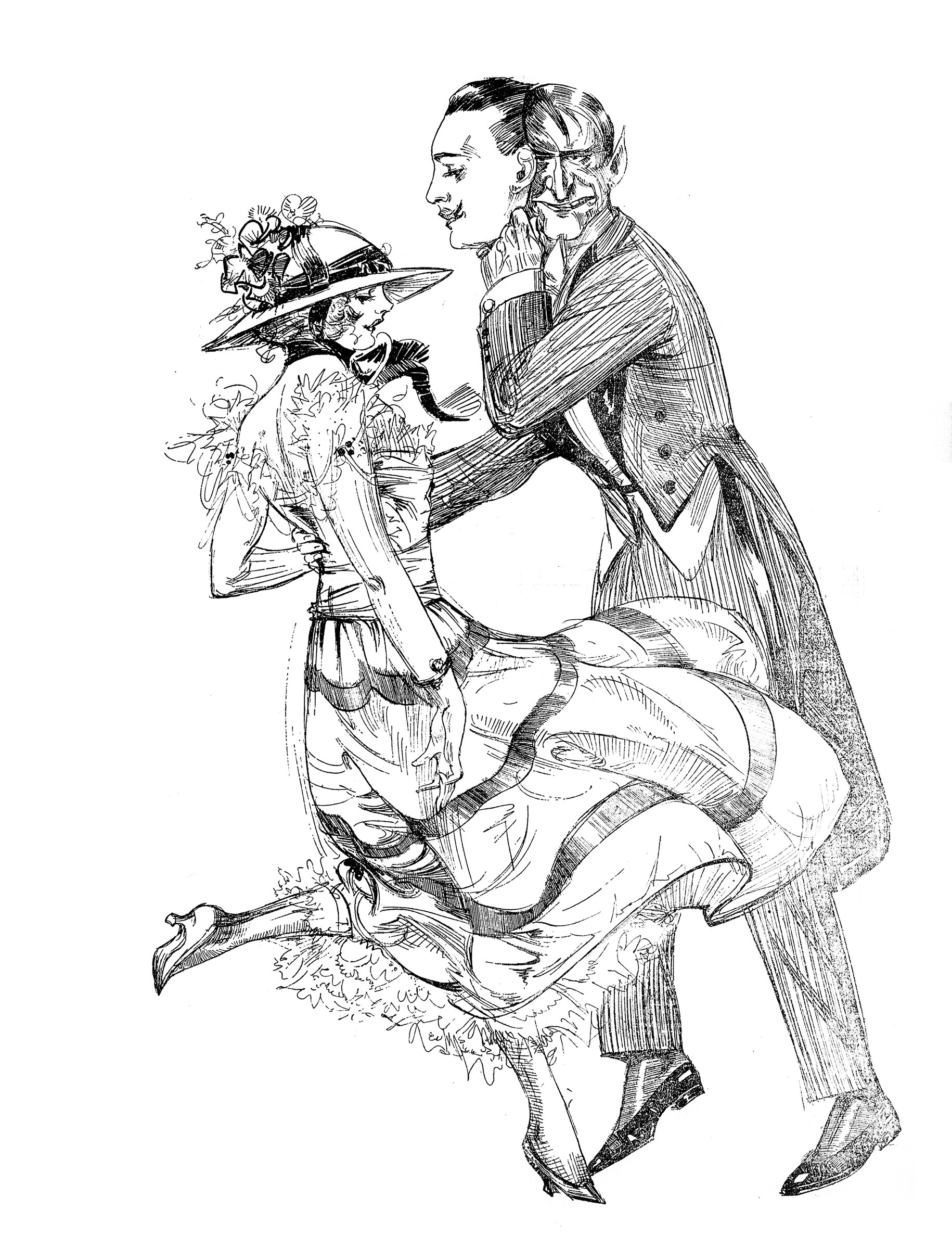
The new "social gangsters" who prey upon the rich and silly women with whom they dance
Unknown
- Medium:
- Ink
- Dance:
- Tango
- Era:
- 1900-1920 (Ragtime/Early Jazz)
- Source:
- Wikimedia Commons
- Rights:
- Public domain — free to use, share and adapt.
- Recorded as:
- Public Domain
The image is evidence of the moral panic surrounding tango in the 1910s and the gendered anxieties it provoked. It shows us not how dancers themselves understood tango, but how journalists and illustrators characterized it as dangerous, seductive, and a vehicle for social predation. The dramatic exaggeration of the dip—the woman's almost helpless surrender—reflects anxieties about women's autonomy and the dance's association with sexual transgression.
What you are looking at
A man in a dark formal suit dances with a woman in an ornate, patterned dress and elaborate wide-brimmed hat trimmed with flowers. The couple is captured mid-movement, the woman's body tilted sharply backward in a dramatic pose with her leg extended, her skirts billowing. The man leans forward and to the side, his arm supporting her, his posture displaying the characteristic frame of ballroom dance. The sketch is rendered in bold black ink with energetic, gestural linework that suggests rapid movement and the liveliness of the moment. There is no background or setting; the figures float in white space, allowing full focus on the interaction between the dancers and the theatricality of their pose.
The dancing
The couple is in a closed ballroom hold, but the frame is highly exaggerated and theatrical. The woman's body is deeply arched backward—almost horizontal—with one leg extended upward, suggesting the man is supporting her full weight in a dramatic dip or turn. The man's posture is forward-leaning and commanding; his upper body drives the movement. Both figures are in profile or three-quarter view. The woman's arm position is not fully clear due to the sketch technique, but the overall composition emphasizes asymmetry and a moment of suspended, almost precarious balance. This is ballroom dancing pushed toward spectacle.
The dance depicted
This is social ballroom dancing, almost certainly the tango, which the catalogue identifies and which fits both the formal dress and the dramatic, close frame characteristic of tango in this period. The exaggerated dip and the sharp backward arch of the woman's body are signature theatrical moments in tango performance, particularly as the dance was practiced and portrayed in American and European high society in the 1910s. The tango was exotic and transgressive in this era, and the artist has chosen to capture it at its most visually extreme moment—the point of greatest vulnerability and display. The sketch style emphasizes the drama and energy, capturing not a static pose but a moment of active propulsion and suspension.
How it was made
This is a pen-and-ink sketch, likely produced for journalistic or satirical publication. The bold, confident linework and the absence of shading or background are characteristic of early 20th-century commercial illustration. The technique allows rapid rendering of gesture and is well-suited to weekly magazines or illustrated newspapers, where timeliness and clarity were essential. The style suggests this is editorial or satirical commentary rather than fine art; the artist's hand is visible and expressive, capturing movement through line rather than through modeling or color.
About this work
This 1915 sketch depicts a moment from a social tango in the years when the dance was both fashionable and controversial among the wealthy. The artist has captured the dance at its most dramatic—a deep backward dip in which the woman is nearly horizontal and the man bears her full weight. The sketch is accompanied by a sardonic caption warning that such dances provided cover for 'social gangsters' and men of bad character to exploit 'silly women' of wealth and status. The work is as much social commentary as dance documentation: it records not simply how the tango was danced, but how it was perceived and moralized about in the American press.
How to look at it
Attend to the moment the artist chose to freeze: not a moment of balance or control, but a moment of extremity and suspension. The woman is nearly horizontal; her hat and dress are in full disorder; she is wholly dependent on the man's support. This is not how the tango was necessarily danced—the deep theatrical dip exists on a spectrum—but it is how the artist and the publication wanted readers to imagine it: as a loss of the woman's stability and agency. The exaggerated, almost satirical linework reinforces this reading; the sketch style makes the moment seem breathless, vertiginous, almost out of control.
The period
The tango arrived in North America from Argentina around 1911–1912 and was adopted immediately by fashionable society, but with intense resistance from moralists, clergy, and social commentators. Parents feared the close hold, the hip motion, and the sensuality of the dance; newspapers ran exposés and advice columns warning against it. By 1915, when this sketch was published, the tango had become a flashpoint in broader anxieties about modernity, women's freedom, class mixing, and the influence of 'foreign' and non-white cultural forms. The dance was also associated with taxi dancers and dance halls—venues where working-class men could pay to dance with women, creating a commercial and sexual economy that horrified middle-class observers. The caption's invocation of 'social gangsters' reflects this: the fear that the tango provided a plausible social context for men of questionable character to gain access to wealthy, naive, or lonely women.
Where it lives
The work comes from Wikimedia Commons and its precise original publication is not recorded. The style and caption suggest it appeared in an American illustrated newspaper or magazine around 1915, likely one aimed at a middle-class readership.
Dance in this work
Questions about this work
Why does the caption talk about 'gangsters' and crime?
The caption reflects a moral panic of the era: the fear that the tango—with its close hold and sensual movement—provided a social cover for men of bad character to exploit wealthy women. The dance was so controversial that it was used as a symbol of danger and moral degradation. The term 'social gangster' was contemporary slang for a man who used charm, good looks, and fashionable dress to seduce or defraud women of money or virtue.
Is this a realistic representation of the tango?
It is a realistic moment—the deep dip does appear in tango—but exaggerated for effect. The artist has chosen the most dramatic, visually extreme moment to emphasize the dance's perceived danger and the woman's vulnerability. The linework and composition are intentionally theatrical and satirical, not documentary.
What made the tango so controversial?
The tango's close hold, hip motion, and sensuality were seen as sexually suggestive and immoral. It arrived from Argentina and was associated with working-class dance halls and sex work, which made middle-class Americans deeply uncomfortable. It was also a 'foreign' dance from a non-white context, which added to anxieties about cultural contamination and the influence of 'decadent' outsiders on American youth.
More Tango artwork
![[Les noces de trottoir, par les compagnies Tango Sumo et Vendaval. Chalon dans la rue. 2007 / photographies de Joël Verhoustraeten] by Verhoustraeten, Joël (1954-2019). Photographe](https://gallica.bnf.fr/iiif/ark:/12148/bc6p058zgkc/f1/full/800,/0/native.jpg)