40 works in this view — arrow keys or swipe to move between them.
Dance in Art · 1922
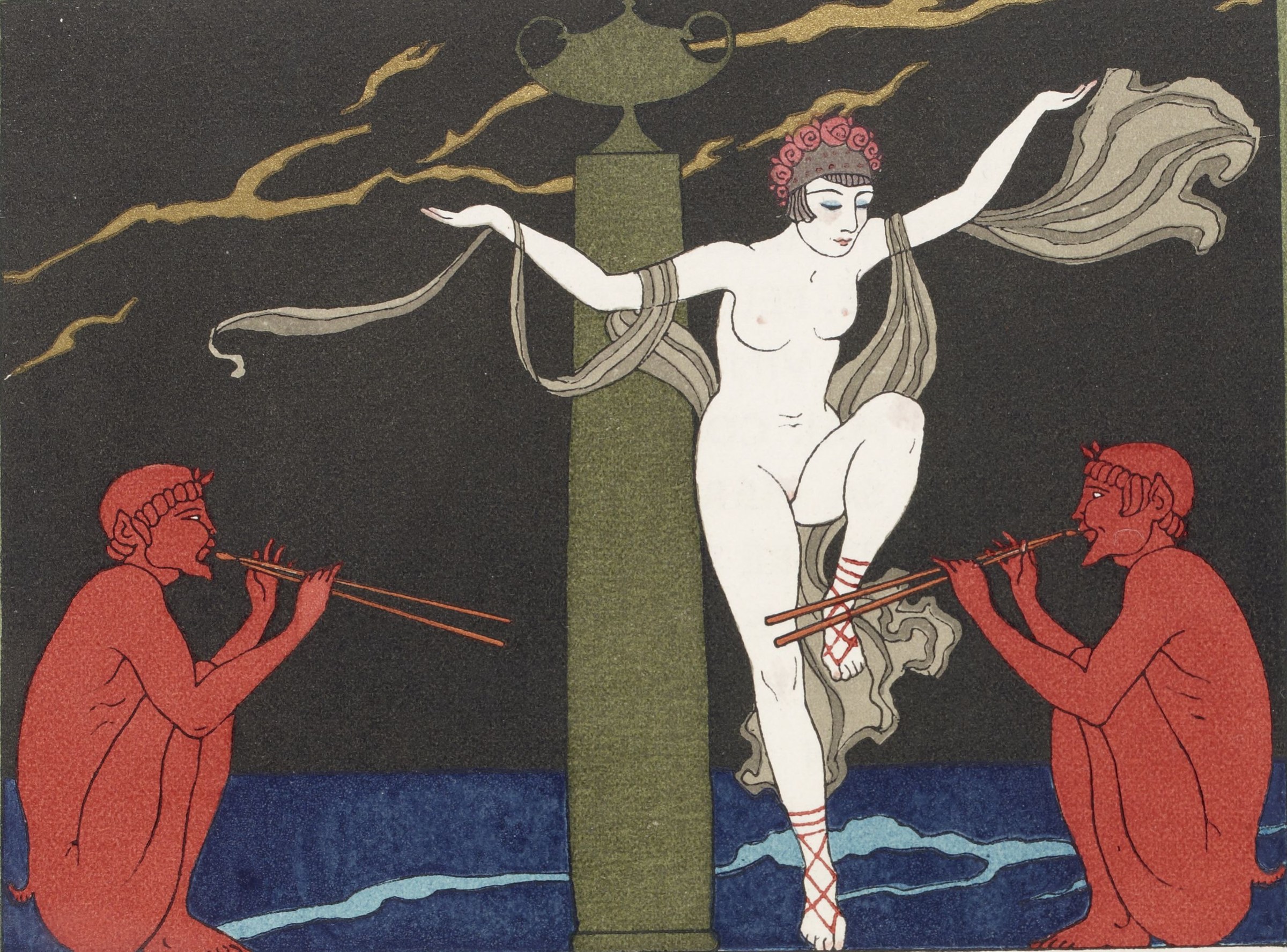
Bilitis (2) par George Barbier
George Barbier
- Medium:
- Oil Painting
- Era:
- 1920-1950 (Swing Era)
- Source:
- Wikimedia Commons
- Rights:
- Public domain — free to use, share and adapt.
- Recorded as:
- Public Domain
Barbier was a celebrated society illustrator and a primary visualizer of the aesthetic ideals of the interwar decades; his work shaped how millions understood elegance, femininity, and artistic fantasy. Though the figure here is not executing a recognized dance technique, the image participates in a critical conversation between dance, fashion, music, and visual art in the early twentieth century—one in which the boundary between the decorative and the genuinely corporeal is deliberately blurred.
What you are looking at
A pale woman with a rose crown stands elevated on a pedestal, her body arched in a languid pose against a dark background. Her pale skin contrasts sharply with the olive-green architectural support beneath her and two crimson-skinned attendant figures on either side, each playing pipes or wind instruments. Flowing drapery in muted tones surrounds her lower body and trails upward in decorative arabesques. The woman's arms extend outward in soft curves; her gaze is downward and inward. Golden decorative branches and a magical lamp float in the upper portion of the scene, while a band of deep blue suggests water or night sky at the base. The entire composition is framed in the delicate, jewel-toned palette and sinuous line-work typical of early twentieth-century art nouveau illustration.
The dancing
The central figure is in a supported, reclining or floating attitude, her weight distributed across the pedestal rather than grounded in her own feet. Her arms are raised and extended softly to the sides, elbows slightly bent, with hands open and expressive but not grasping. Her spine curves in a gentle arch; her head tilts back and to the side. The two smaller attendants flank her symmetrically, standing upright in profile with focused posture, their instruments (possibly syrinx or pipes) raised to their mouths. The composition suggests stasis and reverie rather than locomotion.
The dance depicted
This illustration most closely evokes the aesthetic of orientalist dance fantasy and sensuality prevalent in early twentieth-century French art, particularly the tradition of depicting muses, odalisques, and mythological or literary figures in languorous, contemplative poses. The imagery aligns with theatrical or salon contexts rather than social dance; the figure's costume, the attendants with instruments, and the dreamlike setting suggest a theatrical tableau or a scene from a literary or operatic work. The pose itself—arched, supported, inward-gazing—is more consistent with statuary or posed tableau than with any codified dance technique.
How it was made
The work is recorded as an oil painting, but the technique visible here—flat colour fields, delicate linear contours, decorative patterning, and precise draughtsmanship with minimal modelling—is characteristic of early twentieth-century illustrative art, possibly executed as an illustration for a luxury edition book or art periodical. The restraint of the palette (creams, olives, crimsons, deep blues, gold accents on black) and the graphic treatment of line suggest the influence of Japanese prints and the linearity of art nouveau. This was a technique suited to reproduction and circulation in high-end print media.
About this work
This work is an illustration by George Barbier for Pierre Louÿs' *Chansons de Bilitis* (Songs of Bilitis), a collection of prose poems published between 1894 and 1922. Louÿs' text claimed to be translations of ancient Greek verses attributed to a fictional female poet; the verses are sensual, melancholic, and often erotic. Barbier's illustration captures not a moment of actual dance but a condition of aesthetic surrender and interiority—the figure is attended, supported, and enraptured, existing in a state of dreamy complicity with desire and music. The work belongs to a tradition of art nouveau and art deco illustration that used the female body and orientalist iconography to express modern anxieties about beauty, interiority, and the boundary between art and life.
How to look at it
Attend to the suspension of the figure's weight and the absence of any grounding or effort—she is not dancing but being held, attended, made the object of musical and visual devotion. Notice the symmetry of the composition: the attendants bracket her like supporting architecture, their instruments creating an aural frame. The woman's gaze is averted and inward, denying the viewer direct engagement; she exists in an aesthetic trance. This inward turn was a hallmark of Symbolist and art nouveau representation of the feminine, and it signals a fantasy of interiority and removed sensuality rather than performance or sociability.
The artist
George Barbier (1882–1932) was a French fashion illustrator, designer, and painter best known for his depictions of the Parisian demi-monde, theatrical society, and haute couture during the 1910s and 1920s. He published widely in luxury magazines and illustrated high-end editions of literary classics, including Louÿs' works. His style—elegant, linear, with flat colour and orientalist and art deco influences—made him a defining visual voice of the Roaring Twenties and the interwar aesthetic.
The period
The *Chansons de Bilitis* were among the most fashionable and controversial texts of French Symbolism; Louÿs' sensual, classicizing voice appealed to readers seeking a veneer of antiquity for modern desire. The 1922 edition with Barbier's illustrations appeared in the interwar period, when orientalism and the female body had become central to avant-garde aesthetics, high fashion, and theatrical modernism. Nijinsky, the Ballets Russes, and the visual culture of Diaghilev were reshaping ideas about dance, and Barbier's work sat comfortably within that ecosphere of aesthetic restlessness and sensual experiment, even if his style was more decorative than revolutionary.
Where it lives
The work is documented as an illustration from the 1922 Pierre Courrard edition of the *Chansons de Bilitis*. The image is held in Wikimedia Commons, suggesting it is available in the public domain or under open access terms. It belongs to the category of luxury book illustration and decorative art of the interwar period.
Questions about this work
Is this a dance scene?
It is not a depiction of actual dance, but rather an illustration of a dreamlike, orientalist fantasy informed by aesthetic ideas about movement, music, and the body. The figure is posed and attended rather than actively dancing; the scene captures a state of sensual reverie more akin to sculpture or tableau vivant than to choreographed movement. However, it belongs to a visual culture deeply influenced by contemporary dance and theatrical innovation.
Who is Bilitis?
The *Chansons de Bilitis* are a collection of prose poems by French writer Pierre Louÿs, published in fragments from 1894 onwards and collected in full in 1922. The poems are attributed to a fictional ancient Greek female poet named Bilitis; they are sensual, erotic, and often melancholic, and were highly fashionable among French Symbolist and decadent circles. The 'translation' was a literary hoax, but an elegant and influential one.
What is the significance of the two red figures?
The two attendants with instruments represent both the ancient Greek symposium tradition (music as accompaniment to pleasure and philosophical discourse) and the orientalist fantasy popular in early twentieth-century European art. They are servants or muses to the central figure, whose experience of beauty and desire is the true subject. Their red colour and profile stance emphasize their role as supporting players in a scene of aesthetic consumption.
Why is this in a dance gallery?
Although not a documentation of an actual dance technique, the image participates centrally in the cultural history of dance and the body in the early twentieth century. The interwar period saw a radical reimagining of what dance could be—more abstract, more interior, more allied with fine art and symbolism. Barbier's work illustrates how dance iconography and the aestheticized body influenced broader visual culture, and how boundaries between dance, theatre, sculpture, and fashion were deliberately dissolved.
More dance artwork