49 works in this view — arrow keys or swipe to move between them.
Dance in Art · 1915
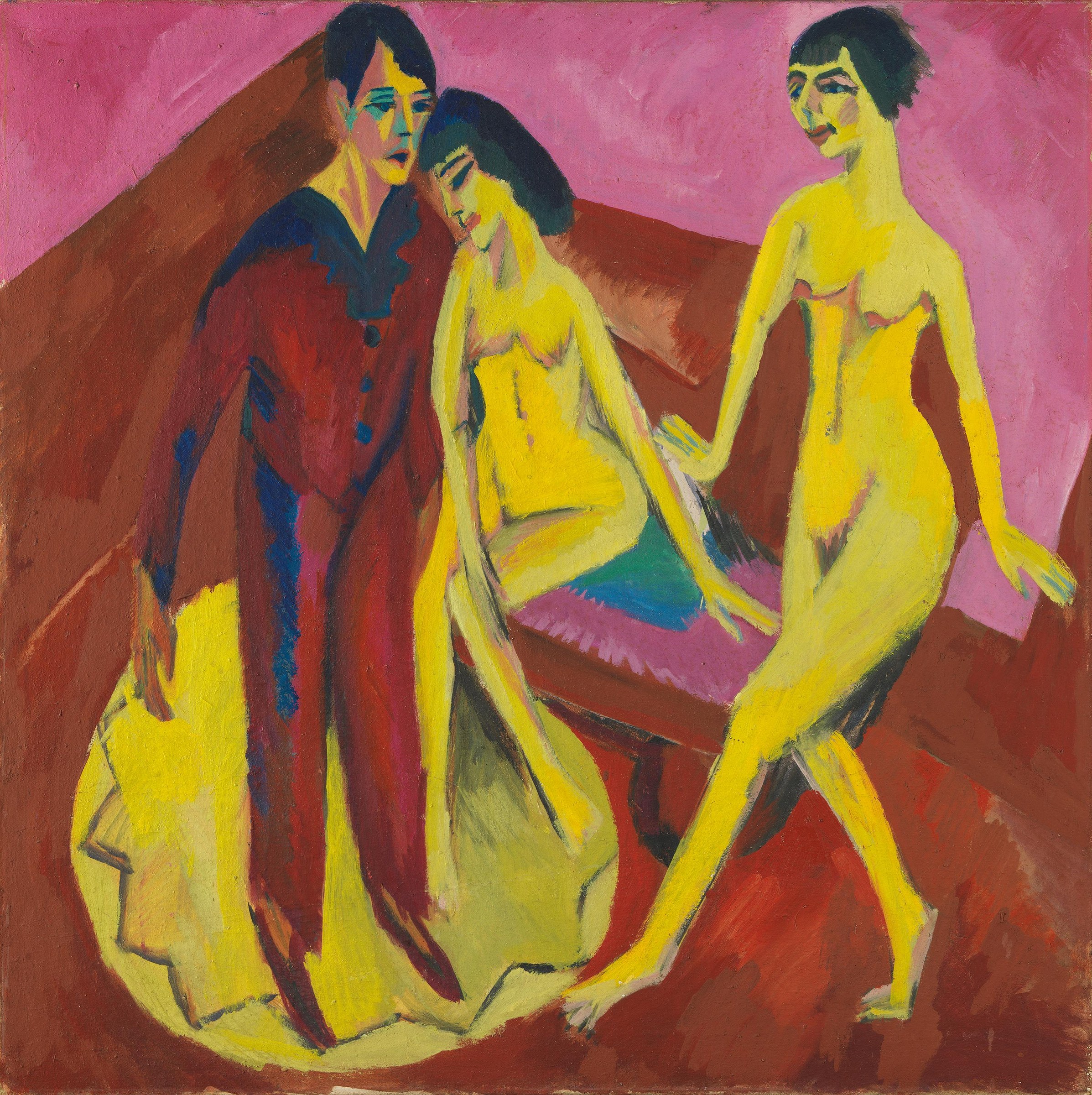
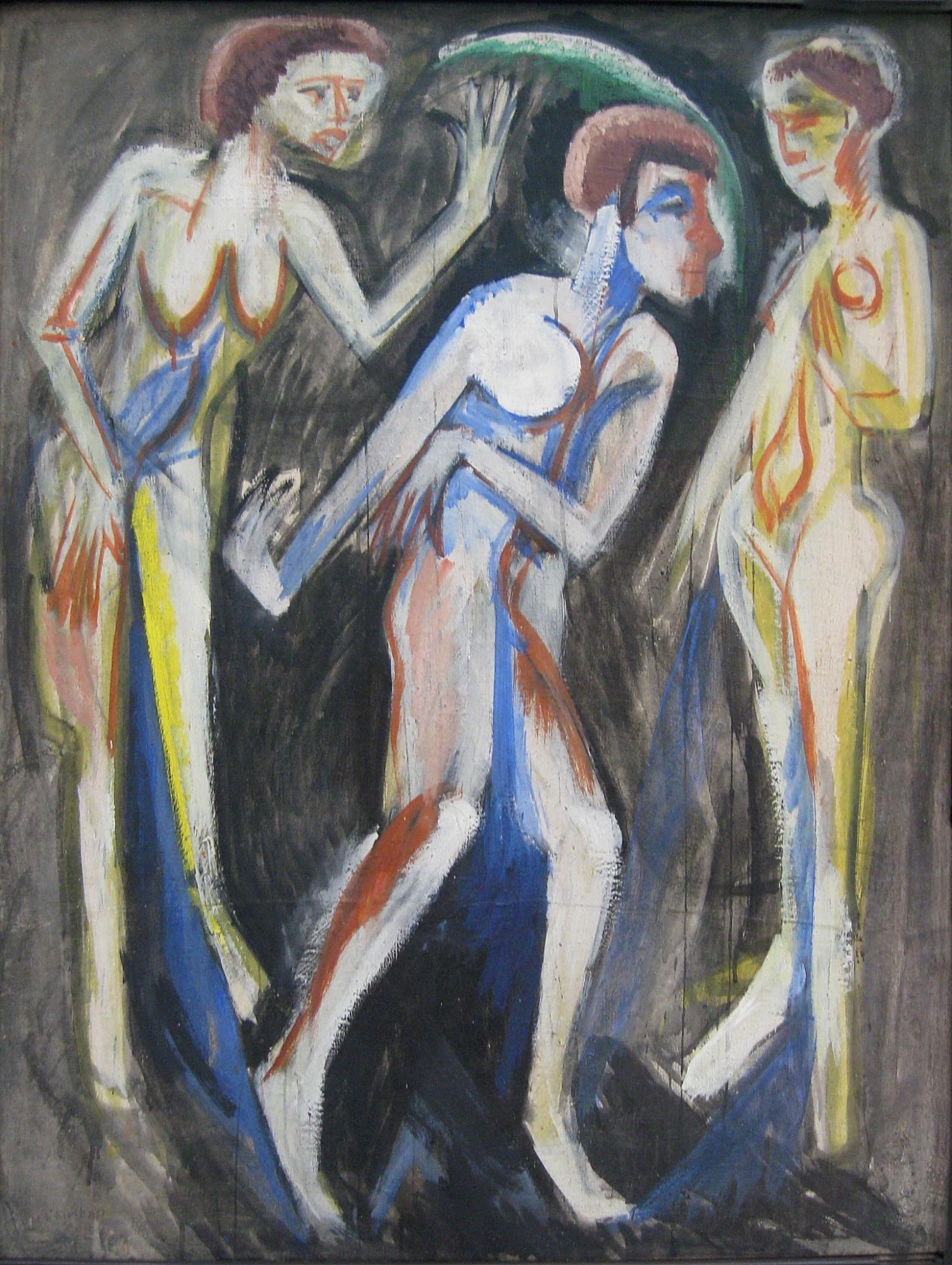
Ernst Ludwig Kirchner Der Tanz zwischen den Frauen 1915-1
Ernst Ludwig Kirchner
- Medium:
- Oil Painting
- Era:
- 1900-1920 (Ragtime/Early Jazz)
- Source:
- Wikimedia Commons
- Rights:
- Public domain — free to use, share and adapt.
- Recorded as:
- Public Domain
This work shows how early 20th-century avant-garde artists engaged with dance and nightlife not as formal movement to be mastered, but as a site of modern experience—anxiety, desire, and social transformation. It represents the moment when dancers and artists were the same people, sharing venues and questioning academic hierarchies of art and movement.
What you are looking at
Five nude or near-nude figures are arranged in a compressed, energetic composition against a dark ground. The central figure, painted in cooler whites and blues, faces forward with an intense expression and raised arms, while four surrounding figures in warmer ochres and reds frame this core figure. The bodies are rendered with visible musculature and anatomical line-work in orange and red, creating an almost dissected appearance. The style is expressionist, with bold, angular contours and a claustrophobic spatial arrangement that suggests intimate proximity rather than ballroom distance. The figures appear to be in movement or arrested mid-gesture, their poses suggesting a moment of social or erotic intensity rather than formal choreography.
The dancing
The figures are predominantly upright or slightly angled, with limbs extended or raised rather than clasped in partnership. The central figure dominates with both arms lifted and a confrontational forward-facing pose. The surrounding figures lean inward, their arms reaching or gesturing toward the center. The rendering emphasizes individual silhouettes rather than coupled holds; there is no closed position or frame evident. The musculature and anatomical striations suggest physical exertion, but the spatial relationships and the title—'Dance Between the Women'—suggest this is about social navigation or desire rather than ballroom technique.
The dance depicted
This does not depict a recognizable ballroom or theatrical dance style. The composition and title suggest an exploration of social or erotic interaction among female figures in a nightclub or cabaret setting. The energetic, crowded arrangement and the expressionist distortion of bodies recall early 20th-century German and Viennese nightlife imagery. The painting may represent modern social dancing—the informal, improvisatory movement of figures in close proximity in a club or dance hall—rather than a codified technique. The absence of formal costume, clear gender pairing, or recognizable frame makes identification of a specific dance style impossible.
How it was made
Oil painting on canvas, executed in the Expressionist manner with bold, linear gesture and vivid color contrasts. The artist has used thick paint and direct, visible brushwork to create an almost sculptural surface. The anatomical rendering—the visible musculature, the orange and red line-work defining the body—suggests the influence of primitive and non-Western art, which was central to German Expressionism. The technique prioritizes emotional intensity and bodily presence over mimetic realism, allowing rapid execution and visible decision-making.
About this work
This is an Expressionist oil painting from the early 20th century depicting a nightclub or cabaret scene with five female figures in close, dynamic proximity. The work belongs to the tradition of modern urban nightlife painting pioneered in Berlin and Vienna, where dance and performance were vehicles for exploring contemporary sexuality, social anxieties, and the liberation and tension of modern life. It is not a document of technique but an emotional and social statement encoded in the body and the crowd.
How to look at it
Attend first to the spatial compression: five bodies in almost no space, the viewer pulled into a crowded, airless moment. Note the intensity of individual faces and the asymmetry of their arrangement—this is not a balanced, formal composition but a psychological snapshot. The central figure's raised arms and confrontational gaze; the surrounding figures' inward lean; the visible musculature and anatomical line-work: all suggest bodies as both objects of desire and signs of exertion and tension. The color—warm ochres and reds against cool whites and the dark ground—creates visual agitation. This is not a frozen dance step but a frozen feeling.
The artist
Ernst Ludwig Kirchner (1880–1938) was a German Expressionist painter and founder of Die Brücke, a movement that sought to bypass academic tradition through direct, emotional, and often violent pictorial language. He was fascinated by Berlin nightlife—cabarets, dance halls, circuses—and painted these subjects repeatedly from 1912 onward. His figures are typically distorted, flattened, and rendered with acidic color; anatomical accuracy is sacrificed for psychological and social impact. Kirchner lived in Berlin during the Weimar period, a time of radical cultural experimentation and social crisis.
The period
This painting was made in 1915, during World War I and amid the ferment of German Expressionism. The nightclub and cabaret were flourishing in Berlin as sites of avant-garde performance, gender experimentation, and social critique. Dance in this period was undergoing radical transformation: Isadora Duncan and the Denishawn school had challenged ballet orthodoxy; early modern dance was emerging; and popular social dance—fox-trot, tango, jazz rhythms—was seen as both liberatory and morally threatening. For Expressionist artists, the nightclub represented modern consciousness itself—fractured, sensual, and politically charged.
Where it lives
This work is known through Wikimedia Commons and may exist in various museum collections. The record indicates it is an oil painting dated 1915.
Questions about this work
Is this a specific dance?
No. This is Expressionist social art, not a document of a dance technique or ballroom form. The painting depicts the experience of nightlife—the crowding, the mixture of desire and tension—rather than choreography. It represents modern social dancing in cabaret or dance-hall settings, which was improvisatory and expressive rather than codified.
Why are the figures nude or semi-nude?
Nudity was a standard convention in early modern art for representing the body in its most fundamental state. For Expressionists, the nude body was also a site of honesty and vulnerability. In the context of cabaret and performance, nudity signaled modernity, sexual freedom, and social transgression.
What does the title 'Dance Between the Women' mean?
The title suggests interaction, possibly erotic or social, among female figures. In the context of Weimar Berlin, it may allude to lesbian and queer culture, which flourished in cabarets and was a subject of both fascination and anxiety in avant-garde art. It may also simply denote the moment when dancers move in relation to one another, without partnership with men.
Why does the artist show the anatomy so clearly?
The visible musculature and line-work create a kind of anatomical honesty and also suggest the influence of African and Oceanic sculpture, which German Expressionists admired. The technique emphasizes the body as a site of knowledge and feeling rather than as a decorative surface.
More dance artwork