49 works in this view — arrow keys or swipe to move between them.
Dance in Art · 1914
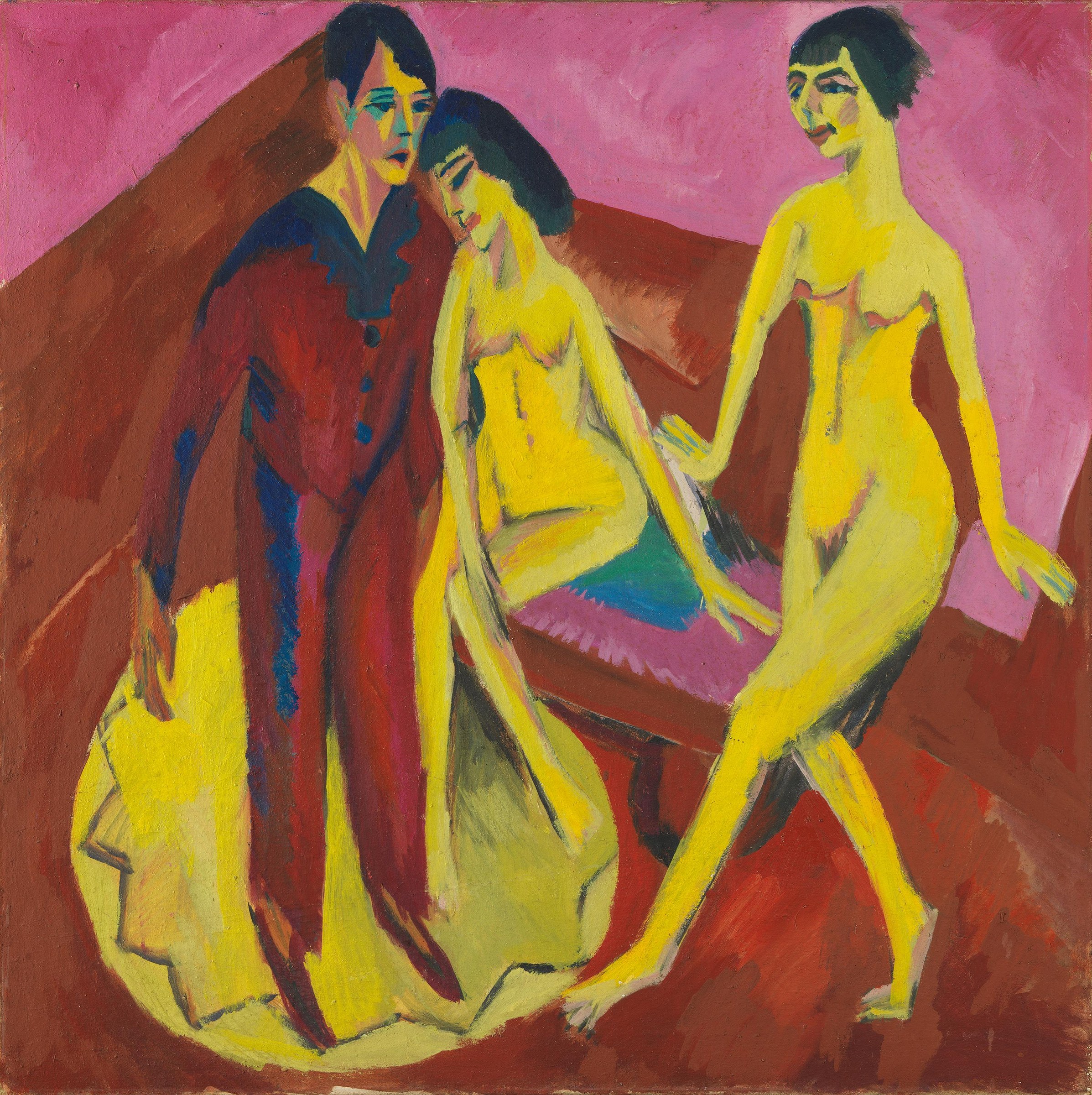
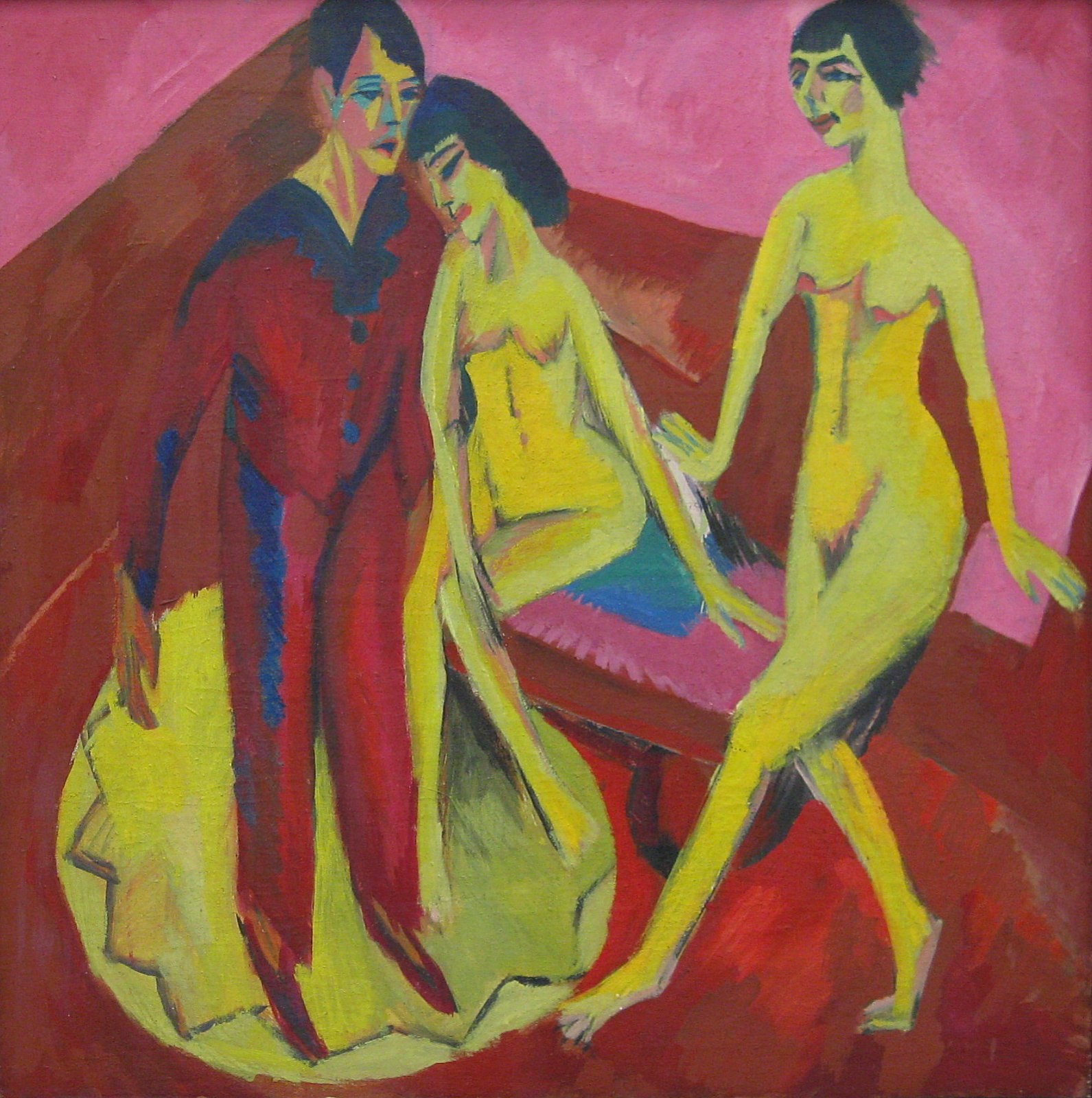
Ernst Ludwig Kirchner Tanzschule 1914-1
Ernst Ludwig Kirchner
- Medium:
- Oil Painting
- Era:
- 1900-1920 (Ragtime/Early Jazz)
- Source:
- Wikimedia Commons
- Rights:
- Public domain — free to use, share and adapt.
- Recorded as:
- Public Domain
This painting documents the emotional and social texture of dance training—vulnerability, authority, exposure—at a moment when Expressionism was making the inner life of modern experience visible. It offers an alternative to idealized or narrative representations of dance, one in which the teaching relationship and the body under scrutiny become the subject itself.
What you are looking at
Three nude or near-nude figures occupy a shallow, compressed space defined by a vivid pink background and deep red-brown floor. The figure at left, dressed in a long red robe with dark blue patterning, leans forward and gestures toward the two central figures with an air of authority or instruction. The two unclothed figures—rendered in acidic yellow—face inward toward each other in attitudes of attention or submission. Their bodies are thin and angular, with dark outlines emphasizing musculature and bone structure. The composition is frontal and planar; the figures do not recede into depth but sit flat against the colored field, creating an almost frieze-like arrangement. The acid yellows and magentas vibrate against one another, producing an unsettling, expressionistic intensity. This is a dance lesson or rehearsal, or possibly a scene of display or judgment.
The dancing
Two slender, unclothed figures in bright yellow occupy the center; both are drawn in sharp, angular contours that emphasize their vulnerability and exposure. Their posture suggests attention rather than motion—they stand or kneel with bodies oriented toward one another and toward the robed figure. The clothed figure at left, by contrast, is solid and contained, his gesture one of address or command, hand raised in a teaching or evaluative pose. The compositional relationship—clothed authority addressing naked pupils—carries implications of power and instruction that structure the whole image.
The dance depicted
This appears to document a dance class or training scenario rather than a finished performance. The two yellow figures show no definite technique or codified movement; instead, their exposure and posture suggest the vulnerability of students under observation. The scene may represent classical ballet instruction, given the formal relationship of teacher to pupil and the nude or near-nude bodies, but the expressionistic style and the absence of any balletic position or turnout make that uncertain. The work is more likely a study of the social and emotional dynamics of dance teaching—exposure, judgment, authority—than a record of any specific dance form.
How it was made
Oil painting, with pigment applied in broad, urgent strokes that prioritize expressive color over naturalistic rendering. The artist works in the Expressionist mode: forms are simplified and distorted for emotional effect, outlines are dark and emphatic, and the palette—especially the clashing magentas and yellows—generates psychological intensity rather than harmony. This technique allows the artist to treat the painting as a vehicle for internal states (anxiety, desire, power, shame) rather than as a document of visible appearance. The method suggests the work is intended for gallery exhibition rather than reproduction or popular circulation.
About this work
Ernst Ludwig Kirchner's *Tanzschule* (Dance School) of 1914 is an oil painting that documents the human dynamics of dance instruction rather than the techniques of dance itself. A robed figure leans forward, addressing two unclothed pupils rendered in acidic yellow against a clashing pink background. The work is constructed in the Expressionist idiom: forms are distorted, outlines darkened, and color used to convey psychological states rather than naturalistic appearance. The composition suggests tension and vulnerability—the pupils exposed, the teacher commanding—and the painting functions as a study of power, authority, and the body under scrutiny in the pedagogical setting.
Created in the early years of German Expressionism, this work belongs to a tradition of dance imagery that emphasizes the social and emotional dimensions of bodily practice. Kirchner uses the dance class as a vehicle for exploring modern anxieties about the body, instruction, and display. The work is neither a celebration of dance technique nor a narrative scene; it is an interrogation of the conditions under which bodies are trained and watched.
How to look at it
Attend first to the relationship established by the composition: the robed figure addresses the two yellow figures, who are turned toward him and toward each other. This triangular arrangement encodes a power structure—instruction, exposure, attention. Notice the palette: the acid yellows of the pupils' bodies, the deep reds and magentas of the ground, the dark outlines. These colors do not describe natural appearance; they are chosen to unsettle and to suggest emotional states—anxiety, intensity, desire. The painting is not documentary; it is interpretive. The pupils are not shown dancing or posing in any recognizable manner; they are shown attending, exposed, vulnerable to the teacher's gaze.
The artist
Ernst Ludwig Kirchner (1880–1938) was a founding member of Die Brücke (The Bridge), the pivotal Expressionist group established in Dresden in 1905. Kirchner's practice centered on the human figure—nudes, street scenes, and portraits—rendered with distorted form and urgent color to convey psychological intensity and modern alienation. He was fascinated by dance and performers, creating numerous studies of cabaret, circus, and theatrical life. His approach to the body was at once modernist (rejecting naturalism) and deeply engaged with questions of desire, vulnerability, and social power. Kirchner's later work was suppressed as "degenerate art" by the Nazi regime; he emigrated to Switzerland, where he remained until his death.
The period
In 1914, German Expressionism was at its peak, having declared war on Academic naturalism and bourgeois aesthetics. The movement embraced distortion, bold color, and emotional extremity as tools for revealing truths about modern consciousness that traditional representation could not capture. Concurrently, modern dance was emerging as a new form: Mary Wigman and others were developing systems of movement based on human emotion and authentic feeling rather on ballet technique. Kirchner's *Tanzschule* sits at the intersection: it applies Expressionist method to a dance-adjacent subject, treating the body in training as a site of psychological and social complexity rather than as a vehicle for abstract or narrative meaning.
Where it lives
The work is documented via Wikimedia Commons. The holding collection and current location are not recorded in the available catalogue.
Questions about this work
Is this a real dance class, or is Kirchner inventing the scene?
The work is a studio painting, not a documentary record. Kirchner distorts and simplifies form to express emotional and social truths rather than to document what he saw. The scene evokes the structure and feeling of a dance class—instruction, exposure, authority—but it is a psychological investigation of those dynamics rather than a naturalistic representation of them.
What kind of dance is being taught here?
The painting does not depict any recognizable dance technique. The pupils show no balletic turnout, no codified position, no specific movement vocabulary. The work is more interested in the social and emotional situation of the dance class—the exposure of the body, the authority of the teacher, the attention of the students—than in any particular style or system of movement.
Why are the pupils painted in yellow and the teacher in red?
The colors are expressive and symbolic rather than naturalistic. The acid yellow isolates and highlights the pupils' bodies, making them appear vulnerable and exposed. The deep red of the teacher's robe asserts his presence and authority. The violent clash between the yellows and the pinks and reds of the background creates an emotional intensity that mirrors the psychological dynamics of the scene—instruction, vulnerability, observation, power.
What does this painting tell us about dance in 1914?
It suggests that for Kirchner and his Expressionist peers, dance was not primarily a technique or a narrative but a site of modern experience—of bodily exposure, instruction, and the complex power relations between teacher and pupil. The painting reflects the broader Expressionist preoccupation with revealing the hidden emotional and psychological content of everyday life, including the life of the body in training.
More dance artwork