49 works in this view — arrow keys or swipe to move between them.
Dance in Art · 1670
Jacob Van Loo - A Bacchanal
Jacob van Loo
- Medium:
- Oil Painting
- Era:
- Pre-1700 (Renaissance/Baroque)
- Source:
- Wikimedia Commons
- Rights:
- Public domain — free to use, share and adapt.
- Recorded as:
- Public Domain
For historians of dance and the body, this work demonstrates how Baroque art used mythological subject matter to imagine, display, and celebrate movement and sensuality outside the bounds of courtly propriety. The painting shows what liberation from formal dance structure could look like in the artistic imagination of the period—how artists envisioned the body moving when freed from the minuet, the courante, or the pavan. It also reveals the gendered and racial politics of that fantasy: the central figures are white, flesh-toned, and feminized, while the attendants and servants are darker-skinned, sidelined, and made ancillary.
What you are looking at
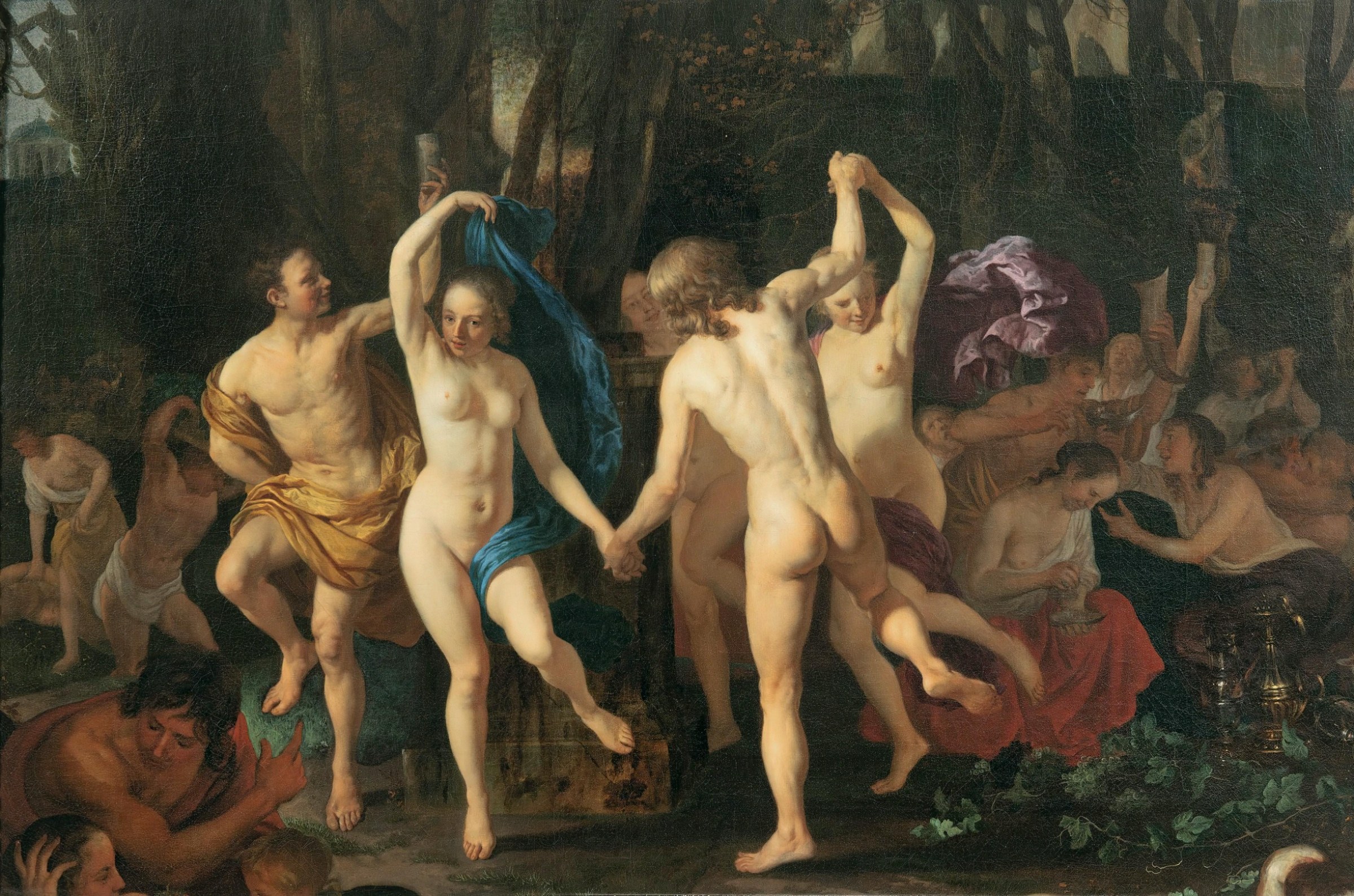
A fleshy, exuberant scene unfolds in a wooded grotto: five nude or seminude female figures occupy the center, their pale bodies arranged in an open group rather than paired couples. They gesture, stretch, and interact with loose physical abandon—arms raised, bodies twisted, weight shifted freely across the space. Around them, darker-skinned attendant figures and putti emerge from the shadows; in the foreground left, a bearded satyr-like figure reclines; to the right, a figure in deep red fabric sits in repose. The setting is a deep forest interior, with massive tree trunks creating a natural arcade overhead and a glimpse of classical architecture visible through the gloom. The light is warm and falls selectively on the pale flesh of the central figures, heightening their visibility and sensuality against the darker surround. The entire composition suggests revelry and abandon—the mythological bacchanal—rather than formal or courtly order.
The dancing
The five female figures occupy varied, asymmetrical positions: one stands with both arms raised to arrange her hair or headdress; another faces away, arms lifted in a mirror pose; a third stands in three-quarter view with weight on one leg and arms at different heights; a fourth stretches with elongated grace; a fifth reclines or sits lower. The spacing is open and lateral rather than closed-hold or partnered; the bodies do not correspond to partnered ballroom alignment. Postures emphasize extension, lift, and individual expressiveness—the quality of bodies displaying themselves or caught mid-reverie—rather than synchronized locomotion or mutual support.
The dance depicted
This is a Bacchanal—a mythological orgy or ecstatic procession in honor of Bacchus (Dionysus), the god of wine, revelry, and theatrical transformation. The bacchanal was a recurring subject in Renaissance and Baroque art as a licence to depict flesh, sensuality, and disorder. Dancing was integral to bacchanalian iconography, though the motion here is better described as revel, display, and pose than as a codified dance: the figures exhibit the freedom and intoxicated fluidity associated with Dionysian rites rather than the measured progression of a courtly or theatrical dance form. The work captures the fantasy of bacchanal—a moment of transgression and release—rather than documenting an actual dance practice.
How it was made
Oil painting on canvas, executed in the Baroque manner with rich impasto and careful sfumato, especially in the treatment of flesh and fabric. The artist has used selective illumination—warm light concentrated on nude or lightly draped bodies against much darker surroundings—to create both visual drama and a sense of nocturnal or cavernous privacy. This was a technique suited to the large-scale mythological narrative paintings that decorated European aristocratic collections and palaces. The scale and technique imply this work was made for an educated elite patron, familiar with classical mythology and the Baroque pictorial tradition.
About this work
Jacob van Loo's Bacchanal is an oil painting of the late Baroque period (1670, according to the record) depicting the mythological orgy in honor of Bacchus. Five nude or seminude female figures occupy a wooded grotto, their bodies arranged in expressive, non-partnered poses that emphasize individual display and sensual abandon over formal dance structure. Attended by satyrs, putti, and draped servants in the shadows, the scene conjures a fantasy of Dionysian license and transgression. The work exemplifies the Baroque fascination with classical mythology as a pretext for depicting the body, movement, and desire outside courtly or moralistic constraint.
This is not documentary evidence of how people actually danced in the 17th century. Rather, it is a painted fantasy—a space where the artistic rendering of the body in motion could evade the formal protocols governing actual social dance. The Bacchanal tradition in Baroque art offered painters a culturally sanctioned way to explore rhythm, posture, sensuality, and the body's expressive potential.
How to look at it
Look first at the asymmetry and openness of the composition: the figures do not form couples or lines, and they do not move in unison. Each body is caught in a different attitude, at a different moment. Notice how the artist has used light to individualize the bodies—each pale form reads as separate, sensual, exposed. Then observe the gesture vocabulary: the raised arms, the twisted torso, the stretched leg, the reclined posture. These are not the restrained hand positions or the low, grounded center of contemporary courtly dance; they are theatrical, exaggerated, and bound up with ideas about intoxication and divine possession. Finally, note the setting and the attendant figures—the satyr, the servants, the putti—who frame the central action and remind the viewer that this scene belongs to myth, not daily life.
The artist
Jacob van Loo (1614–1670) was a Dutch Golden Age painter who worked in Amsterdam and traveled to Paris and Rome. He was known for large-scale historical, mythological, and religious narratives, as well as portraiture. Van Loo was part of a generation of painters who synthesized Italian Baroque dynamism with Northern European attention to light, fabric, and descriptive detail. Bacchanal subjects were popular among wealthy Amsterdam collectors, and van Loo painted several large mythological scenes during his career.
The period
The 1670s were the height of the European Baroque, when aristocratic courts and merchant elites supported a market for large mythological narratives. In France, Louis XIV's court was codifying and performing ballet de cour—formal, courtly dances with strict technique and allegorical themes. The contrast between the rigid geometry of court ballet and the libertine chaos of painted bacchanalian scenes is not accidental; art and dance occupied complementary but distinct spaces. Painted mythological revels offered an imaginative counterpoint to the discipline and order of actual courtly performance. In the Netherlands, independent merchants and civic elites were collecting these grand historical paintings as marks of learning, wealth, and cultural aspiration.
Where it lives
The work is recorded in the catalogue as an oil painting, dated to 1670, with the title 'A Bacchanal.' No current location or collection is recorded in the available information. The image source is cited as Wikimedia Commons.
Questions about this work
Is this painting about an actual dance performed in the 17th century?
No. This is a mythological fantasy based on classical sources about the orgiastic rites of Bacchus. While it shows bodies in motion and gestures that evoke dance, the Bacchanal was an imaginative subject that gave painters permission to explore sensuality and disorder outside the formal structures of real court dances like the minuet or courante. It is better understood as a narrative painting about transgression than as a record of dance practice.
Why are there so many different body positions in one scene?
The artist is emphasizing the chaos and intoxicated freedom of the bacchanal. Unlike formal courtly dances, where all participants move in synchrony, this scene celebrates individual abandon. Each body is caught in a different attitude—stretching, lifting, displaying—to convey the sense of ecstatic disorder and sensual liberation that the subject promised.
Who is depicted dancing, and who is watching?
The five pale female figures in the center are the primary revelers. Around them are darker-skinned attendant figures, satyrs (including a bearded male figure in the foreground), putti (cherubs), and a figure in red fabric. The hierarchical arrangement—central white female figures framed by servants and mythological creatures—reflects the racial and gender politics of Baroque painting and collecting.
What does the setting tell us about this scene?
The wooded grotto with massive trees and glimpses of classical architecture positions the bacchanal in an imagined natural or sacred space, removed from the city and court. Grottos and forests were conventional settings for mythological license in Baroque art. The darkness and enclosure reinforce the sense that this is a transgressive space, a fantasy away from social order.
More dance artwork