49 works in this view — arrow keys or swipe to move between them.
Dance in Art
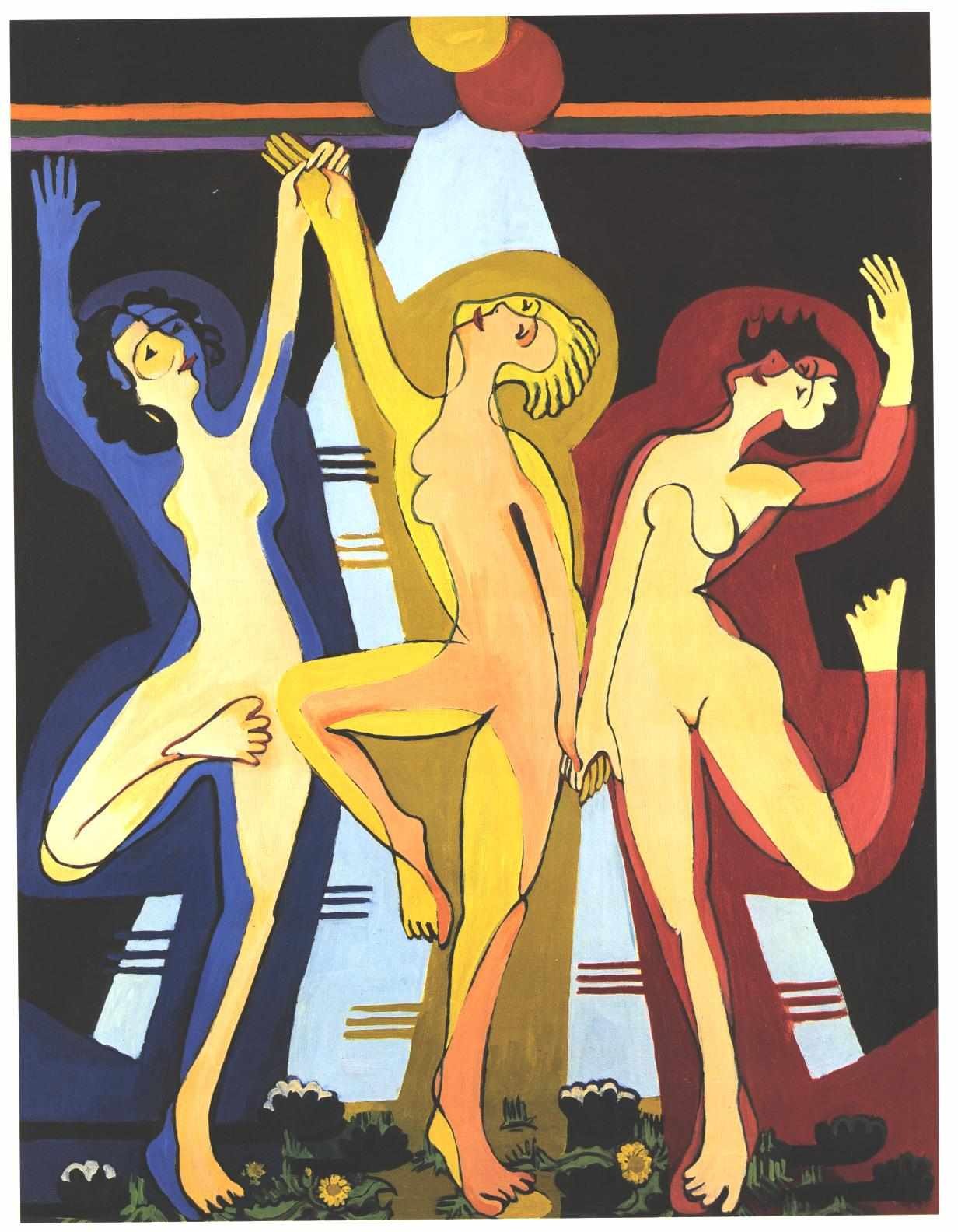
Kirchner - Farbentanz
Ernst Ludwig Kirchner
- Medium:
- Oil Painting
- Source:
- Wikimedia Commons
- Rights:
- Public domain — free to use, share and adapt.
- Recorded as:
- Public Domain
This work documents a crucial moment in early-20th-century art history when European avant-gardes—particularly German Expressionism—identified dance as a primary mode of modernist expression, equal to painting or sculpture. The painting shows how artists of this period understood dance not as entertainment or technique but as a vehicle for expressing the inner life, anticipating decades of contemporary practice that would treat dance as a conceptual and philosophical medium.
What you are looking at
Three nude female figures dance against a dark background, their bodies rendered in pale yellow with bold black outlines. They are positioned in a dynamic triangular composition, each woman in a different pose of joyful movement. The leftmost dancer, silhouetted against a deep blue shape, raises one arm overhead while her body twists. The central figure, the tallest, throws both arms upward in exultant celebration, her head tilted back. The rightmost dancer, framed by a deep red shape, also raises one arm while her body curves. Behind them, three geometric circles—yellow, dark blue, and red—hover like suns or celestial bodies, connected by bold horizontal stripes of orange and purple that divide the composition into registers. At the base, patches of earth with small yellow flowers suggest an outdoor setting. The painting's bold, flattened forms and vivid colour fields are characteristic of German Expressionism.
The dancing
All three dancers are depicted with lifted spines, extended arms, and legs positioned to suggest upward momentum or rotation. Their poses are symmetrical and mirror-like in feeling, suggesting a unified emotional state rather than a structured partner dance. The bodies are simplified to essential gesture—no visible footwork or specific ballroom frame, but rather expressive, uninhibited movement rooted in the torso and arms. The nakedness and freedom of gesture suggest dance as a mode of emotional or spiritual expression rather than social form.
The dance depicted
This appears to depict modern expressionist dance rather than a specific ballroom or folk tradition. The work's title, *Farbentanz* (Colour Dance), emphasises the synthesis of colour, movement, and emotion rather than narrative or technical form. The figures embody the early-20th-century avant-garde preoccupation with dance as a vehicle for psychological liberation and the direct expression of feeling through the body. This aligns with the values of German Expressionist circles, where dance was celebrated as an art form freed from classical rules and social propriety.
How it was made
The work is oil painting on what appears to be canvas or board. Kirchner's technique employs bold, gestural brushwork and flattened picture planes characteristic of Die Brücke (The Bridge), the Expressionist movement he helped found. The bold black contours isolate the figures from their background, creating a woodcut-like effect that amplifies their emotional intensity. The limited, high-saturation palette—yellows, reds, blues, and deep purple-black—was typical of Expressionist practice and serves to heighten rather than naturalize the scene.
About this work
This oil painting depicts three women in ecstatic, uninhibited dance against a symbolic landscape of primary colours and geometric forms. The work exemplifies German Expressionism's embrace of dance as a subject for exploring psychological and emotional truths, released from the constraints of ballroom convention or folk tradition. Kirchner and his peers regarded modern dance—particularly the abstract, body-centred practice pioneered by figures like Mary Wigman—as a visual and spiritual phenomenon worthy of serious artistic attention. The painting synthesises movement, colour, and emotional intensity in a flattened, almost abstract composition that celebrates the body's expressive power.
How to look at it
Notice how Kirchner has frozen the moment at its peak—each dancer suspended at the apex of her gesture, arms extended, bodies open. This is not a snapshot of technique but a capture of emotional release. Observe the colour field behind each figure: the deep blue, red, and yellow are not landscape but emotional atmosphere, a synaesthetic rendering of the dance's psychological effect. The geometric circles overhead function as both light source and symbol of cosmic or transcendent experience. The small flowers at the base anchor the scene in nature while the boldly outlined bodies read almost as abstract shapes, collapsing the boundary between figuration and non-objectivity.
The artist
Ernst Ludwig Kirchner (1880–1938) was a German Expressionist painter and a founding member of Die Brücke in Dresden (1905). His work is characterized by bold colour, distorted forms, and an intense emotional directness. Kirchner was profoundly interested in dance as both subject matter and aesthetic principle; his paintings, prints, and drawings repeatedly depict dancers, performers, and figures in states of movement and psychological intensity. He saw in modern dance a visual analogue to Expressionism's goals of emotional authenticity and the rejection of academic convention. His work was later condemned by the Nazi regime as *Entartete Kunst* (degenerate art).
The period
This painting emerges from the early-20th-century ferment around modern dance in Europe, particularly in Germany and Central Europe. Mary Wigman, Harald Kreutzberg, and other pioneers of *Ausdruckstanz* (expressive dance) were creating new vocabularies of movement freed from ballet's codification and social dance's formality. Simultaneously, Expressionist artists were seeking visual languages that could convey psychological and emotional states beyond representational accuracy. Dance and Expressionism converged as allies in this project: both celebrated the body as a site of authentic emotion and both rejected the aesthetics of restraint or classical beauty in favour of intensity and distortion.
Where it lives
The work is catalogued as an oil painting by Ernst Ludwig Kirchner with an unknown date and unknown current location. It was sourced from Wikimedia Commons, a digital archive of out-of-copyright and freely licensed images.
Dance in this work
Questions about this work
Is this ballet, modern dance, or something else?
It is neither classical ballet nor a specific folk tradition. The work depicts the kind of free, expressive movement that characterized German modern dance (*Ausdruckstanz*) in the 1910s–20s, as pioneered by dancers like Mary Wigman. The title *Farbentanz* (Colour Dance) emphasizes the synthesis of feeling, colour, and bodily movement rather than technical form or narrative.
Why are the figures naked?
Nudity was a deliberate choice in German Expressionist art and modern dance. It signified the stripping away of social convention to reveal authentic, unmediated emotional and bodily truth. Many modern dancers of this period performed barefoot and in minimal costume to emphasize freedom, authenticity, and the body's direct expressiveness.
What do the circles and stripes in the background mean?
They function symbolically rather than literally. The circles suggest celestial or cosmic forces; the horizontal stripes divide the composition into zones of colour. Together, they create a visual equivalent to the dance's emotional intensity—a synaesthetic rendering where colour, form, and movement merge to express psychological or spiritual states.
When was this painted?
The catalogue record does not provide a date. Based on style and subject matter, it likely dates from the 1910s or early 1920s, when Kirchner was most active in Die Brücke and German Expressionism was at its height. A more precise attribution would require direct examination of the work or archival research.
More dance artwork