49 works in this view — arrow keys or swipe to move between them.
Dance in Art · 1899
LOTUS - La Vie
credited only as "LOTUS"
- Medium:
- Oil Painting
- Era:
- Late 1800s (Victorian Ballroom)
- Source:
- Wikimedia Commons
- Rights:
- Public domain — free to use, share and adapt.
- Recorded as:
- Public Domain
This painting shows how Romantic artists used the language of dance and mythological subject matter to depict sensuality and freedom outside the constraints of Victorian social convention. For dance historians, it is a record of what nineteenth-century painters imagined when they imagined dance freed from ballroom propriety—a counterpoint to the era's documented social dances.
What you are looking at
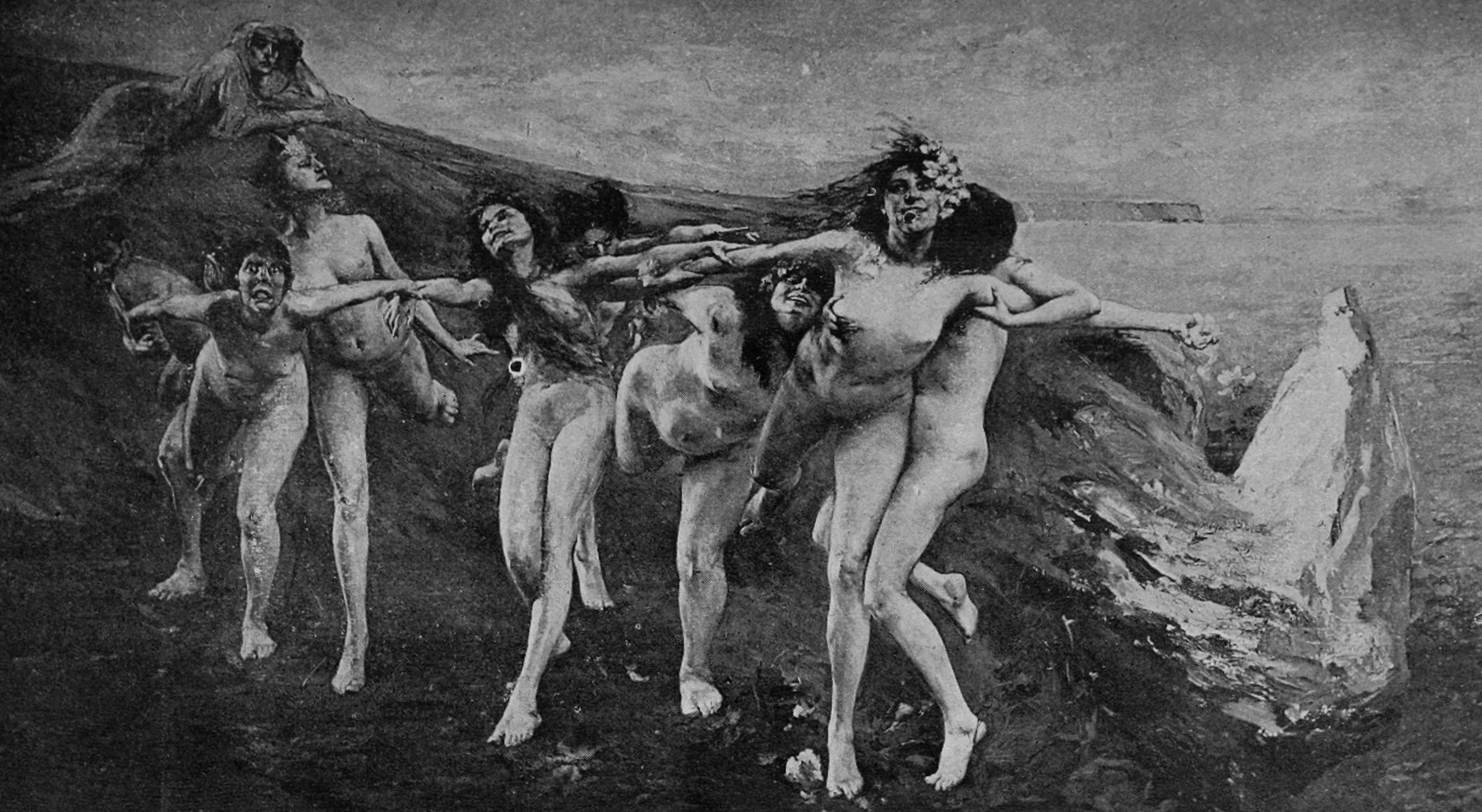
A mythological scene of nymphs or bacchantes in a woodland or seaside setting, painted in dark oils with a Romantic sensibility. Multiple female figures, most unclothed or partially draped, are arranged across the canvas in a diagonal composition that draws the eye from lower left toward the upper right. The foreground shows three to four figures in the immediate plane, their bodies caught in movement; the middle ground recedes into shadowed foliage and what appears to be water or mist. A satyr or mythological male figure emerges from the upper left, watching or participating. The light is cool and diffuse, modeling the pale flesh tones against dark earth and vegetation. The women's poses range from languid to animated—some reach outward, others turn, at least one appears to be in active motion. The overall mood is one of abandon and revelry, whether dance, bathing, or bacchanal play.
The dancing
The bodies are arranged without obvious formal partnering or ballroom frame. The nearest figures show open-limbed, expansive gestures—arms extended or raised, legs in varied positions from standing to stepping. The movement reads as freestyle and ecstatic rather than codified: weight shifts, torsos twist, heads turn. At least six to eight figures are visible, ranging from central and clearly posed to peripheral and half-obscured in shadow. The artist has rendered the musculature and weight distribution with anatomical attention, suggesting bodies in transition rather than static rest.
The dance depicted
This is most likely a vision of Romantic-era mythological revelry—a bacchanal or nymph dance—rather than a specific historical dance form. The painting treats dance or ecstatic movement as an expression of natural, uninhibited pleasure, a Romantic ideal that contrasts sharply with the ballroom dances of the Victorian era to which it is catalogued. No codified hold, frame, or step pattern is evident. The work belongs to a tradition of history painting and academic nudes that appropriates the language of dance to depict mythological license and sensuality. This is movement as metaphor, not documentation of a social or theatrical practice.
How it was made
Oil painting on what appears to be canvas, executed with a loose, painterly technique that favours atmospheric effect over linear clarity. The artist has used glazing and impasto selectively, building luminosity in the flesh tones and creating depth through tonal gradation in the background. The brushwork in the foliage and drapery is summary and expressive. This technique and scale suggest a work intended for exhibition and sale to collectors rather than reproduction or popular circulation, placing it within the tradition of academic salon painting.
About this work
This is a Romantic-era oil painting of a mythological scene—nymphs and a satyr in a state of ecstatic movement or dance in a woodland or aquatic setting. The work exemplifies the academic tradition of using classical and mythological subjects to depict the female form in motion, uninhibited by the social constraints of contemporary dance. It belongs in a gallery of dance in art because the painter has chosen to express the subject through bodily movement and spatial composition, treating dance or ecstatic motion as the vehicle for expressing Romantic ideals of nature, pleasure, and freedom. Yet it also registers the gap between mythological fantasy and the actual dances of the period—this is not a waltz or quadrille, but an imagined, timeless revelry.
How to look at it
Observe the poses and transitions: the artist has not frozen a single moment of static display, but rather suggested continuous motion through the arrangement of overlapping figures and varied arm and leg positions. Notice how the satyr watches from above, creating a narrative layer of desire and transgression. The composition pulls the eye diagonally, as if witnessing a procession or gathering in motion. The shadows and half-obscured figures at the edges suggest that the revelry extends beyond the frame—this is not a contained scene, but a glimpse of an ongoing bacchanal.
The artist
The artist is credited only as "LOTUS," a signature that is not otherwise documented in standard art historical references. The practice of signing work with a single word or pseudonym was not uncommon among academic salon painters of the late nineteenth century, particularly those working in popular or sensational genres. Without further documentation, the artist's identity, training, and exhibition history remain unknown.
The period
In the 1890s, academic salon painting in Europe was dominated by historical, mythological, and allegorical subjects, often with an erotic charge. Romantic Orientalism, classical revival, and the celebration of the female nude were central to the market and to official exhibitions. At the same moment, the social ballroom dances that were also being painted—waltzes, quadrilles, and country dances—were highly regulated by propriety and partner etiquette. The painting reveals the split between the constrained dances of actual Victorian and Gilded Age society and the fantasies of uninhibited movement that salon painting offered to viewers. The symbolism of Bacchus, satyrs, and nymphs allowed artists to depict sensuality that would have been unacceptable in contemporary dress and context.
Where it lives
The work is held in an unrecorded collection and was accessed via Wikimedia Commons, where it is available as a digital image. The original location, exhibition history, and ownership status are not documented in the catalogue record.
Questions about this work
Is this a real dance or a fantasy?
This is a Romantic fantasy of mythological revelry, not a depiction of an actual social or theatrical dance form. The painter has used the language of ecstatic movement and classical mythology to imagine a kind of uninhibited dance that existed outside the Victorian era's ballroom conventions. It tells us more about what nineteenth-century artists and audiences wished dance to be than what people actually danced.
Why are these figures unclothed?
The nudity is justified through classical and mythological subject matter—nymphs, bacchantes, and satyrs are traditional figures in European art. The painting belongs to the academic tradition of history painting, in which classical or mythological settings permitted the representation of the nude body in ways that contemporary costume would not allow. The nudity also serves the Romantic project of the painting: it emphasizes the figures' freedom from social constraint.
What does the satyr represent?
The satyr is a figure of desire, danger, and transgression within classical mythology. His position above and watching the female figures suggests a narrative of seduction or invasion—the intrusion of masculine appetite and wildness into a space of feminine pleasure. The satyr is a common motif in late nineteenth-century academic nudes, often symbolizing the liminal space between civilization and nature, restraint and appetite.
More dance artwork