49 works in this view — arrow keys or swipe to move between them.
Dance in Art · 1914
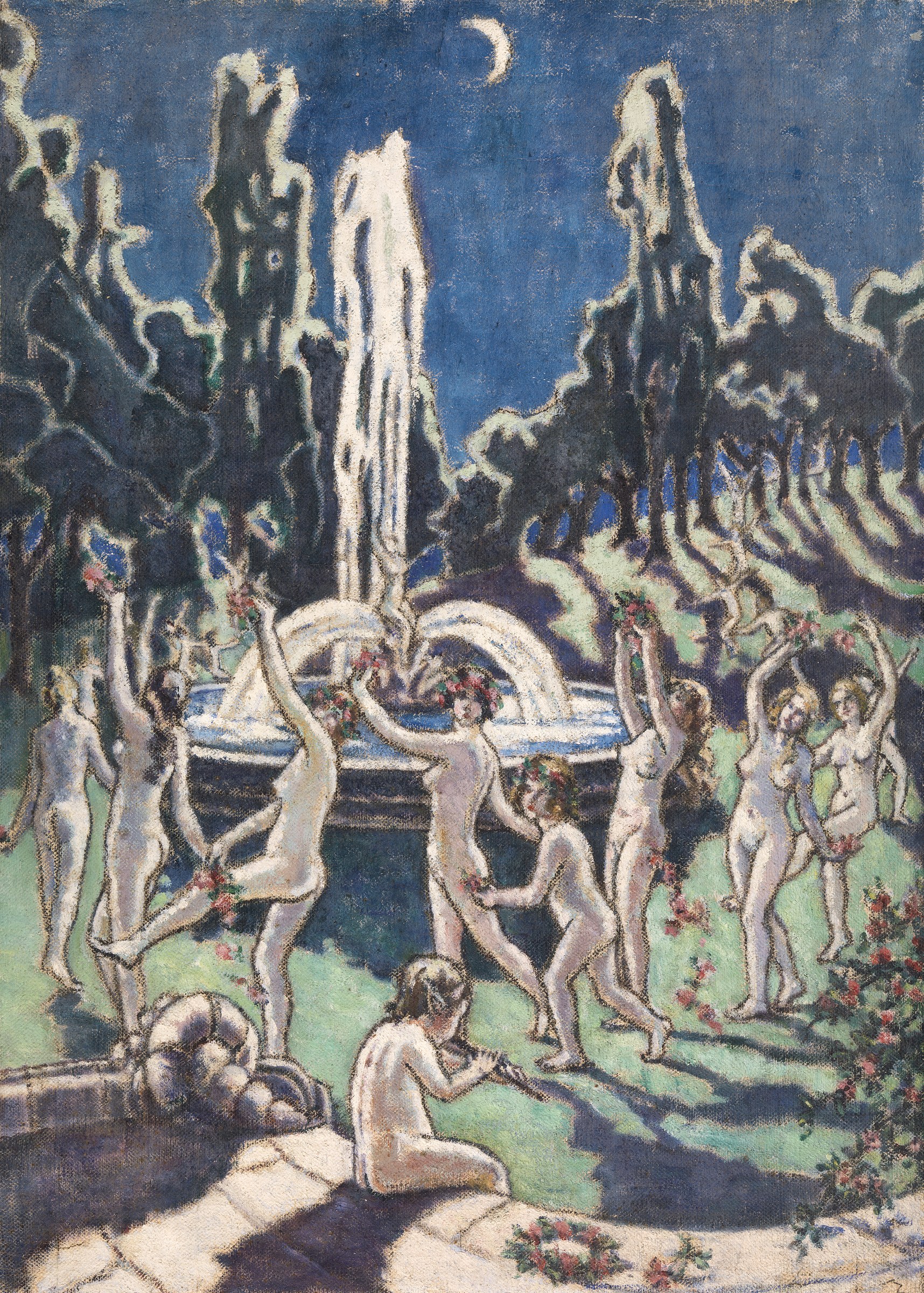
Nudes Dancing round a Fountain by Moonlight P5718
Mainie Harriet Jellett
- Medium:
- Oil Painting
- Era:
- 1900-1920 (Ragtime/Early Jazz)
- Source:
- Wikimedia Commons
- Rights:
- Public domain — free to use, share and adapt.
- Recorded as:
- Public Domain
The painting shows how early twentieth-century visual artists understood dance not as a social or theatrical practice but as a vehicle for visionary or spiritual expression. For dance historians, it documents the aesthetic ideals—freedom of the body, communion with nature, rhythmic collectivity—that motivated the modern dance movements emerging contemporaneously (Graham, Denishawn, Dalcroze). The work reveals a gap between the visual culture and the actual dances of the period.
What you are looking at
A moonlit glade enclosed by tall, pale trees with luminous trunks that rise like columns into a starry blue-black sky. A crescent moon hangs above. In the foreground, a circular pool or fountain reflects the scene. A line of nude or lightly draped figures processes around the pool in a ritualistic formation: some stand with arms raised or extended, others move in varied poses suggesting rotation or spiral motion around the central water. The ground is verdant, dotted with flowering plants rendered in vivid reds and pinks. The figures are pale, almost glowing against the darker vegetation. The composition is symmetrical and ceremonial, with the fountain as the still centre around which the dancers orbit. The palette emphasizes deep blue nocturnal space against cream-coloured bodies and foliage.
The dancing
The bodies are elongated and stylised, rendered in pale cream or white against the surrounding vegetation. Arms are often raised, extended sideways, or positioned in arcs above the head—gestures suggesting celebration or invocation rather than ballroom technique. The figures appear to be arranged in a circular or spiral processional formation, suggesting collective rather than coupled movement. At least twelve to fifteen figures are visible, distributed in depth around the pool. Legs and feet are not rendered with anatomical precision; the bodies have a simplified, almost serpentine quality. There is no sign of ballroom hold or partnership; each figure seems autonomous within the group formation.
The dance depicted
This is not a recognisable ballroom or theatrical dance of the 1910s. The imagery—nude figures, moonlit ritual, circular formation around water, raised arms—suggests pagan, fertility, or neo-classical reverie rather than social or stage dance. The work appears to be a visionary or allegorical composition drawing on Symbolist and Art Nouveau conventions. The lack of costume, the sylvan setting, and the ceremonial procession point to imaginative or spiritual dance rather than a documented social practice. The era label '1900–1920 (Ragtime/Early Jazz)' appears contradictory to the work's actual content and aesthetic.
How it was made
Oil painting, indicated by the handling of light and colour and the soft blending of tones. The artist has used luminous greens and cream tones to create nocturnal atmosphere and the glow of the pale figures. The technique favours simplified, almost decorative forms and flat colour areas—characteristic of Art Nouveau or early Modernism—over illusionistic depth. The brushwork is visible but not gestural; the composition is carefully structured around symmetry and the central pool. This is a work of formal ambition intended for exhibition or salon display.
About this work
This is a visionary painting of nude figures dancing in moonlight around a fountain in an enchanted wood, rendered in the idiom of Art Nouveau and Symbolism. It belongs to a tradition of imaginative art that treated dance as a subject for spiritual or allegorical expression rather than social documentation. The work sits between Symbolist painting (with its moonlit forests and pale nymphs) and early twentieth-century modernism (in its simplified forms and decorative rhythm). Its inclusion in a dance archive rests on the artist's treatment of the human body in motion and collective ritual; it offers a window into how dance—particularly the idea of expressive, non-ballroom movement—was imagined in early modernist art.
How to look at it
Attend to the symmetry and stillness of the central pool, around which all motion is organised. The artist has chosen a moment of suspension rather than action: the figures are poised or turning, but rarely in violent motion. The pale, almost spectral quality of the bodies draws the eye across the composition; they glow against the dark foliage. Notice how the raised and extended arms create a visual rhythm that repeats around the circle—a formal and decorative principle that converts gesture into pattern. The work asks the viewer to read the painting as a unified design, not a snapshot of social dancing.
The artist
Mainie Harriet Jellett (1884–1943) was an Irish painter and pioneer of abstract art. She trained under William Orpen and studied in Paris with André Lhote and Albert Gleizes, becoming one of the earliest Irish modernists. Her work ranged from figurative and symbolic compositions to geometric abstraction. This painting belongs to her pre- or early-abstractionist period, when she was exploring Symbolist and Art Nouveau aesthetics before moving toward Cubist-influenced geometry later in her career.
The period
The painting dates to 1914, on the eve of the First World War, when European art was absorbed in the ideologies of natural movement and spiritual renewal. The Ballets Russes had premiered *L'Après-midi d'un faune* (1912) and was reshaping ideas of expressive dance; Isadora Duncan's influence on visual culture was at its height, promoting the ideal of the free body and ancient Greek models. In the visual arts, Symbolism and Art Nouveau were in their final phase, often retreating into mythological or dreamlike subjects. Jellett's painting sits within that aesthetic while showing the influence of early Modernism—an encounter between Romantic idealism and formal innovation.
Where it lives
The painting is recorded as sourced from Wikimedia Commons. No current holding collection is recorded.
Questions about this work
Is this a real dance or an imaginary one?
It is imaginary. The image shows no actual dance style but rather a visionary composition combining Symbolist mythology (nymphs, moonlit groves, water as sacred space) with modern art's interest in the expressive body. It reflects how artists of the period imagined dance as a form of spiritual expression rather than documenting a specific social or theatrical practice.
Why does the catalogue say 'Ragtime/Early Jazz' when this doesn't look like that at all?
The era label appears to be a chronological default rather than a description of the work's content or style. The painting's subject matter—mythological nudes and ritual—has nothing to do with Ragtime or Jazz. This is a mismatch between the work and its classification in the record.
What is the connection to modern dance?
The ideals the painting expresses—freedom from ballroom constraints, communion with nature, the body as a vehicle for inner states—were central to the modern dance movement emerging at the same moment. However, the work itself is a painter's vision, not a document of modern dance practice. It shows how those ideals circulated in visual culture.
More dance artwork