49 works in this view — arrow keys or swipe to move between them.
Dance in Art · 1898
MET LC-JIB 128 a c a 006
Kōgyo Tsukioka
- Medium:
- Oil Painting
- Era:
- Late 1800s (Victorian Ballroom)
- Source:
- Wikimedia Commons
- Rights:
- Public domain — free to use, share and adapt.
- Recorded as:
- CC0
The work records a moment in late-19th-century Japanese visual culture when traditional theatrical characters and costumes were being documented and circulated to audiences beyond the theatre itself. It raises questions about how we define and archive dance—whether static costume and character records belong in dance history, and what such images tell us about how performers were perceived and valued.
What you are looking at
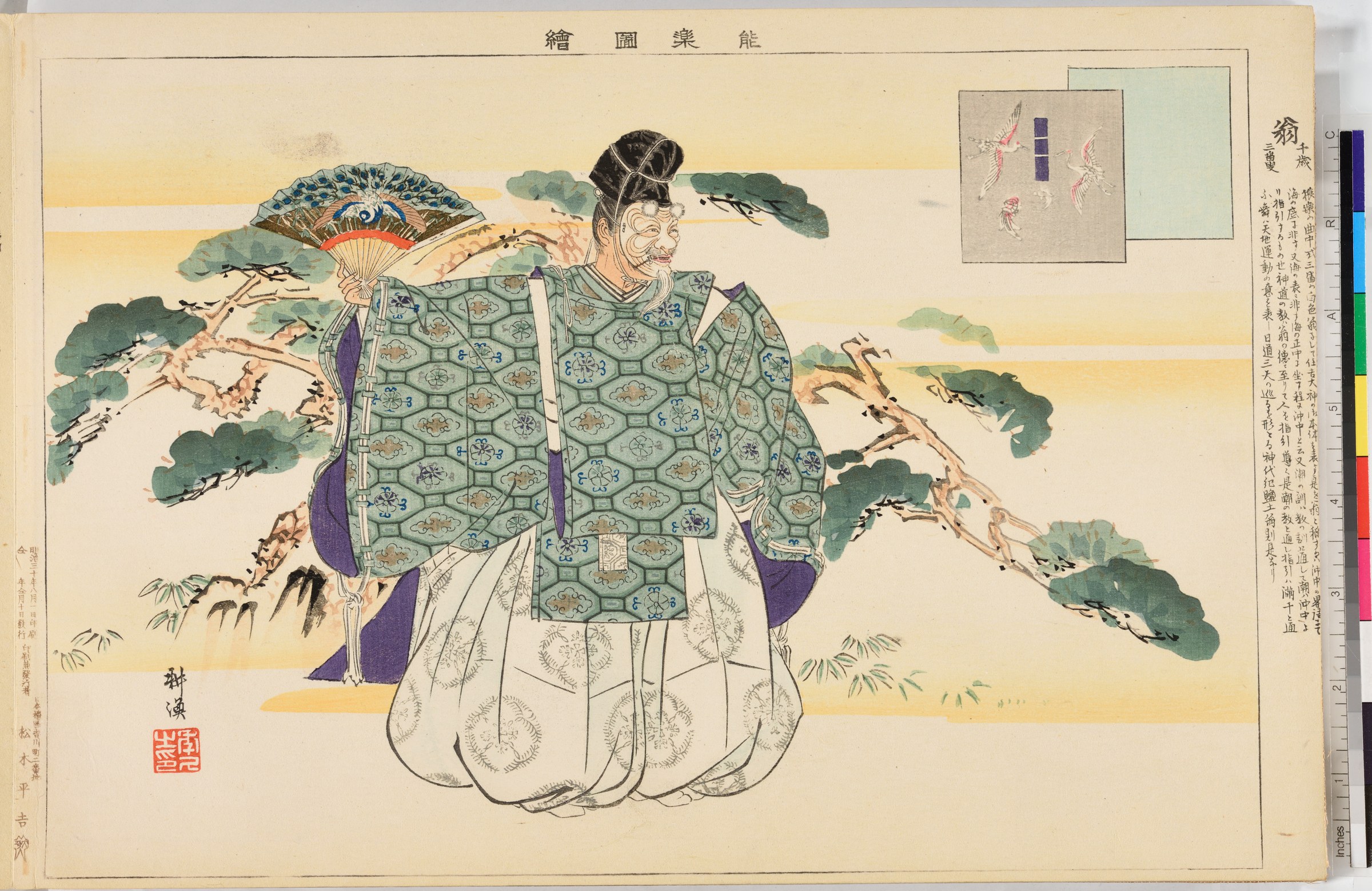
A figure in elaborate costume stands in a landscape of shallow space, surrounded by gnarled pine trees rendered in soft green washes. The figure wears a voluminous lower garment gathered into deep pleats or folds, and an ornate upper robe patterned with geometric designs in blue and earth tones. A tall black hat sits atop an exaggerated, caricatured face with prominent features. In one hand the figure holds a large folded fan decorated with blue and red patterns; the other hand rests on the body. The background is painted in warm yellows and pale cream, with minimal atmospheric depth. The overall effect is theatrical and stylised rather than naturalistic—the proportions and presentation suggest this is a character or performer rather than a portrait from life.
The dancing
A single standing figure, posed frontally with weight evenly distributed. The posture is static and formal rather than dynamic—there is no suggestion of movement or mid-gesture capture. The arms hang relaxed, one holding the fan. The costume is so voluminous and stiff that body articulation is largely obscured; the silhouette dominates over anatomical clarity. This is presentation rather than action—a display of dress and character type rather than dance captured mid-motion.
The dance depicted
The image does not appear to depict dance as active movement. Instead, it presents a character in theatrical or performative dress—likely from Japanese Noh or Kyogen theatre, or a related performance tradition. The exaggerated facial features, ornate costume, formal stance, and fan suggest a comic or grotesque character role rather than a dancer performing a recognisable movement vocabulary. If this is related to dance, it documents a performer's costume and character type rather than choreographic action.
How it was made
This is a hand-colored woodblock print (indicated by the flat colour fields, visible registration, and the characteristic soft washes of watercolor applied to woodblock impressions). The print shows careful use of overprinting—the intricate patterning on the robe required multiple blocks or passes. The delicate handling of the landscape background and the precise line-work of the costume details are typical of Japanese ukiyo-e and related colour woodblock techniques from the late 19th century.
About this work
This is a character study or costume documentation from Japanese theatre tradition, rendered as a hand-colored woodblock print. The work belongs in a dance collection only provisionally: it records a performer in costume rather than capturing dance as embodied action. However, it documents a theatrical tradition whose performance vocabularies (gestural, postural, and choreographed) are central to the history of Asian performance. The image shows the artist's skill in rendering elaborate costume and exotic character type for a cultivated audience.
How to look at it
Attend first to the costume and how the artist has rendered its structure and pattern—the volumetric quality of the pleated skirt, the geometric patterning of the upper robe, the construction of the hat. The exaggerated facial proportions and the formal, frontal pose establish this as a character type or mask-like presentation rather than a naturalistic figure. Notice also how the artist has used the landscape setting not to ground the figure naturistically but to provide a complementary aesthetic space—the spare rendering and soft washes create a stage-like flatness that enhances the theatrical quality.
The artist
Kōgyo Tsukioka (1862–1927) was a major Japanese painter and printmaker active in the Meiji period. He is known for his detailed costume studies and character portraits from Noh, Kyogen, and Kabuki theatre, as well as for his landscapes and figure studies. His work sits at the intersection of traditional Japanese aesthetics and modern printmaking techniques, and his theatre documentation in particular was influential in preserving visual records of performance traditions during a period of rapid cultural change.
The period
The late 1890s in Japan saw intense interest in documenting and preserving traditional arts as the country modernised. Photography and colour woodblock printing allowed wider circulation of images of theatre performers and costumes. At the same time, theatrical traditions including Noh and Kyogen were being formally codified and elevated as 'national treasures.' This print sits within that moment of documentation and valorisation, when traditional performance was being recorded for posterity and for audiences who might not attend live performances.
Where it lives
The work is identified as a colour woodblock print in the Tsukioka Kōgyo style, reproduced in the Wikimedia Commons collection from an institutional holding. The original catalogue record is minimal and does not specify the current location of the print or its accession details.
Questions about this work
Is this actually a dance image?
It documents a character in Japanese theatrical tradition, presented in full costume and static pose. Whether this belongs in dance history depends on how we define dance—if we include all performance traditions and costume documentation, yes; if we require visible choreographed movement, this is borderline. It is valuable as a record of a performance tradition's visual culture and the conventions by which characters were presented and understood.
What is the costume?
The garment is typical of Noh or Kyogen theatre dress: a voluminous lower skirt (hakama or similar) with deep accordion pleats, and an ornate patterned upper robe (kataginu or uwagi). The exaggerated facial features and the formal presentation indicate a grotesque or comic character type—possibly a demon, sage, or stock comic figure. The fan is a standard prop of Japanese theatrical performance.
Why is the face so distorted?
The exaggeration is intentional and serves multiple purposes: it establishes the figure as a character type or mask-like persona rather than a naturalistic portrait; it may indicate a specific role or character category within the theatrical tradition; and it reflects the aesthetic conventions of caricature and character study common in Japanese theatre documentation and woodblock prints of the period.
More dance artwork