49 works in this view — arrow keys or swipe to move between them.
Dance in Art · 1899
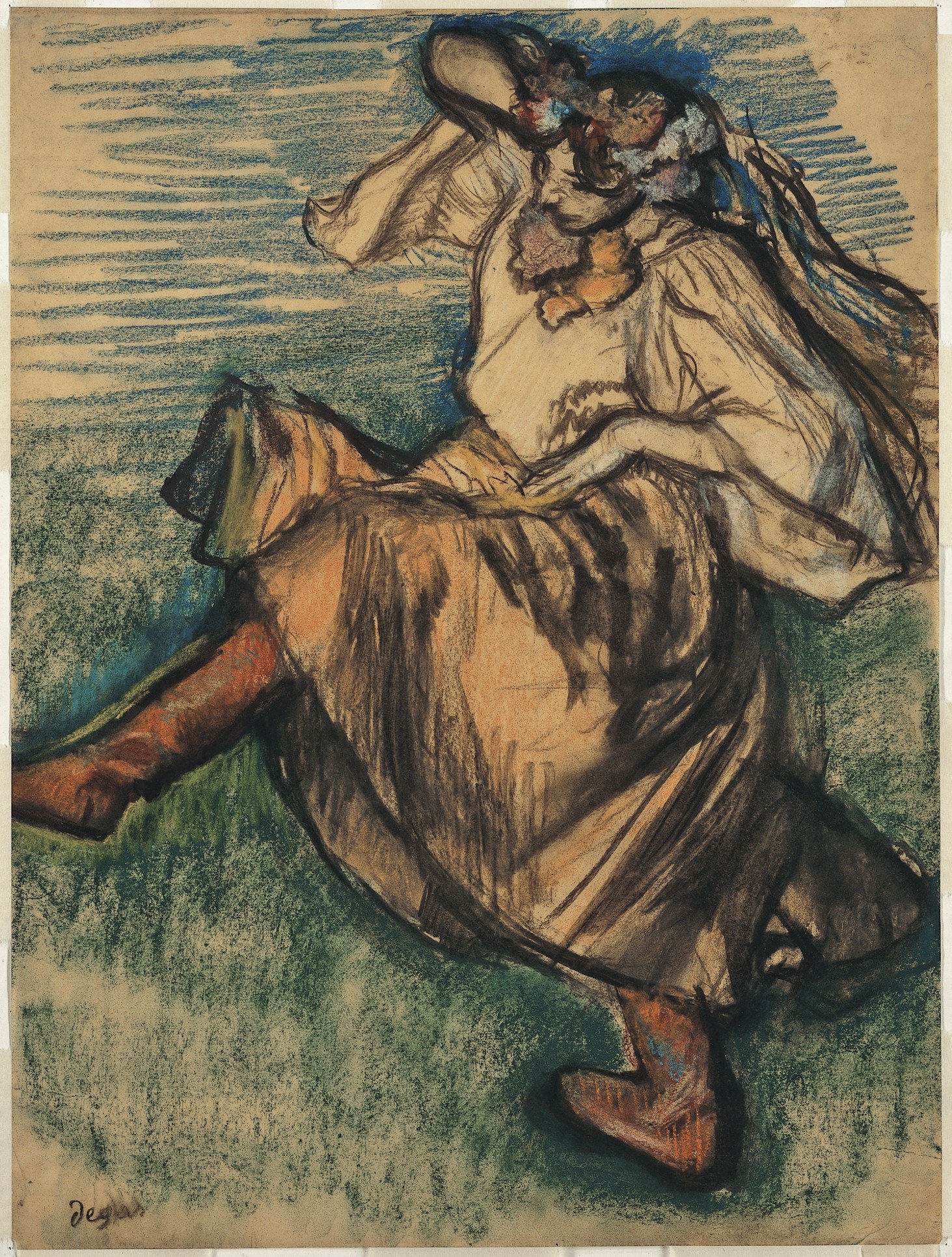
Dancer in Ukrainian Dress MET 77I 052R2M
Edgar Degas
- Medium:
- Drawing
- Dance:
- Ballet
- Era:
- Late 1800s (Victorian Ballroom)
- Source:
- Wikimedia Commons
- Rights:
- Public domain — free to use, share and adapt.
- Recorded as:
- CC0
This work documents the presence of Ukrainian and Eastern European folk dance on the Paris stage in the 1890s, a context often overlooked in favor of Degas's more famous ballet subjects. It also demonstrates Degas's late technique: the marriage of sharp contour and diffuse color, the focus on dynamic imbalance rather than classical pose, and the artist's commitment to recording the actual mechanics of movement in real time.
What you are looking at
A female dancer in a light linen chemise and dark, voluminous skirt poses in a dynamic, off-balance moment against a loosely sketched background of blue-green wash. Her body twists sharply, weight thrown onto her back leg, her torso arching backward and to the left with her head tilted back and long dark hair streaming. Her forward leg extends, knee softened. The pose suggests a pivot or sharp directional change rather than a held position—a moment of propulsion and release. The background is left barely indicated, a field of horizontal blue strokes that suggests neither interior nor outdoor setting but rather the working space of the studio. The drawing style is characteristically rapid: bold black outlines define the figure while colored chalks—ochre, rust, blue, white—are layered and blended to suggest volume and shadow, particularly in the folds of the skirt and the flesh of the body.
The dancing
One female dancer, captured mid-movement in a sharply asymmetrical pose. Her center of gravity is displaced; she is caught in the moment of falling away from her supporting leg, her torso counter-rotated to her hips, her arm extended for balance or momentum. The pose reads as unstable and dynamic rather than positioned—the artist has seized a fleeting moment rather than a classical alignment. Her head is thrown back, mouth open slightly, suggesting exertion or expression. The softness of the knee and the length through the extended leg suggest trained movement, but the overall frame is looser and more naturalistic than academic ballet vocabulary would prescribe.
The dance depicted
This appears to be a study of a dancer in folk or character dance rather than strict classical ballet. The costume—a simple chemise and dark skirt—and the title's reference to Ukrainian dress point toward a national character dance, likely a Ukrainian or Eastern European regional style that would have been performed in the Paris theater and music halls of the 1890s. The pose itself does not follow the turned-out, upright aesthetic of classical ballet; instead it captures a moment of twisting, weight-displaced movement that reads as folk-inflected or vernacular. The sketch may record a live performance or a studio study for a larger work.
How it was made
Drawing in chalk, charcoal, and pastel on cream laid paper. The technique is characteristic of Degas's late practice: broad areas of colored chalk are applied loosely and blended, creating volume and atmosphere with minimal definition. Black contour lines define the figure sharply against this softer ground. The technique allows rapid capture of movement and the play of light on fabric; the skirt in particular shows how layered color suggests depth and flutter. This is a studio work, likely not intended for direct public view, and represents the kind of private rehearsal or performance study that occupied much of Degas's later career.
About this work
This is a rapid chalk study of a female dancer in folk costume, likely Ukrainian or Eastern European, caught in a moment of dynamic, weight-displaced movement. The figure twists and arches backward, her dark skirt billowing, against a loosely indicated background. Degas's technique—bold black outlines combined with layered colored chalk—conveys both the structure of the moving body and the atmosphere of the studio. The work belongs to Degas's long engagement with the theater and dance practice, but records not the polished classical ballet of the Paris Opéra so much as the more vernacular, character-inflected dances that appeared on stage and in performance studies. It is an intimate record of movement, the kind of drawing Degas made to understand a gesture rather than to commemorate a finished work.
How to look at it
Notice first the pose itself: the body is twisted, off-balance, caught between one direction and another. This is not a moment of repose or classical alignment, but a moment of propulsion and instability. Look at the extension of the forward leg and the twist of the torso; the artist understood how the body distributes weight and creates momentum through counter-rotation. Then attend to the skirt: watch how Degas has used layered color—rust, ochre, black, white—to suggest both the weight and the flutter of the fabric in motion. The background, loosely indicated with horizontal strokes, is deliberately vague, directing all attention to the body itself. Finally, note the head: thrown back, mouth open, it conveys not just the pose but also the exertion and expression of the dancer.
The artist
Edgar Degas (1834–1917) was a French painter and draftsman whose career centered on the representation of movement, particularly dance. From the 1860s onward, he made thousands of drawings, pastels, paintings, and prints of dancers in the Paris Opéra, in rehearsal studios, and in other performance spaces. His interests extended beyond classical ballet to include acrobats, circus performers, and vernacular dances from other cultures. He was obsessed with capturing movement in its most transient and unstable moments, often drawing from backstage vantage points or creating works from memory and imagination in the studio. His late work, as exemplified here, became increasingly loose and expressive, less concerned with documentary accuracy than with the essence of motion and the play of light on form.
The period
In the 1890s, the Paris music halls and theaters hosted performers from across Europe and beyond, including Ukrainian, Russian, and other Eastern European dancers whose folk styles contrasted sharply with the academic classical ballet that dominated the Opéra. At the same time, artists were becoming increasingly interested in non-Western and folk performance traditions as sources of authenticity and vital movement. Degas, in his seventies during this decade, was still deeply engaged with the theater and with drawing from live performance, and his late works often blur the boundaries between documentation and imaginative reconstruction. This drawing sits at the intersection of his long involvement with dance and the cultural currents of the fin-de-siècle Parisian theater.
Where it lives
The work is recorded as part of the Metropolitan Museum of Art's collection (accession 77.I.52R2M). It comes from the Met's extensive holdings of Degas's drawings and studies, many of which were acquired through major gifts and bequests in the twentieth century.
Dance in this work
Questions about this work
Is this a study for a larger painting or a finished work?
This is almost certainly a studio study rather than a finished work intended for exhibition. It captures a moment and explores technique—how to render the play of fabric, the twist of the torso, the displacement of weight—rather than presenting a polished or narrative composition. Degas made thousands of such studies throughout his career, often returning to them years later or using them to inform other works.
What is Ukrainian dance and how would Degas have seen it?
Ukrainian folk dances are characterized by complex footwork, dynamic body twists, and often a low center of gravity. By the 1890s, Ukrainian and other Eastern European performers were regular attractions in Paris music halls and theatrical cafés. Degas, with his deep engagement with the theater, would have attended these performances and studied them intensively, as he had with classical ballet and circus acts decades earlier.
Why is the figure so unstable-looking?
This instability is deliberate. Degas was interested in capturing movement in its most transient, dynamic state—not the poised, held position of classical ballet, but the moment of propulsion, weight displacement, and directional change. This reflects both the nature of folk and character dance, which can be earthier and less formally contained than classical ballet, and Degas's late artistic interest in gesture and motion rather than pose.
What does the costume tell us?
The simple chemise and dark, full skirt are consistent with traditional Ukrainian folk dress and its theatrical adaptations. This costume would have immediately signaled to a Parisian audience in the 1890s that the dancer was performing a national character or folk dance rather than classical ballet. The costume is functional as well as cultural: the full skirt allows for the rapid footwork and dynamic weight shifts that characterize many Eastern European folk dances.
More Ballet artwork