49 works in this view — arrow keys or swipe to move between them.
Dance in Art · 1894
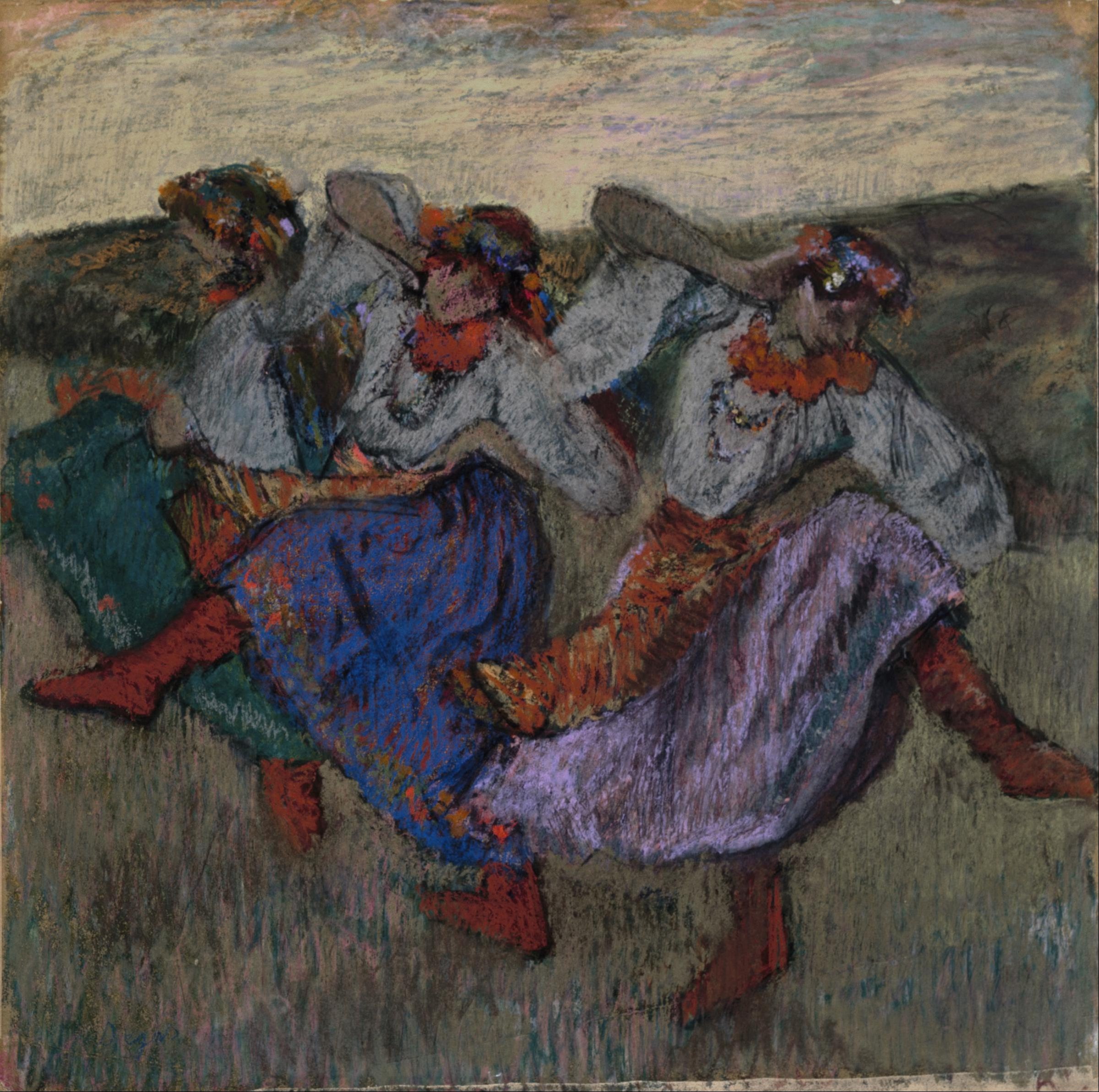
Edgar Degas - Russian Dancers
Edgar Degas
- Medium:
- Oil Painting
- Dance:
- Ballet
- Era:
- Late 1800s (Victorian Ballroom)
- Source:
- Wikimedia Commons
- Rights:
- Public domain — free to use, share and adapt.
- Recorded as:
- Public Domain
This painting shows that Degas's late work engaged not only with ballet and ballroom but with character and folk dance, and that the distinction between staged entertainment and social dance was increasingly blurred in the 1890s. For dance historians, it is a rare visual record of how Russian folk dance was perceived and aestheticized by a canonical European modernist, and how the exoticism of the Russian body inflected late-nineteenth-century art.
What you are looking at
Three female dancers occupy the composition, their bodies arranged in a dynamic cluster against a muted, textured background of greens and grays. The nearest figure, at right, wears a lavender skirt with a white blouse and flowers in her dark hair; she leans forward with weight on her front leg, arms raised, her posture suggesting active movement. The central dancer, in a blue skirt and white blouse with red flowers, is caught mid-turn, her body twisted and arms extended. The third figure, at left wearing a darker skirt, is partially obscured but similarly animated. All three wear corseted white blouses with puffed sleeves and ornamental floral garlands or wreaths in their hair. The setting is outdoor or theatrical, with grass or ground suggested by the warm foreground and cool, distant landscape. The paint is applied with visible brushwork; colors are warm in the dancers' flesh tones and dress, cool in the background, creating depth and focus on the figures.
The dancing
The dancers are not in closed hold with partners but rather in individual, autonomous movement within the same frame. Their arms are raised and extended outward—not in the controlled frame of ballroom but in looser, more expressionistic gestures. The weight appears to shift from foot to foot; the central dancer's twisted torso and visible rotation suggest turning. Their posture is upright but not stiffly formal; there is a quality of lift and ease. The bodies are modeled with solidity and volume; the artist understood how fabric drapes and how a turning torso displaces weight.
The dance depicted
This work most likely depicts Russian folk or character dance rather than classical ballet, despite the catalogue's ballet label. The outdoor setting, the exuberant arm gestures, the floral garlands, and the informal grouping are consistent with peasant or folk celebration dance. The women's costume—full skirts, white embroidered blouses, flowers in the hair—echoes Russian folk dress. The painting's title specifies Russian dancers, and the historical moment (1890s) coincides with European fascination with Russian and Eastern European culture, including performances of character dances on Parisian stages. The movement captured is energetic but not pointed-toe or turnout-based; it reads as a moment of social or festive dancing.
How it was made
This is oil on canvas with visible brushwork throughout, applied in short, directional strokes that follow the form of the fabric and the movement of the bodies. The technique allows Degas to capture both the solidity of the figures and the play of light and shadow across their clothing. The finish is not polished; the surface remains tactile and sketch-like, which gives the work an immediacy and suggests a study made from observation or memory rather than a formal commission. The impressionistic handling of the background—loose greens and grays—contrasts with the more careful modeling of the dancers, directing the viewer's attention to the figures and their gesture.
About this work
This 1894 oil painting shows three Russian women dancers in folk costume, caught in a moment of animated, outdoor celebration. Their raised arms, turned bodies, and informal grouping convey joy and movement rather than the formal discipline of classical ballet. The work is characteristic of Degas's late practice: a study of women in motion, using bold color and loose brushwork to capture the immediate impression of a fleeting moment. It belongs in a dance gallery not as a document of ballet technique but as evidence of how fin-de-siècle visual artists understood and represented non-Western and non-elite forms of dance, and how the Russian cultural moment fascinated European painters.
How to look at it
Look first at the raised arms and the turning of the central figure: this is not the controlled rotation and pulled-up frame of classical ballet, but an outward, expansive gesture. Note the three separate bodies occupying the same space, not mirrored or responding to one another in the formal way of ballroom couples. Observe how the floral wreaths and embroidered blouses anchor the work in folk costume rather than the tulle and silk of the opera house. The background is deliberately vague and atmospheric, which pushes the figures forward and emphasizes their solidity and vivacity. Finally, attend to the brushwork itself: the short, directional strokes give the painting a quality of immediacy and sketch, as though Degas caught these women in a moment he could never fully stabilize or perfect.
The artist
Edgar Degas (1834–1917) is best known for paintings of Parisian ballet dancers and rehearsals, but his late work (1890s onward) expanded to include other forms of dance and movement: circuses, café concerts, and character dances. His technique evolved toward looser brushwork and more vivid color, as shown here. Degas was fascinated by movement and the body in motion across all registers; for him, the informal gesture of a folk dancer was as worthy of formal pictorial study as the classical arabesque. His late paintings often show the influence of Japanese prints and his own experiments with pastel and oil, creating a more experimental, less polished finish.
The period
The 1890s saw a surge of interest in non-Western and folk cultures across European visual and performing arts, partly driven by colonial expansion and partly by the modernist hunger for alternatives to academic convention. Russian culture, in particular, held romantic and exotic appeal for Paris after the diplomatic alliance of 1894 and the presence of Russian performers at the Opéra and in café concerts. Simultaneously, Impressionist and Post-Impressionist painters were moving away from narrative realism toward subjective perception of light, color, and gesture. Degas, aging and increasingly isolated, pursued his own version of this shift: abandoning the sharp draughtsmanship of his earlier work for a more expressive use of color and a looser, more spontaneous surface.
Where it lives
The work is listed as sourced from Wikimedia Commons with no holding collection recorded in the catalogue. This suggests it may be in a public collection with digital access, or the provenance is unknown or not catalogued in the source database.
Dance in this work
Questions about this work
Is this classical ballet?
No. While Degas was famous for ballet paintings, this work depicts Russian folk or character dance. The costume, the outdoor setting, the informal grouping, and the expansive arm gestures are all inconsistent with academic ballet. The dancers are not in pointe shoes or a formal frame; they are celebrating in peasant dress.
Why are there flowers in their hair?
The floral wreaths and garlands are part of Russian folk costume and are typical of peasant celebration dress. They situate the dancers in a specific cultural and social context—a festive or commemorative occasion—rather than a theater stage.
What is Degas doing with Russian subject matter?
In the 1890s, Russian culture held romantic appeal for Paris, especially after the French-Russian alliance of 1894. Russian performers appeared regularly in Parisian venues, and the Russian body and character dance fascinated visual artists. For Degas, a Russian folk dancer offered the same opportunity for studying movement and the figure as his beloved Parisian ballet dancers, but with different formal properties: wider arm gestures, different costumes, a different energy.
More Ballet artwork