49 works in this view — arrow keys or swipe to move between them.
Dance in Art · 1895
Edgar Germain Hilaire Degas 022
Edgar Degas
- Medium:
- Oil Painting
- Dance:
- Ballet
- Era:
- Late 1800s (Victorian Ballroom)
- Source:
- Wikimedia Commons
- Rights:
- Public domain — free to use, share and adapt.
- Recorded as:
- Public Domain
This painting is significant as a document of how fin-de-siècle artists represented folk and peasant dance at a moment when such traditions were being newly valorized and collected by nationalist movements across Europe. For dancers and historians, it offers visual evidence of what a communal celebration dance looked like in 19th-century memory and imagination, even if the specific choreography remains implicit rather than explicit.
What you are looking at
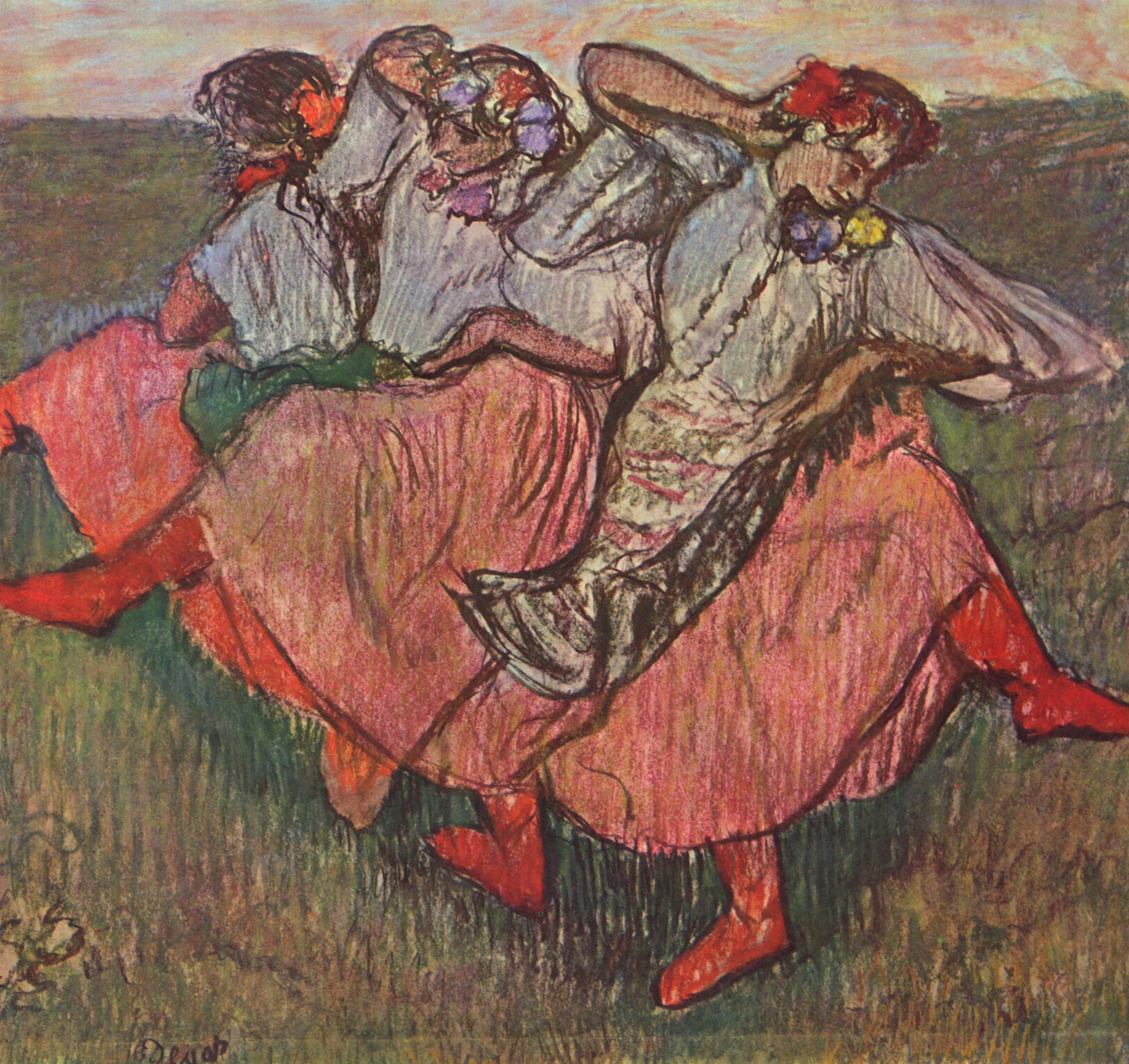
Four young women in vibrant red-and-pink skirts dance together in an outdoor pastoral setting, their bodies animated and closely grouped. They wear white blouses with puffed sleeves and decorative flower garlands in their hair—red, purple, and yellow blooms—suggesting a festive or ceremonial occasion. The composition is tightly clustered, with the dancers' bodies overlapping and intertwining, their skirts billowing outward in concentric layers that dominate the lower half of the canvas. The background is minimal: soft green grass and a hazy, warm-toned sky with rolling hills, rendered in loose brushwork that contrasts with the detailed, linear definition of the figures. The light is diffuse and golden, warming the cream and pale violet tones of the blouses while the bright reds of the skirts appear almost luminescent against the muted landscape. The moment captured is one of movement and gaiety—the dancers lean and turn into each other, their poses suggesting spinning or whirling motion, though none touch the ground with obvious weight.
The dancing
The four figures are arranged in a dense, almost merged composition where individual bodies are difficult to separate. Their arms are raised and extended, some hands visible, suggesting arm patterns in a turning or circling motion typical of folk or social dance. The dancers appear to have minimal weight on the ground, with skirts lifted and billowing, suggesting rapid rotation or elevated movement. The heads are tilted and angled toward each other, creating a sense of intimate group engagement. Their posture is upright and buoyant rather than grounded, and the densely overlapping arrangement suggests they move as a unified cluster rather than in a formal hold or linear formation.
The dance depicted
This appears to depict a folk or regional celebration dance, most likely from a European peasant or rural tradition given the styling, costume, and outdoor festival setting. The garlands, bright celebratory dress, and close group choreography suggest a springtime or harvest festival round dance or circle dance of the kind performed across Central and Northern Europe—possibly a Scandinavian or Slavic tradition. The dense, whirling composition and the emphasis on collective motion rather than partner structure points toward a communal round or chain dance rather than ballroom form. The specific steps and regional origin cannot be determined from the image alone, but the festive costume, outdoor setting, and emphasis on joyful group movement are consistent with vernacular dance traditions associated with seasonal celebration.
How it was made
This is an oil painting on canvas, executed with a technique that combines detailed linear drawing—particularly evident in the firm outline of figures and the cross-hatching of the white blouses—with expressive color and loose brushwork in the landscape. The artist used bold color contrasts: the saturated reds and pinks of the skirts are set against the warm but muted background, and the flower garlands are rendered in bright accents. The technique allows for both the careful delineation of costume detail and the more atmospheric rendering of setting, creating a composition that foregrounds the human figures while keeping the landscape subordinate. This mixed approach was typical of late 19th-century figurative painting that sought both naturalistic detail and decorative effect.
About this work
This oil painting depicts four women dancing together in a pastoral outdoor setting, their red-and-pink skirts and flower garlands suggesting a European folk celebration or festival. The composition emphasizes collective joyful movement through a densely clustered, whirling arrangement of figures, with the bright costumes dominating the canvas against a soft, atmospheric landscape. The work is a celebration of folk culture and communal dance at a moment when both were subjects of intense artistic and ethnographic interest in Europe. It belongs in a dance gallery as evidence of how 19th-century artists understood and represented the festive traditions of rural and working communities, capturing a specific cultural moment in which folk dance was valued as an emblem of national character and authentic human expression.
How to look at it
Attend to the composition's density and the way the four bodies merge into a single whirling form rather than remaining separate dancers. Notice how Degas emphasizes the upward lift and outward billow of the skirts, which suggest rapid rotational movement. The artist has chosen to freeze a moment of maximum animation and collective engagement, with the dancers leaning into each other, heads angled toward the center of the group. Look at how the detailed linear drawing of the white blouses and flower garlands anchors the figures while the looser brushwork of the landscape recedes, keeping the viewer's focus on the human celebration. The warm, golden light and soft background create an almost dreamlike or nostalgic quality, suggesting this is memory or ideal rather than documentary observation.
The artist
Edgar Degas (1834–1917) was a French impressionist painter and printmaker best known for his scenes of ballet, opera, and urban leisure in Paris. While this work sits outside his primary focus on professional performance dance and the modern city, it aligns with a broader 19th-century European interest in capturing folk traditions, rural life, and the customs of working and peasant communities. Degas's practice often combined close observation of movement with a strong linear style influenced by Japanese prints and Renaissance drawing, evident in this painting's combination of detailed figural outline and painterly background.
The period
The painting dates to 1895, a moment when European artists and intellectuals were intensely engaged with questions of national identity, folk authenticity, and the documentation of rural traditions in the face of industrialization and urbanization. Across Europe, folk dance was being collected, notated, and represented in art as a symbol of cultural continuity and national character. The 1890s also saw the height of the Symbolist movement, which often idealized rural and pre-modern life. Simultaneously, professional ballet was evolving toward both more classical rigidity and toward modernist innovation, making peasant and folk dance an appealing contrast—representing spontaneity, joy, and authentic human expression untouched by theatrical artifice.
Where it lives
The work is catalogued as an oil painting by Edgar Degas from 1895. The record indicates it was sourced from Wikimedia Commons, suggesting it is likely in a public collection, though the specific holding institution is not recorded in the catalogue information provided.
Dance in this work
Questions about this work
What dance is this?
The painting does not depict a named, specific dance style with recognizable steps or notation. Instead, it shows a communal folk celebration or festival round dance of the kind performed across Central and Northern Europe, likely inspired by Scandinavian or Slavic traditions. The emphasis is on the festive spirit and collective motion rather than on choreographic precision.
Why did Degas paint folk dancers?
By the 1890s, folk traditions were subjects of intense artistic and nationalist interest across Europe. Artists, ethnographers, and cultural theorists viewed peasant dance as an expression of authentic human feeling and national character, in contrast to what they saw as the artifice of professional theater. Degas's interest in capturing movement in all its forms extended beyond the Paris ballet to include the village celebration.
Are these real garlands or symbolic?
The flower garlands are likely both. In 19th-century European folk tradition, floral crowns and wreaths were worn during spring and summer celebrations, particularly at Midsummer and harvest festivals. Degas has rendered them as bright, detailed accents—yellow, purple, and red flowers woven into the hair—which suggests both historical accuracy and a heightened, almost idealized quality that speaks to the romantic nostalgia surrounding folk culture in art of the period.
More Ballet artwork