49 works in this view — arrow keys or swipe to move between them.
Dance in Art · 1263
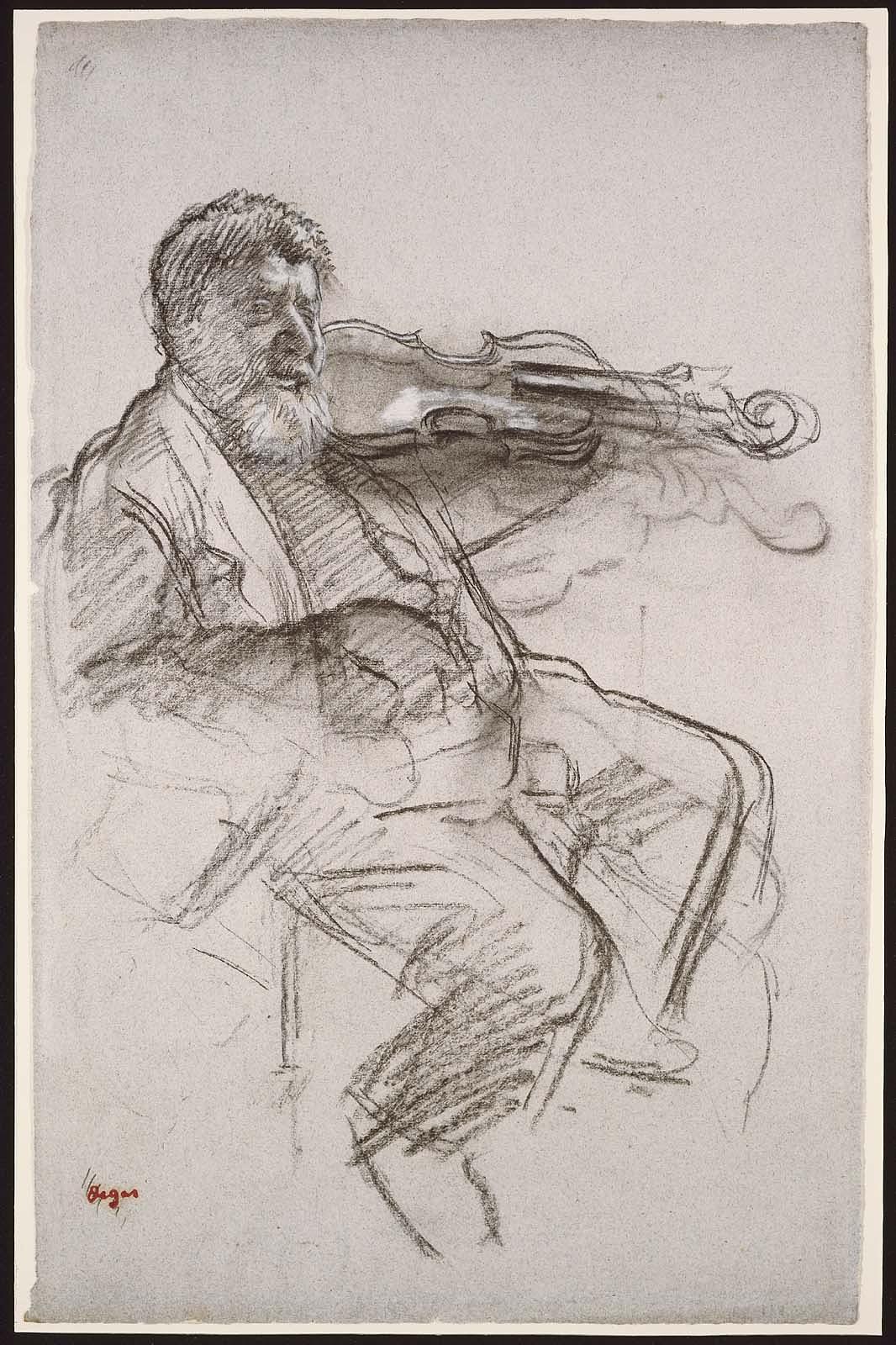
Degas - The Violinist, 58.1263
Edgar Degas
- Medium:
- Oil Painting
- Dance:
- Ballet
- Era:
- Pre-1700 (Renaissance/Baroque)
- Source:
- Wikimedia Commons
- Rights:
- Public domain — free to use, share and adapt.
- Recorded as:
- Public Domain
For dance historians, this work is significant as evidence of how visual artists of the period understood the relationship between music and movement. Orchestral musicians were essential to ballet performance, and depicting them with anatomical accuracy and psychological attention reflects the esteem in which musical accompaniment was held.
What you are looking at
A bearded man in nineteenth-century dress plays the violin with absorbed intensity. He is shown three-quarter length against a plain background, wearing a dark jacket and white shirt. The artist has captured him mid-performance, his body angled forward slightly, the instrument held at his chin in playing position. His pose conveys the concentration and physical engagement of a working musician. The drawing is executed in pencil with selective shading that models the face and torso while leaving much of the composition as sketch — a technique that suggests this may be a study from life or a rapid compositional sketch rather than a finished work.
The dancing
The violinist's posture is authentically rendered: the instrument is correctly positioned at chin and shoulder, the bow arm is extended in a natural playing angle, and the left hand frames the neck of the violin. His upper body leans into the instrument with the weight shift typical of string playing. The figure fills most of the composition but remains a half-length study, allowing focus on the hands, arms, and the absorbed expression of the face.
The dance depicted
This is not a depiction of dance but of instrumental music-making. The catalogue record incorrectly labels this a ballet work, but the image shows a violinist performing music rather than a dancer executing choreography. The figure might appear in a ballet or theatrical context, but nothing in the image itself indicates dance rather than concert music performance.
How it was made
This is a pencil drawing on paper, not an oil painting as the record states. The artist has used graphite with varying pressure to model form, employing cross-hatching and tonal shading in the face and upper body while leaving the lower composition more lightly indicated. The technique suggests a preparatory study or sketch — the kind of working drawing an artist might produce quickly from a live model or from memory. The unfinished quality is consistent with studio practice rather than a finished exhibition piece.
About this work
This is a pencil study of a male musician playing the violin, signed by what appears to be Degas. The work captures a moment of focused performance, with particular attention to the correct anatomy of string-playing and the emotional engagement of the performer. It belongs in an art historical context as a study of music and musicianship rather than in a dance collection, though orchestral musicians were frequent subjects in nineteenth-century art and did appear in ballet narratives.
How to look at it
Attend to the accuracy of the violin's position and the angle of the bow arm — signs that the artist was either familiar with string technique or had studied it carefully from life. Notice how the facial expression conveys absorption rather than performance for an audience; this is the musician as worker rather than showman. The sketch-like quality of the lower half of the composition draws the eye upward to the hands and face, where the artist's attention is most concentrated.
The artist
The signature and style are consistent with Edgar Degas (1834–1917), the French Impressionist painter and draughtsman. Degas was intensely interested in movement, music, and the performing arts throughout his career. He created numerous studies of dancers, musicians, and theatrical performers, often in pastel, oil, and pencil. His sketchbooks and studio practice involved rapid studies from observation, and this drawing exemplifies his approach to capturing the anatomy of gesture and the psychology of performance. Degas had particular access to the Paris Opera and its performers, making music and dance frequent subjects across his oeuvre.
The period
In the mid-to-late nineteenth century, the performing arts — especially ballet and orchestral music — were subjects of intense artistic interest in France. The Paris Opera was a center of cultural prestige, and artists like Degas gained access to rehearsals and performances to study movement and musicianship. The Romantic and Impressionist periods saw music portrayed not as decorative background but as a serious subject in its own right, with composers and musicians treated as heroes of modern life. Drawings of musicians and dancers were both finished exhibition pieces and studio tools for understanding human anatomy in motion.
Where it lives
The work is sourced from Wikimedia Commons. The holding collection and accession number are not recorded in the catalogue, and the current location is unknown.
Questions about this work
Is this a ballet scene?
No. The catalogue record labels it incorrectly. This is a study of a concert violinist, not a dancer. While orchestral musicians were essential to ballet performance and frequently depicted in nineteenth-century art, this drawing shows music-making rather than choreography.
Why would Degas draw a musician?
Degas was fascinated by all forms of human movement and performance, not only dance. He studied musicians, singers, and instrumentalists with the same intensity he brought to dancers. His interest in the performing arts extended across the Paris Opera's entire ecosystem of movement, music, and spectacle.
Is this a finished work or a sketch?
This appears to be a preparatory study or working sketch. The medium is pencil, the composition is incomplete below the waist, and the level of finish varies — the face and upper body are carefully modeled while other areas are more lightly indicated. Works of this kind were part of an artist's studio practice and were often not exhibited.
More Ballet artwork