49 works in this view — arrow keys or swipe to move between them.
Dance in Art
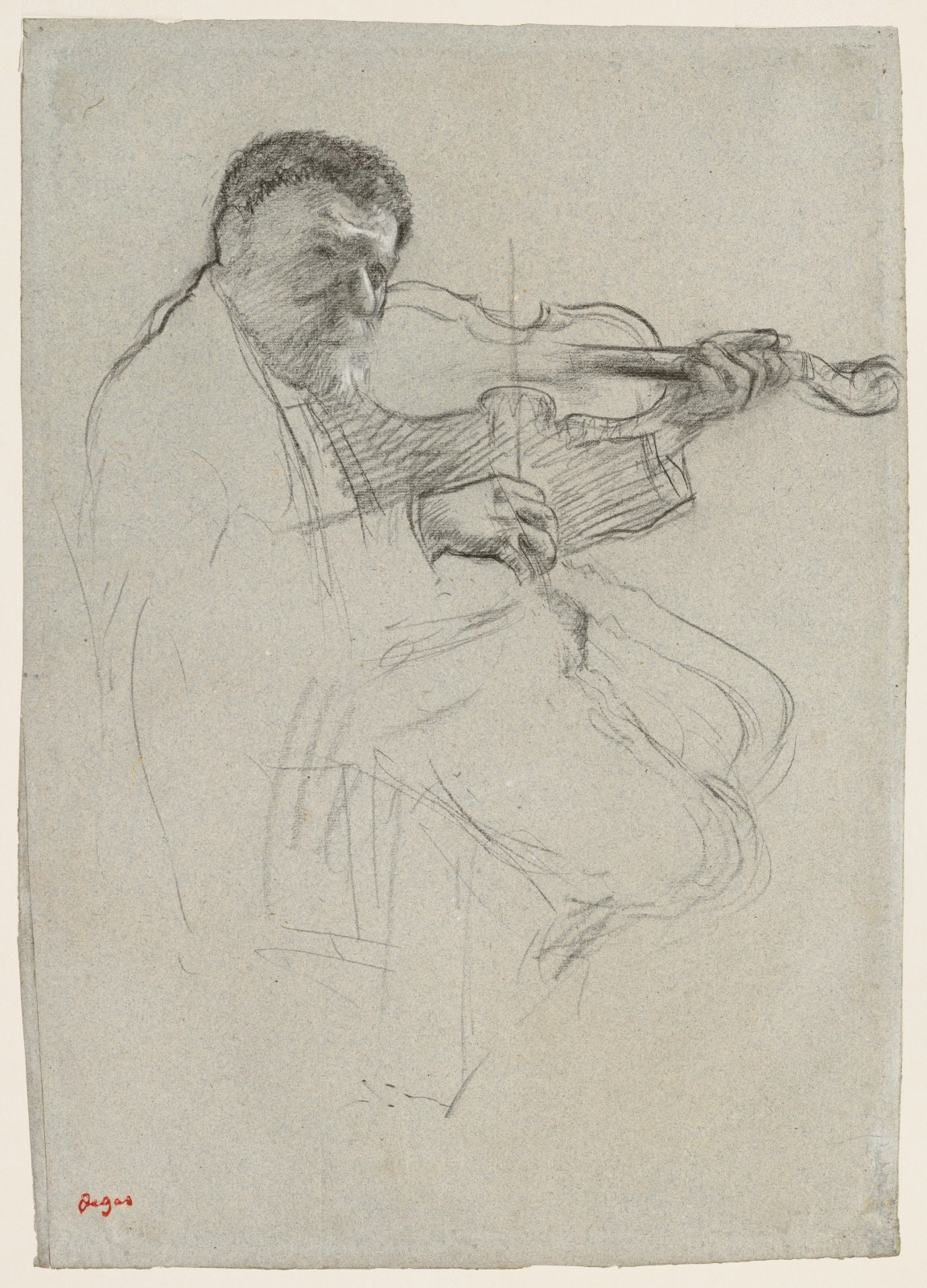
Degas - The Violinist, Study for The Rehearsal, 1955.1395
Edgar Degas
- Medium:
- Oil Painting
- Dance:
- Ballet
- Era:
- Late 1800s (Victorian Ballroom)
- Source:
- Wikimedia Commons
- Rights:
- Public domain — free to use, share and adapt.
- Recorded as:
- Public Domain
This work documents Degas's deep investment in the physical reality of ballet—not idealized dancers in tutus, but the actual labor of rehearsal, including the musicians whose playing made dancing possible. The study also exemplifies Degas's draftsmanship and his habit of building large compositions from accumulated studies of individual figures, a practice that reveals how nineteenth-century theatrical spectacle was constructed from careful observation and repeated revision.
What you are looking at
A bearded man in late nineteenth-century dress—a collared shirt with visible ribbed or pleated detail and what appears to be a jacket—stands in a dynamic, animated pose while playing a violin. He is drawn in graphite with bold, confident lines that convey movement and energy. The figure leans forward and to the right, his body twisted in the act of playing, suggesting the physical engagement required of a violinist. The drawing is rendered on laid paper, with the background left largely blank to emphasize the solitary musician. The sketch quality and the absence of color or finish give it the character of a preparatory study rather than a finished work.
The dancing
The violinist occupies the center of the composition, rendered in a three-quarter view that emphasizes the twist of the torso and the stretch of the right arm holding the bow. His left arm is bent to hold the instrument, and his posture conveys the muscular engagement of playing—weight forward, shoulders engaged. The artist has paid particular attention to the hands and their relationship to the instrument, though the feet are only lightly sketched. The figure is solitary; there is no ensemble or partner, only the musician caught in the moment of performance.
The dance depicted
This is not a depiction of dance but of instrumental music-making. The violinist is a performer in a musical ensemble, almost certainly an orchestra or chamber group. The cataloging of this work as a study for a rehearsal painting suggests it was made in preparation for a larger composition showing dancers and musicians together in a ballet rehearsal setting. The violin was essential to ballet accompaniment in the nineteenth century, and this study captures the physical vitality and concentration of the musician supporting the dancers.
How it was made
This is a graphite drawing on laid paper, not an oil painting as the catalogue record states. The work exhibits the quality of a life study or preparatory sketch: confident line work that defines form through contour and minimal cross-hatching for shadow and volume, particularly visible in the face and hands. The sketch-like finish indicates this was a working study, probably made from a live model or memory of one, for use in a larger composition. The medium allowed rapid notation of pose and gesture before committing to paint.
About this work
This is a graphite study of a violinist by Edgar Degas, a painter and draftsman obsessed with capturing movement and the rehearsal spaces where movement was made. The work is part of Degas's extensive investigations of ballet and the theatrical world: not just dancers, but the musicians, costumes, and studio practices that enabled performance. The sketch reveals Degas's working method—studying individual figures in isolation before assembling them into a finished composition. The cataloging as a study for *The Rehearsal* suggests it was made in preparation for one of his major ballet scenes, where the violinist would occupy the pit or a corner of the studio, visible to the dancers and choreographer but at the periphery of the visual drama.
How to look at it
Attend to the twist and lean of the violinist's posture: Degas has chosen the moment of active playing, with the body engaged in the physical effort of drawing the bow. The ribbed or pleated fabric of the shirt is rendered with fine parallel lines that suggest both the actual material and the underlying muscularity of the figure. The head is tilted back slightly, the focus downward toward the fingerboard—a naturalistic gesture that conveys concentration. The sketch leaves much unfinished, particularly the lower body, which invites the viewer to complete the figure in imagination as Degas himself would have done when transferring this study to a larger composition.
The artist
Edgar Degas (1834–1917) was a painter and printmaker of the Parisian avant-garde who made the opera house and ballet studio his primary subjects from the 1860s onward. He was fascinated by movement in all its forms—dancers, jockeys, laundresses—and by the modern technologies of seeing, including photography and Japanese printmaking. He was not a Realist in the manner of Courbet or Manet, but a colorist and designer who worked obsessively from nature, building his compositions through drawing, pastel, and experimental mixed media. His ballet studies span decades and exist in thousands of drawings, oils, and pastels; they represent a sustained meditation on the human body at work, strain, and rest.
The period
In the last quarter of the nineteenth century, the Paris Opéra was the center of European ballet performance, and Degas had privileged access to the rehearsal studios, backstage areas, and performance spaces. Romantic Ballet, which had dominated the mid-century, was giving way to more eclectic and technically demanding styles, and dancers were increasingly celebrated for their technical virtuosity. The orchestra pit was evolving, and the violin remained the instrument most identified with ballet accompaniment. Degas's studies of musicians and dancers together document this moment of institutional and artistic change.
Where it lives
The work is documented as part of a major Degas collection, cataloged as study 1955.1395. The source is listed as Wikimedia Commons, suggesting it is held in a public collection with open-access documentation, though the specific holding institution is not recorded in the available catalogue data.
Questions about this work
Is this a finished painting?
No. This is a graphite study, a preparatory drawing made before a finished work. The catalogue record incorrectly lists it as an oil painting. The sketch quality and the absence of color indicate it was made from life or memory as part of Degas's working process, to be used as reference when painting a larger composition.
Why would Degas draw a violinist?
Degas was documenting the ballet world in all its aspects—not just dancers, but the musicians, stagehands, and infrastructure that made performances possible. Violins were essential to ballet accompaniment in the nineteenth-century opera house, and the violinist was a visible presence in rehearsals and performances. This study would have been incorporated into a larger painting of a rehearsal scene, where musicians and dancers worked together.
What does 'study for *The Rehearsal*' mean?
It means this drawing was made as preparation for a larger finished composition, titled *The Rehearsal*, in which the violinist would appear as one of several figures. Degas's method was to draw individual figures separately in his notebook or on separate sheets, study them from different angles, and then assemble them into a complex multi-figure composition. This study allowed him to perfect the pose and proportions of the musician before placing him in the final painting.
What tells you this is Degas's work?
The catalogue record attributes it to Degas, and the style is consistent with his known graphic studies of ballet and theatrical subjects. The technique—confident graphite line work defining form through contour—is characteristic of his drawing practice. The subject matter—a musician in the rehearsal space—is typical of Degas's obsessive documentation of the opera house.
More Ballet artwork