45 works in this view — arrow keys or swipe to move between them.
Dance in Art · 1926
Edward Okuń - Walc Chopina
Edward Okuń
- Medium:
- Oil Painting
- Dance:
- Waltz
- Era:
- 1920-1950 (Swing Era)
- Source:
- Wikimedia Commons
- Rights:
- Public domain — free to use, share and adapt.
- Recorded as:
- Public Domain
This painting captures a crucial moment in the cultural history of waltz: the transition from waltz as a living social practice to waltz as Romantic mythology and artistic subject. It shows how a single musician and a single composition—Chopin's waltz—could be reimagined as the vehicle for an entire fantasy of femininity, grace, and the transformative power of music. For anyone studying how dance entered fine art in the late 19th and early 20th centuries, or how composers and musicians were heroized through their relationship to dance, this is an essential image.
What you are looking at
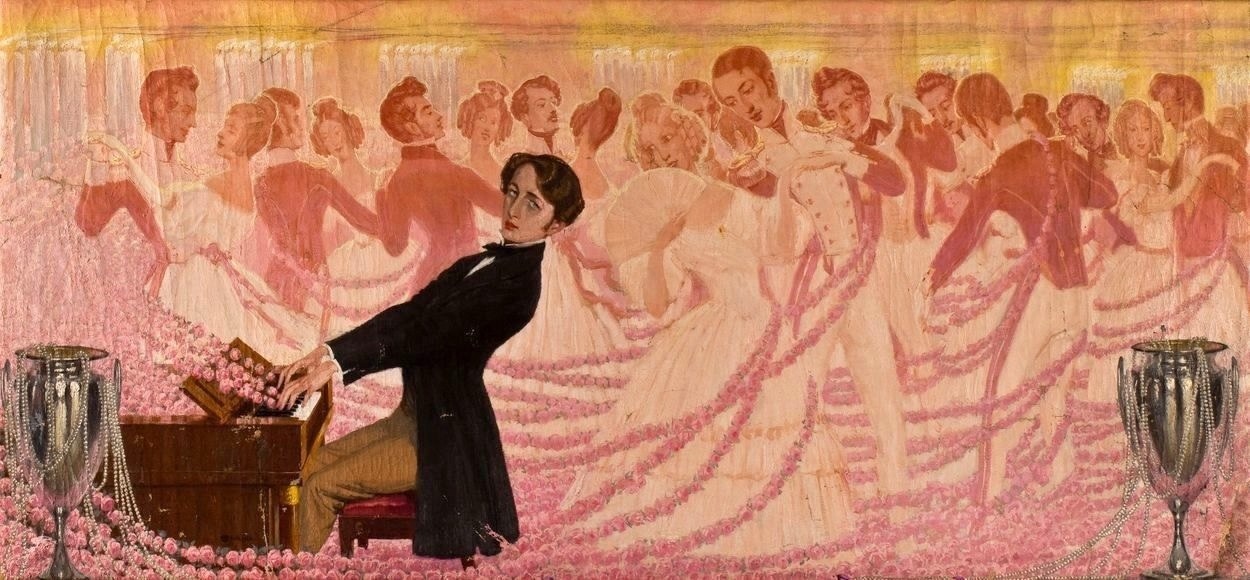
A man in formal black evening dress stands at a piano in the lower left, his body turned to address a vast, ethereal assembly of female figures rendered in pale pink and cream tones. The women fill the upper two-thirds of the canvas in a shimmering, almost translucent crowd, their bodies caught in various attitudes of motion—some with arms raised, others turning or swaying. The setting is dreamlike: the background suggests a grand ballroom with vertical striations that might be columns or drapery, suffused with warm golden light. The man's posture is one of presentation or invitation; his gaze meets ours while his hand gestures toward the throng. Two tall candlesticks or candelabra flank the scene in the lower corners, adding to the formality and luminosity. The overall effect is of a Romantic reverie—a solitary conductor summoning or presiding over an invisible orchestra of dancers.
The dancing
The male figure occupies a commanding but intimate scale at the painting's edge: he leans slightly forward from the piano bench in a posture of offering or enticement, his arm extended in a gesture that draws the eye upward toward the women. The female figures are depicted at much smaller scale and in varying degrees of definition; those nearest are more solid and individuated, while those receding into the background dissolve into almost abstract silhouettes. Their bodies suggest ballroom posture—upright, with arms extended or lifted—but the translucent, ghostly rendering prevents clear reading of specific holds or frames. The repetition and shimmering quality of the female forms creates a sense of multiplicity and weightlessness rather than the grounded physicality of actual dancers.
The dance depicted
The title indicates this is a representation of a Chopin waltz—the composition that would have governed both the music and the social dance at a formal ball of the 19th century. The women's poses and the vertical, upright carriage of their bodies are consistent with Romantic-era waltz posture, but the work is not documenting an actual dance scene; instead it is a poetic rendering of the spell cast by Chopin's music. The male figure, likely a pianist or the composer himself, mediates between the audible (the music at the piano) and the visible (the dance). This is waltz as reverie or aspiration rather than as social practice—the women are more apparition than dancer, their dance more imaginative than physical.
How it was made
The painting is executed in oil, a medium that allows for the layering of translucent glazes and the subtle modulation of tone that creates the dreamlike, glowing quality of the female figures. The artist has used delicate half-tones and a restricted palette of pinks, creams, and golds to evoke atmosphere rather than form. The technique—particularly in the rendering of the background figures—is closer to impressionistic suggestion than academic precision. This approach was well suited to the subjective, emotional content of Romantic art and allowed the work to circulate in the gallery and private collection world of the early 20th century as a finished, exhibition-scale painting.
About this work
"Walc Chopina" (Chopin's Waltz) is a Romantic allegory of dance as music made visible, created by Polish artist Edward Okuń in 1926. The composition presents a pianist at a grand instrument facing a luminous throng of women whose bodies seem to materialize in response to his playing. It is not a scene of social dancing but a poetic meditation on how music moves the body and imagination—a theme deeply rooted in 19th-century Romantic aesthetics, though painted well into the modernist 20th century. The work bridges the intimate scale of the musician and the transcendent, almost supernatural vision of the dancers he conjures.
How to look at it
Attend first to the relationship between the musician and the dancers: the pianist is tangible, located, material; the dancers are ethereal, multiplied, almost bodiless. The artist has chosen the moment not of actual dancing but of summoning or inspiration—the pianist is in the act of calling the vision forth. Notice the gradation from the more defined female figures in the middle ground to the barely sketched forms receding into the golden haze at the top: this technique creates depth and suggests a realm of pure imagination. The vertical format and the upward thrust of the composition make the painting about transcendence and aspiration rather than the horizontal, outward energy of a real ballroom.
The artist
Edward Okuń (1872–1945) was a Polish painter and graphic artist, part of the Art Nouveau and Symbolist circles that dominated Central European visual culture around 1900. He was known for his richly colored, often dreamlike canvases depicting literary and musical subjects, mythological scenes, and allegorical treatments of human emotion and experience. His style was decorative and sensuous, with a particular gift for rendering fabric, light, and the human form in states of reverie or transformation. Okuń's work was rooted in Romantic aesthetics and the Symbolist belief that visual art could evoke and crystallize the ineffable experiences promised by music and literature.
The period
By 1926, the waltz was already a century old as a social dance, but it retained its cultural prestige as the dance of the Romantic era—the music of Vienna, the ballroom of imperial courts, and the archetypal scene of courtship and longing. The 1920s saw a retrospective turn toward 19th-century subjects in conservative and academic art, even as modernism and jazz dance were reshaping the cultural landscape. Okuń's decision to paint this work at this moment reflects both nostalgia for the Romantic past and the continuing power of Chopin—Poland's national musical genius—as a subject of artistic veneration. The painting sits between the fading world of the classical waltz and the modernist aesthetics emerging around it.
Where it lives
The work is recorded as oil on canvas dated 1926, attributed to Edward Okuń. The current holding collection is not recorded in the catalogue. The source is Wikimedia Commons, indicating that the image is in public circulation but the physical location of the original is not noted in this record.
Dance in this work
Questions about this work
Is this painting depicting a real waltz or is it abstract/symbolic?
It is symbolic. The women are not dancers in the conventional sense but rather visions conjured by music and the pianist's imagination. The translucent, dreamlike quality of their forms, their lack of clear spatial or physical definition, and the title's reference to Chopin all signal that this is a Romantic allegory of music's power to inspire movement and emotion, rather than a documentary representation of an actual ballroom scene.
Why is there only one man and so many women?
The imbalance reflects both the conventions of Romantic art—where a solitary male genius (the composer, the artist, the musician) is the source of inspiration for a feminized, receptive, often multiplied vision—and the gender dynamics of the waltz itself, which was structured around male leadership and female participation. Here, the pianist appears as the originating force, and the women exist as the visible manifestation of his musical creation.
When was this painted and why does it look so old-fashioned?
It was painted in 1926, well into the modernist era, but Okuń was working in a Symbolist and Art Nouveau style that was already associated with the early 1900s or even the 19th century. His choice of subject—Chopin's music, the Romantic waltz, a dreamlike vision of feminine grace—was deliberately retrospective and nostalgic, even as he was using modern oil painting technique to create it.
What is Okuń's background and nationality?
Edward Okuń was a Polish artist (1872–1945) associated with Symbolism and Art Nouveau. His work often drew on Polish literary and musical subjects, and he was part of the cosmopolitan artistic circles of Central Europe in the late 19th and early 20th centuries. Chopin, like Okuń himself, was Polish, making this painting part of a broader cultural investment in celebrating Polish genius through Romantic and musical subjects.
More Waltz artwork