43 works in this view — arrow keys or swipe to move between them.
Dance in Art · 1810
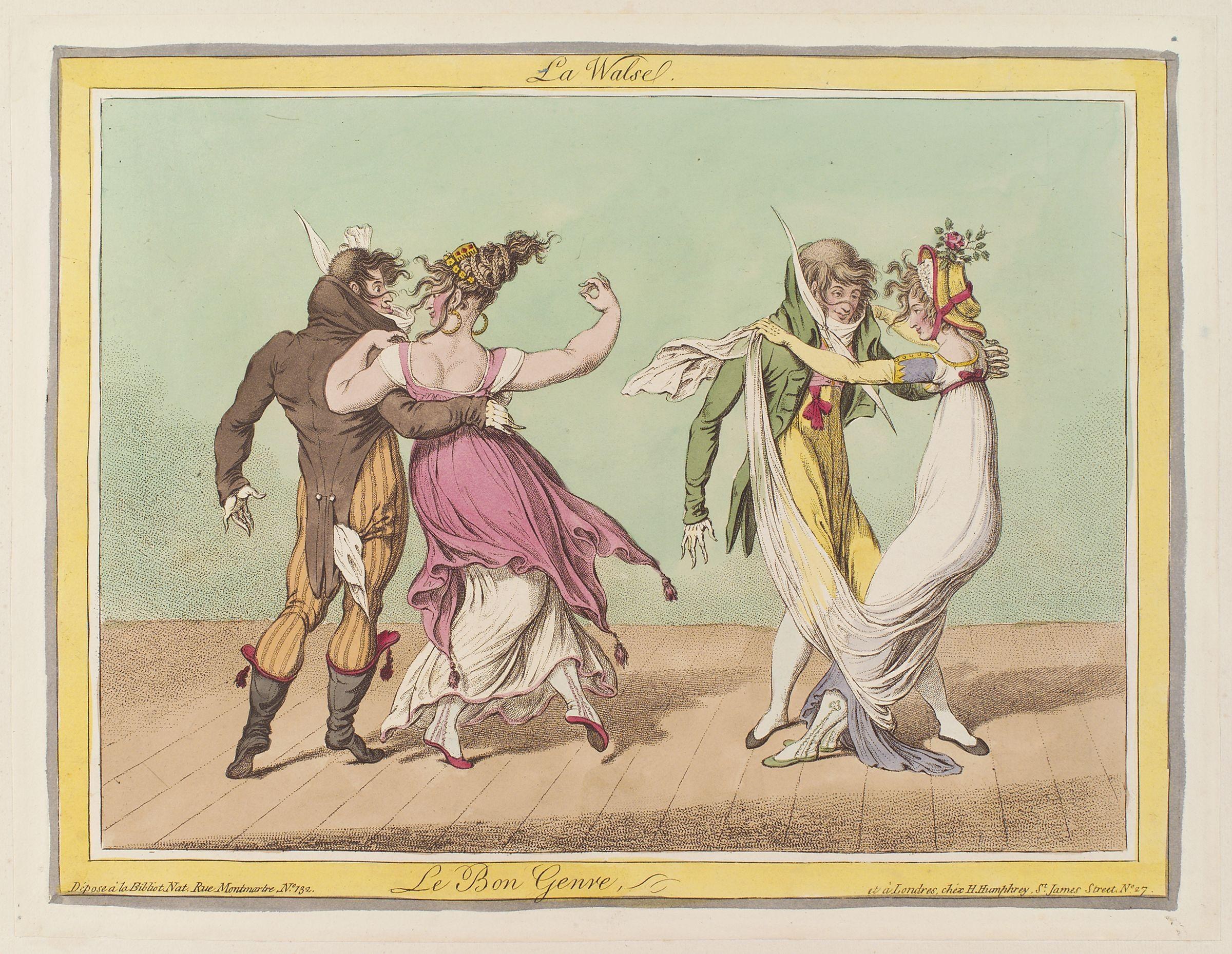
La walse by James Gillray
James Gillray
- Medium:
- Oil Painting
- Dance:
- Waltz
- Era:
- Early 1800s (Waltz Revolution)
- Source:
- Wikimedia Commons
- Rights:
- Public domain — free to use, share and adapt.
- Recorded as:
- Public Domain
For dance historians, this engraving is primary evidence of how the waltz's innovations—particularly the closed couple-hold—were perceived as scandalous in early 19th-century English society. For visual culture scholars, it exemplifies Gillray's method: he does not exaggerate the hold or the frame, but rather presents two versions of identical physical contact and lets the viewer's own anxieties fill in the moral difference. For anyone studying the cultural resistance to new forms of intimacy, the work documents a moment of genuine social rupture.
What you are looking at
A satirical engraving depicting four figures in a ballroom setting, illustrating the controversial waltz as it appeared in early 19th-century England. On the left, a demonic male figure with exaggerated features and a sword grasps a woman in pink drapery from behind; she throws her head back in what appears to be rapture or alarm. On the right, a more conventionally dressed young man in green and gold holds a woman in flowing white drapery, their bodies in close proximity. Both pairs are positioned on a wooden floor against a pale green background, suggesting an indoor dance space. The composition contrasts the grotesque and the genteel, inviting the viewer to judge which couple represents the moral danger the waltz supposedly posed. The title "La Walse" appears at top and bottom, with publication information in French.
The dancing
The left pair shows the man's arm wrapped around the woman's waist from behind in a close embrace; her arms are raised and her body leans backward in an exaggerated swoon. The right pair demonstrates a forward-facing closed hold with the man's arm at the woman's waist and their bodies turned together, a more restrained version of the same intimate contact. Both women's heads are thrown back, suggesting dizziness or loss of control. The disparity in technique between the two couples appears deliberate: the left pair embodies disorder and abandon, while the right suggests respectability—yet both employ the characteristic waltz frame of arm-to-waist contact that was itself the source of moral outrage.
The dance depicted
This is unquestionably a waltz, the couple-dance that scandalized British society in the early 1800s. The waltz had only recently arrived from the Continent and was shocking principally because the gentleman placed his arm around the lady's waist—a liberty previously reserved for married couples or courtship in private. Gillray's satirical comparison suggests that even the 'respectable' version of the waltz (right) embodied the same moral transgression as its most grotesque caricature (left). The artist understood the hold and the turning movement of the dance, but weaponized that understanding for social commentary rather than dance documentation.
How it was made
This is a hand-colored engraving or etching, not an oil painting as the record states. The fine line work, the composition suggesting reproduction for circulation, and the publication line identifying an English printer all support this identification. The technique allowed Gillray's satirical imagery to be reproduced and sold widely to a London audience invested in anxieties about Continental manners and sexual propriety. Color was applied by hand after printing, a labor-intensive process that indicates the work's market value and intended audience of educated, affluent viewers.
About this work
This is James Gillray's mordant visual argument against the waltz, staged as a comparison between two versions of the same dance and finding them morally equivalent. The work sits at the intersection of dance history, social history, and political satire: it documents not how the waltz was danced, but how it was seen—as an invasion of bodily propriety that no amount of genteel execution could redeem. The image matters precisely because it reveals the anxieties the waltz provoked and the specific bodily contact that scandalized observers. Gillray's caricature is a historical source for understanding not the dance itself but the moral panic surrounding its adoption in England.
How to look at it
Attend first to the composition's symmetry: Gillray presents two versions of the same moment, inviting comparison. The left pair is rendered grotesque through exaggeration of feature and expression, but the hold and frame are anatomically identical to the right pair—which suggests that the difference is social judgment rather than physical fact. Notice how both women's eyes are directed upward and their heads thrown back, a gesture that reads as both ecstasy and loss of control. The engraver's line-work is deliberately precise: the folds of drapery, the curve of the spine, the position of the hands are all carefully observed, which makes the grotesquerie of the left figure all the more pointed. Gillray is not exaggerating the dance itself; he is using facial features and dress to stage a moral argument about the same bodily contact.
The artist
James Gillray (1757–1815) was the preeminent English satirical engraver of his era, known for savage political and social commentary delivered through expertly observed caricature. His prints were widely circulated in London and were influential in shaping public opinion on matters from politics to fashion. Gillray often targeted Continental influences and social change, positioning himself as a defender of English propriety. His technical mastery of the engraver's art allowed him to pack tremendous visual information and wit into a single image; his anatomical knowledge and ability to exaggerate without losing recognizability made his work both immediately legible and enduringly memorable.
The period
The waltz arrived in England from Vienna and Germany in the late 1780s and became a flashpoint for anxieties about Continental decadence, sexual propriety, and social change during the Regency era (1811–1820). Opponents of the dance objected primarily to the closed couple-hold, which allowed unmarried partners to stand in intimate physical contact in public. By 1810, when Gillray made this print, the waltz had become fashionable among the young and wealthy but remained controversial among conservative observers and moralists. The engraving captures a moment of cultural transition: the waltz would eventually become the dominant ballroom dance of the 19th century, but in 1810 its status was still fiercely contested. Simultaneously, Gillray's career was entering its final phase; he would stop working in 1811 and die in 1815.
Where it lives
The source is Wikimedia Commons, which does not indicate a holding collection. The work was published as a commercial print in London and circulated widely; many impressions likely survive in public collections and private hands. The publication line reads "Dis'd a la Bibliothek Nat. Rue Mde Monmartre No92" and "at London chee H.Humphreys S.James Street No 27," indicating simultaneous distribution in Paris and London.
Dance in this work
Questions about this work
Why was the waltz so controversial?
The waltz required the gentleman to place his arm around the lady's waist in a closed embrace, which was considered an improper liberty for unmarried couples in early 19th-century England. The dance also involved rapid turning and movement that was thought to excite the passions and compromise modesty. Conservative observers feared it represented Continental decadence and a threat to English propriety.
Did Gillray dance the waltz himself?
There is no evidence that Gillray was a dancer. He was a visual satirist who understood the waltz principally as a social phenomenon and opportunity for commentary. His knowledge of the dance appears to be observational rather than experiential, though his rendering of the hold and frame suggests he had watched it closely.
Is this engraving accurate to how the waltz was actually danced?
The hold and frame are accurate to the waltz as it was performed. What is not accurate is the exaggeration of the left figure's features and expression. Gillray is using his engraver's skill to separate the physical fact of the dance from the moral judgment he wishes to invite—suggesting that respectable and disreputable versions of the waltz are physically identical.
What does the French title suggest about the waltz's origins?
The French title "La Walse" (not standard French) emphasizes the dance's Continental, specifically Germanic, origins. Gillray's publication of the work in both Paris and London suggests awareness of the waltz as a transnational phenomenon, though his satire is directed primarily at English anxiety about adopting Continental manners.
More Waltz artwork