40 works in this view — arrow keys or swipe to move between them.
Dance in Art · 1883
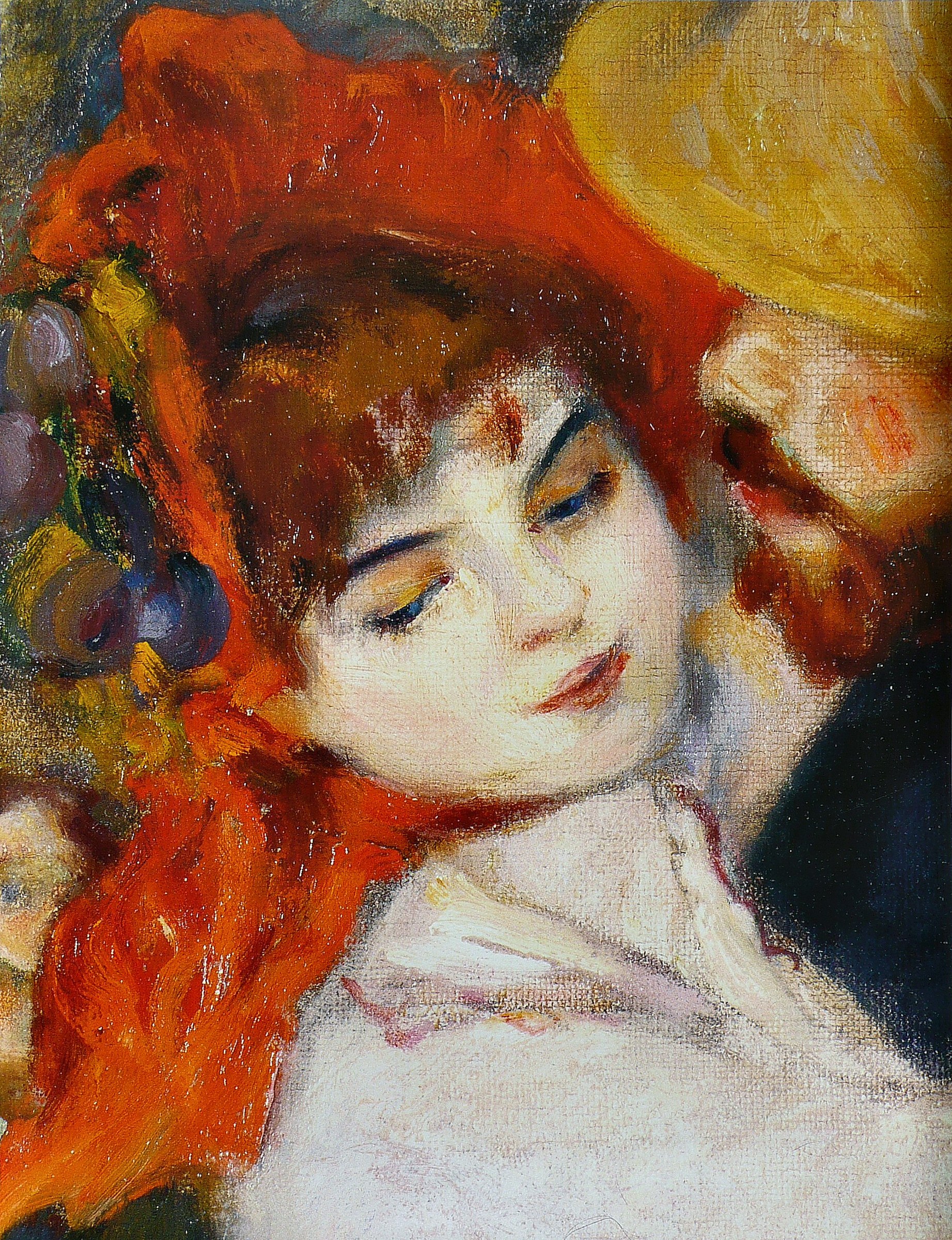
Pierre-Auguste Renoir - Suzanne Valadon - Dance at Bougival - Detail
Pierre-Auguste Renoir
- Medium:
- Oil Painting
- Dance:
- Waltz
- Era:
- Late 1800s (Victorian Ballroom)
- Source:
- Wikimedia Commons
- Rights:
- Public domain — free to use, share and adapt.
- Recorded as:
- Public Domain
Renoir's *Dance at Bougival* is a canonical work of late 19th-century figure painting and a crucial document of how Impressionist and post-Impressionist artists represented social dance as a site of beauty, leisure, and modernity. The work shows that dance was not merely a narrative subject for academic painters but a vehicle for exploring light, colour, and the modern social body.
What you are looking at
A young woman with bright reddish-orange hair, shown in profile and looking downward with a serene expression, dominates the composition. She wears a white or pale cream garment that exposes her shoulder and décolletage. Behind and around her are warm golden-yellow tones suggesting drapery or a interior lit by warm light, and touches of deeper red-orange that echo her hair. At the left margin, partially visible, are small dark forms—possibly grapes or fruit on a vine. The painting is executed in loose, sensuous brushwork with a luminous quality; the figure's pale skin contrasts sharply against the warm background, and the overall effect is intimate and decorative rather than narrative. The style and execution suggest this is a fragment or detail extracted from a larger composition.
The dancing
A single female figure, shown from approximately mid-torso upward, in a relaxed and contemplative pose. Her head is tilted slightly downward and turned in profile; her gaze is lowered. Her shoulders are bare or nearly bare, and the white fabric of her garment drapes loosely. There is no suggestion of active movement or dance posture—the figure is stationary and composed, without the lifted spine, engaged core, or directional momentum that would characterize a dancer mid-movement.
The dance depicted
The catalogue record attributes this work to Renoir and identifies it as a detail from *Dance at Bougival*, a painting that depicts dancers in a social setting. However, the image shown here does not depict active dance. It is a portrait-like detail of a single woman at rest or in a moment of stillness. If this is indeed extracted from a larger dance scene, it represents the pause between movements or the moment of courtship and flirtation rather than the dance itself. Without seeing the full composition, the precise dance style cannot be determined, but the date (1883) and French context suggest a late 19th-century social dance—likely a waltz or other ballroom form popular in the Gilded Age.
How it was made
Oil painting on canvas, executed in an Impressionist-influenced style characterized by broken brushwork, warm colour harmonies, and an emphasis on light and skin tone rather than precise linear definition. The technique allows for luminosity and a sense of immediacy; the loose handling of paint and the way drapery and hair are suggested rather than delineated creates a decorative, somewhat dreamlike effect. This approach was well suited to salon painting and intimate figure studies of the period, designed to appeal to collectors of Parisian art.
About this work
This is a detail from Pierre-Auguste Renoir's *Dance at Bougival* (1883), a painting celebrating social dancing in the Gilded Age. The work exemplifies Renoir's interest in rendering the human figure, particularly women, in warm, glowing light. The full composition depicts a dance in an open-air or garden setting, and this detail isolates one dancer in a moment of rest or introspection, showing the artist's skill in rendering complexion, hair, and fabric with luminous colour and soft brushwork. The painting belongs to a tradition of French salon painting that took social dancing—and the sociability, courtship, and leisure it represented—as a subject worthy of serious artistic attention.
How to look at it
Focus on the contrast between the pale, luminous skin of the figure and the warm, golden background. Observe how Renoir uses colour—the red-orange hair, the white drapery, the golden light—to create visual harmony rather than strict anatomical or spatial accuracy. The downward gaze and relaxed posture suggest a moment between movements, a pause in the social dance that allows the viewer to contemplate the figure's face and form. The detail encourages an intimate, almost portrait-like engagement with the dancer.
The artist
Pierre-Auguste Renoir (1841–1919) was a leading figure of Impressionism and one of the most prolific and celebrated painters of the 19th century. He excelled at figure painting, particularly portraits and scenes of leisure and sociability, and was known for his luminous treatment of skin tone and his ability to capture the charm and vitality of contemporary life. His work was highly sought after by collectors and was exhibited widely in salons and galleries across Europe.
The period
In the 1880s, social dancing—especially the waltz, quadrille, and other ballroom forms—was a central element of bourgeois leisure and courtship in Western Europe. Painters of the period, from Edgar Degas to Henri de Toulouse-Lautrec, took an interest in dance as a subject, whether in the context of ballet, cabaret, or salon society. Renoir's approach was more celebratory and decorative than that of some contemporaries; his dance paintings emphasize beauty, light, and the pleasures of sociability rather than satire or social critique. The painting reflects the Gilded Age's fascination with modern leisure and the display of fashionable society.
Where it lives
The image is sourced from Wikimedia Commons. The full painting, *Dance at Bougival*, is a well-documented work in the Renoir oeuvre; its current location and full accession details are not stated in the catalogue record provided.
Dance in this work
Questions about this work
Is this painting showing an actual dance?
This detail does not show active dancing; it is a pause or moment of stillness extracted from the larger composition *Dance at Bougival*. Renoir has chosen to depict the figure at rest, inviting contemplation of her beauty and the play of light on her face and garment rather than the movement of the dance itself.
What dance does the full painting depict?
The title *Dance at Bougival* refers to a specific location (Bougival, a village near Paris popular for outings and dances), but the full composition likely depicts a waltz or other ballroom social dance of the 1880s, popular in Parisian salon society. The exact style is not documented in the available record.
Why is Renoir showing just one woman and not the dance itself?
By isolating this figure as a detail, Renoir emphasizes the erotic and aesthetic appeal of the female body and the effect of light on skin and fabric. This was a common strategy in late 19th-century salon painting, where dance served as a pretext for exploring beauty, leisure, and modernity rather than the choreography or technique of the dance.
More Waltz artwork