49 works in this view — arrow keys or swipe to move between them.
Dance in Art · 1880
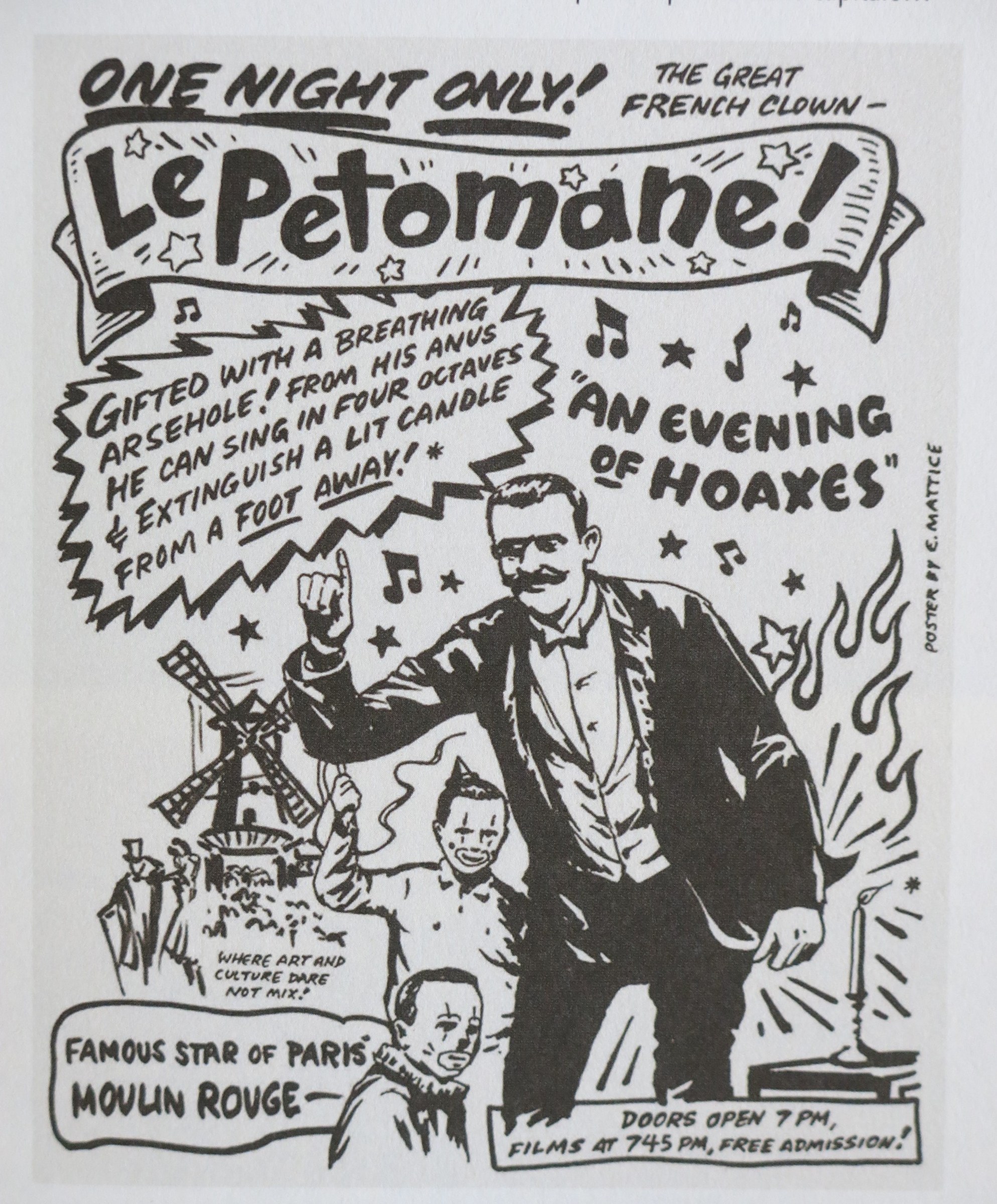
Advertisement about the Pétomane
Tangopaso
- Medium:
- Oil Painting
- Era:
- Late 1800s (Victorian Ballroom)
- Source:
- Wikimedia Commons
- Rights:
- Public domain — free to use, share and adapt.
- Recorded as:
- Public Domain
The Pétomane is an overlooked figure in the history of bodily control and performance art. This advertisement reveals how vaudeville entertainment—physical virtuosity without narrative or music—was promoted and understood in the late 1800s, and how the body's unconventional capabilities could command an international stage and paying audience. For those studying performance history, non-dance bodily spectacle, or Belle Époque popular culture, this work is a vivid primary document.
What you are looking at
This is a hand-drawn advertisement for a vaudeville performance, rendered in bold black ink with the energy of a circus poster. A mustachioed man in formal evening dress—white shirt, dark jacket, bow tie—stands center-stage with his fist raised triumphantly, one leg extended in a theatrical pose. Around him swirl musical notes, stars, and flames. To his left stands a small windmill (a reference to the Moulin Rouge), and below him two stylised child performers in clown makeup grin up at the viewer. The text proclaims "ONE NIGHT ONLY! THE GREAT FRENCH CLOWN—Le Pétomane!" and advertises "An Evening of Hoaxes," promising the performer can "sing in four octaves" and "extinguish a lit candle from a foot away" using only his breathing arsenal. The phrase "Where art and culture do not mix!" appears in a speech balloon. At the bottom, a label reads "Famous Star of Paris / Moulin Rouge," with practical details: "Doors open 7 PM, Films at 7:45 PM, Free Admission!"
The dancing
The central figure commands the composition through an exaggerated theatrical stance: torso twisted, one arm raised in a victorious gesture, the other anchoring the pose, one leg kicked backward in a burlesque or music-hall strut. The posture is pure vaudeville—all swagger and showmanship, with no technical dance vocabulary visible. The body language reads as comedic performance rather than any codified dance form. The two child figures below are posed in playful, exaggerated attitudes typical of clown or acrobatic entertainment.
The dance depicted
This is not a depiction of dance in any traditional sense, but rather a music-hall or cabaret performance piece. The Pétomane (stage name of Joseph Pujol, 1857–1945) was a legendary French performer whose act consisted of precise control of abdominal and intestinal sounds, produced through breathing manipulation and body control. He performed at the Moulin Rouge in Paris between 1887 and 1914. The "dance" elements here are purely theatrical posturing and gestural showmanship—the body attitude of a confident entertainer rather than choreography. The advertisement emphasizes his comedic and novelty act, not movement.
How it was made
This is a printed advertisement, likely a lithograph or letterpress poster, executed in a bold graphic style typical of late 19th-century music-hall publicity. The hand-drawn quality, the use of dynamic line work, musical notation symbols, and stars, and the informal yet legible typography all point to a commercial printing technique designed for quick reproduction and high visibility. The technique allowed for rapid, eye-catching dissemination on street corners and theatre walls, addressing a popular urban audience unfamiliar with the performer's name but attracted by visual spectacle and promises of novelty.
About this work
This is a vaudeville advertisement for Le Pétomane, a celebrated novelty performer at the Parisian Moulin Rouge in the late 1800s. Although the work depicts performance rather than dance in any choreographic sense, it captures the theatrical posturing and showmanship central to music-hall entertainment of the era—a form that influenced early 20th-century cabaret, acrobatic theatre, and avant-garde performance art. The image is valuable as documentary evidence of how such acts were marketed to the public, and of the performative codes and body language audiences associated with cutting-edge vaudeville entertainment. It shows the symbiosis between novelty, comedy, visual spectacle, and bodily control that defined Parisian cabaret culture.
How to look at it
Pay attention to the poster's visual codes of excitement and spectacle: the radiating lines, musical notes, stars, and flames all signal novelty and entertainment. Notice how the figure's pose is one of pure theatrical confidence—no graceful line, no classical proportion, just emphatic gesture and showmanship. The clown faces below anchor the act's comic intent. The text's promises (breathing in four octaves, extinguishing candles) emphasize bodily control and precision rather than aesthetic beauty, which is the key to understanding what the Pétomane offered audiences: proof of human capability at the edge of the grotesque and impossible.
The artist
The artist is credited as "Tangopaso" in the record; the name does not correspond to any major poster artist of the period and may be a pseudonym, house mark, or archival error. The style is consistent with popular French theatrical lithography of the 1880s–1890s, executed in the idiom of Toulouse-Lautrec and his contemporaries, but with cruder draftsmanship and simpler composition. The work shows competent graphic design for commercial purposes but no distinctive artistic signature.
The period
The Moulin Rouge opened in 1889 and quickly became the epicentre of Parisian cabaret entertainment. The 1880s and 1890s saw an explosion of music-hall, vaudeville, and circus acts marketed to urban working and middle-class audiences. This was the era of the can-can, the chahut, and increasingly, novelty and acrobatic acts that pushed the boundaries of acceptable bodily display. The Pétomane's act exemplifies the Belle Époque fascination with bodily virtuosity divorced from classical dance training—a trend that influenced Symbolist art and early modernist performance. The cabaret stage became a laboratory for new forms of entertainment that valued surprise, comedy, and the transgressive as much as beauty.
Where it lives
The work is listed as held in Wikimedia Commons, a digital archive, with no institutional accession number or physical location recorded. The catalogue record attributes it to 1880, though the Moulin Rouge did not open until 1889; the advertisement itself is dated to the Pétomane's active years (1887–1914), making 1880 almost certainly an error.
Questions about this work
Who was the Pétomane?
Joseph Pujol (1857–1945), performing under the stage name Le Pétomane, was a French vaudeville entertainer famous for his extraordinary control of abdominal and intestinal sounds. He performed at the Moulin Rouge in Paris from 1887 to 1914 and became one of the highest-paid performers of his era. His act was based on precise bodily control, not dance, but represented a form of physical virtuosity that captivated international audiences.
Is this a dance?
No. The Pétomane's act was not dance but rather a novelty performance based on sound production and bodily control. The theatrical posturing shown in this advertisement is vaudeville showmanship—the gestures and attitudes that framed his performance—but there is no choreography or movement vocabulary in the modern sense.
Why is this image important to performance history?
This advertisement documents how late 19th-century cabaret marketed bodily spectacle and novelty entertainment to mass audiences. It shows the visual language used to advertise acts that broke conventional boundaries between dance, circus, theatre, and transgressive bodily display. For historians of performance, celebrity, and Belle Époque popular culture, it is a rare primary source.
What does 'Where art and culture do not mix!' mean?
This tongue-in-cheek caption suggests that the Pétomane's act was deliberately lowbrow, novelty-based entertainment rather than serious artistic endeavour. It is a marketing strategy positioning the performance as transgressive fun—precisely what made it popular and controversial in equal measure.
More dance artwork