49 works in this view — arrow keys or swipe to move between them.
Dance in Art · 1906
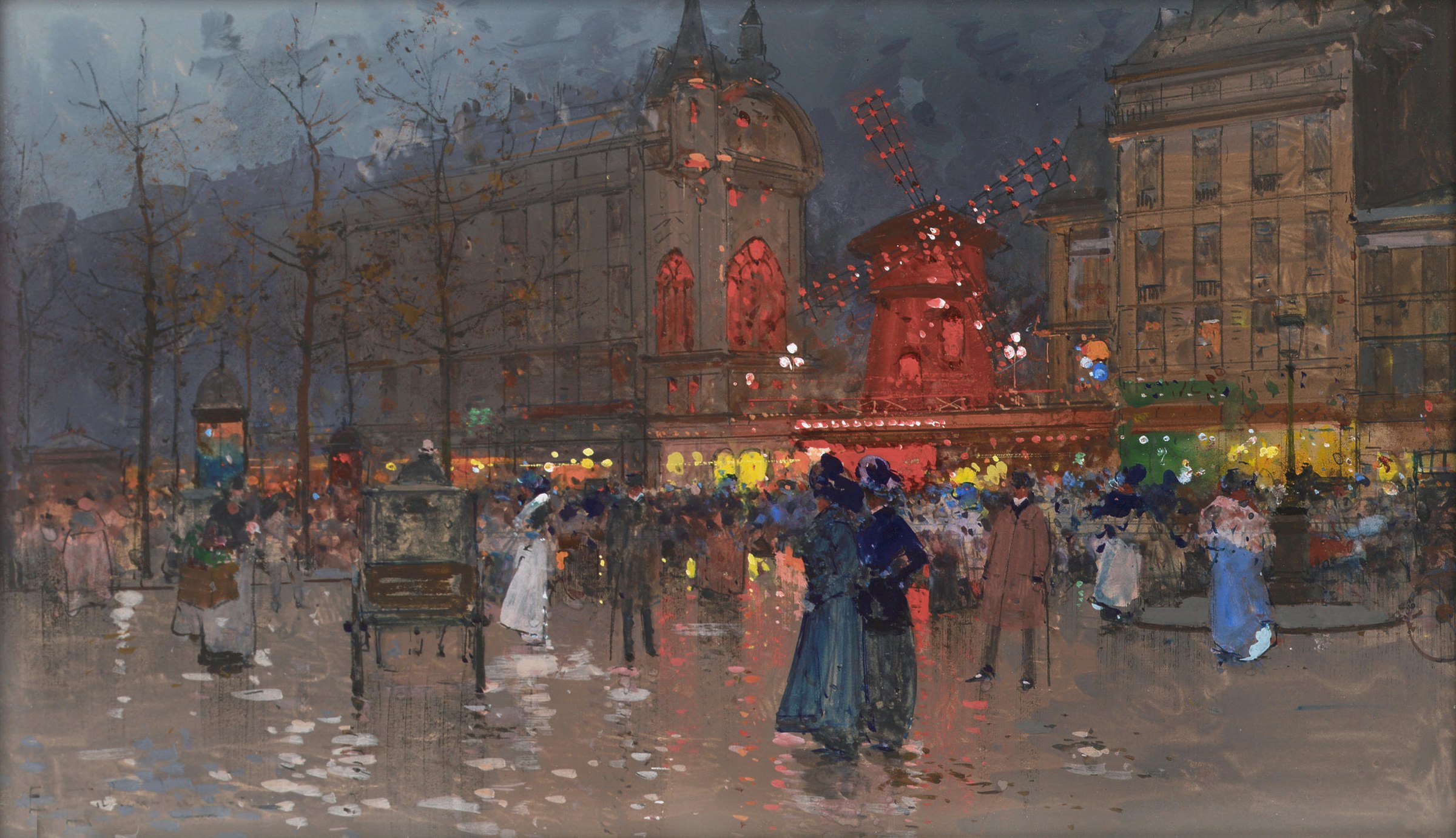
Eugène Galien-Laloue The Moulin Rouge evening
Eugène Galien-Laloue
- Medium:
- Oil Painting
- Era:
- 1900-1920 (Ragtime/Early Jazz)
- Source:
- Wikimedia Commons
- Rights:
- Public domain — free to use, share and adapt.
- Recorded as:
- Public Domain
This painting documents the Moulin Rouge as a working social space for dance and entertainment, not as an abstracted or romanticized subject. It shows the scale of popular attendance at music halls and captures the relationship between urban architecture, public congregation, and the culture of social dance in the Belle Époque. For historians of dance, the work is evidence of how performance venues were embedded in city streets and streetlife, and of the role of spectacle and public gathering in early modern entertainment.
What you are looking at
A crowded evening scene at the Moulin Rouge in Paris, painted in loose, impressionistic brushwork. The cabaret's distinctive red dome and illuminated signage dominate the center, its bright red lights rendered in warm strokes that glow against the twilight sky. Hundreds of figures fill the square in front and to either side—well-dressed Parisians in coats, hats, and gowns in muted blues, browns, and grays, their forms simplified into loose silhouettes. The wet pavement reflects light, suggesting recent rain or damp evening air. Bare trees frame the left side of the composition. To the right, the façade of a Haussmann building glows with golden interior light from its tall windows. The painting captures the thronged, glamorous atmosphere of Belle Époque nightlife: this is the moment of arrival and gathering, not performance—bodies approaching, circulating, waiting to enter.
The dancing
The figures are rendered as a crowd rather than as articulated dancers: hundreds of small, gestural forms in profile and three-quarter view, many wearing formal evening dress. Some stand in loose clusters; others move through the square. The artist has not detailed individual bodies or dance positions—instead the effect is of massed social movement, people arriving and congregating. Posture is upright and promenade-like. There is no evidence of closed holds, partner work, or the specific frame that would characterize ballroom or concert dance. The scene records social movement and public gathering rather than formal choreography.
The dance depicted
This is not a depiction of dance performance but of the social dance environment—the cabaret as a destination for public entertainment and socializing in early 1900s Paris. The Moulin Rouge (Red Mill) opened in 1889 and became the most famous music-hall of the Belle Époque, associated with the can-can and other popular dances performed on stage. The painting shows the street scene and arrival experience rather than any specific choreography. The era label (1900–1920, Ragtime/Early Jazz) is anachronistic for the Moulin Rouge's primary associations, which were with 1890s French can-can and cabaret. The work documents the cultural infrastructure of dance rather than dance itself.
How it was made
Oil painting on canvas, executed in a loose impressionistic manner with thin applications of color and sketchy brushwork, particularly visible in the rendering of the crowd and the wet pavement. This technique—rapid, suggestive rather than detailed—was well suited to capturing the shifting light and atmospheric effects of an evening street scene. The painting's style and scale indicate it was a finished work for exhibition rather than a preparatory sketch, likely intended for a middle-class or collector audience interested in contemporary Parisian scenes. The loose handling of the crowd reflects late 19th-century impressionist influence.
About this work
Eugène Galien-Laloue's view of the Moulin Rouge evening is a social and architectural document of the Belle Époque cabaret as a public institution. The painting does not depict dance itself but rather the context in which dance—particularly the can-can and popular music-hall entertainment—took place. It records the moment of public arrival and congregation at one of Paris's most famous pleasure venues, capturing the glamour and crowding that drew thousands to nightlife in the early 1900s. The work is valuable precisely because it situates dance within its actual social and urban setting: not a theater interior with performers on stage, but the street, the crowd, the façades, and the evening light that framed the experience of going out to dance.
How to look at it
Attend to the scale of the crowd and the impressionistic handling of individual figures—the artist is showing you not specific dancers but the experience of arrival and congregation. Notice the contrast between the warm, glowing interior of the cabaret (the red dome and lit windows) and the cool evening tonality of the street. The wet pavement catches light and suggests the moment is dusk or early evening, the transition into nightlife. The painting's value lies in what it shows about the relationship between the building, the crowd, and the urban setting—how dance entertainment was not a private or elite activity but a public, massed experience accessible to hundreds on any given evening.
The artist
Eugène Galien-Laloue (1854–1941) was a prolific French painter known for street scenes and urban landscapes of Paris, particularly depicting the Belle Époque and early 20th-century city life. He was skilled in capturing atmospheric effects—rain, evening light, crowds in motion—using a loose impressionistic technique. His work was commercially successful and widely reproduced; he painted numerous versions of popular subjects including the Moulin Rouge, the Eiffel Tower, and Parisian boulevards. He was not a narrative painter or genre specialist but rather a painter of the modern city in its everyday and festive aspects.
The period
The Moulin Rouge opened in 1889 and was at the height of its fame and attendance in the 1900s–1910s. The can-can and other high-energy French popular dances were performed there nightly. This period saw the emergence of the music hall as a major urban entertainment form, distinct from both classical theater and from the earlier salon or ballroom. The Belle Époque (roughly 1870–1914) was a period of rapid urban growth, electric lighting, and mass public entertainment in Paris. Galien-Laloue's painting falls in the early 1900s, when the Moulin Rouge was at its cultural peak and a symbol of modern, democratic access to spectacle and entertainment. The impressionist and post-impressionist artistic movements had normalized the representation of contemporary urban life as a subject worthy of fine art.
Where it lives
The work is catalogued on Wikimedia Commons and is reproduced in standard collections of Galien-Laloue's work. No specific holding collection or accession information is recorded in the catalogue.
Questions about this work
Can you see any actual dancing in this painting?
No. This painting shows the street outside the Moulin Rouge, not the interior stage or performance space. The figures are arriving and gathering, not dancing. To see the can-can or other music-hall dances performed there, you would need to look at paintings or prints showing the stage interior, or at posters and photographs from the period.
Why is the Moulin Rouge important to dance history?
The Moulin Rouge (opened 1889) was the most famous music hall of the Belle Époque and became synonymous with French can-can and high-energy popular dance. It pioneered the large-scale cabaret format—multiple acts, orchestral accompaniment, elaborate staging, and nightly performances for a paying public. It made dance entertainment a mass, commercial, democratic form rather than an elite or court activity.
What period is this painting from?
The catalogue dates it to 1906. The style, dress, and the Moulin Rouge's mature appearance as an established institution all support this date. The painting comes from the height of the Belle Époque, about 17 years after the cabaret opened and at a moment when it was drawing hundreds of visitors nightly.
What is Galien-Laloue known for?
Eugène Galien-Laloue (1854–1941) was a prolific painter of Parisian street scenes and urban landscapes. He specialized in capturing the atmosphere of the modern city—rain, evening light, crowds, electric lighting—using a loose, impressionistic technique. His work was commercially popular and widely reproduced, making him one of the most recognizable painters of Belle Époque Paris.
More dance artwork