49 works in this view — arrow keys or swipe to move between them.
Dance in Art · 1900
Le Moulin Rouge, Paris
Eugène Galien-Laloue
- Medium:
- Gouache
- Era:
- 1900-1920 (Ragtime/Early Jazz)
- Source:
- Wikimedia Commons
- Rights:
- Public domain — free to use, share and adapt.
- Recorded as:
- Public Domain
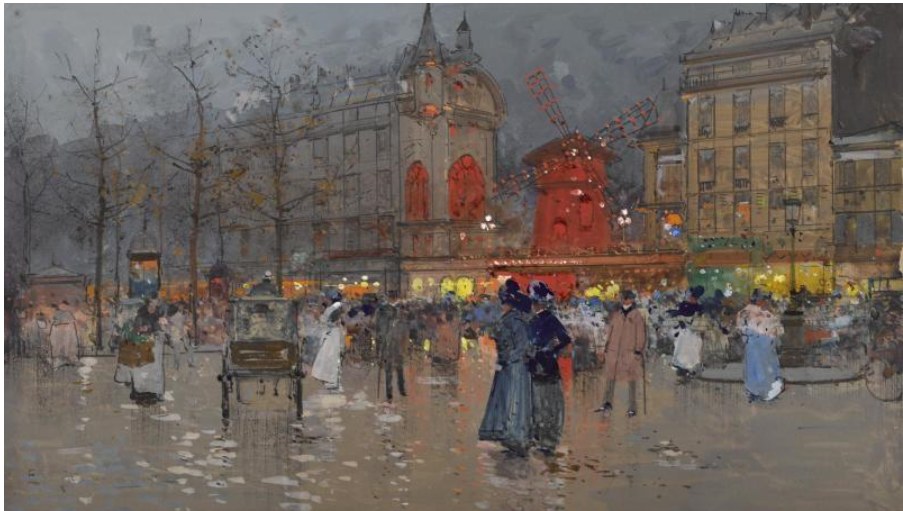
The Moulin Rouge defined early modern cabaret and was the birthplace of the can-can as a theatrical form; this painting records the venue and its social world at the moment of its greatest celebrity. For historians of dance and urban culture, Galien-Laloue's work provides rare visual evidence of how audiences assembled, how entertainment venues functioned as public spaces, and how dance was integrated into the spectacle and commerce of the modern city.
What you are looking at
A crowded evening scene at the Moulin Rouge in Paris, the famous cabaret visible with its distinctive red windmill silhouetted against a grey twilight sky. The square before the venue fills with hundreds of figures in fashionable dress of around 1900: women in long skirts and hats, men in suits and bowlers, all rendered in loose watercolour brushwork that suggests movement and atmosphere rather than precise detail. The composition is aerial and panoramic, looking down on the crowd from above. Bare winter trees line the square, gas lamps glow yellow in the gathering dusk, and the warm red neon of the cabaret's signage contrasts with the cool grey of the sky and pavement. The scene captures a moment of urban leisure and spectacle—this is not a dance performance but the crowd that gathers to attend one.
The dancing
The figures are rendered as small, generalised forms—Galien-Laloue prioritises the overall effect of the crowd over individual anatomy. Bodies stand, stroll, and cluster in loose groups; weight is distributed casually across standing legs, suggesting idle waiting and socialising rather than choreographed movement. Dress is legible despite the loose brushwork: long skirts on women constrain the legs and suggest the posture of the period, while the silhouettes of hats, coats, and frames create rhythm across the composition. No formal dance hold is visible, and no dancers occupy the foreground—this is a scene of spectators and pedestrians.
The dance depicted
This work does not depict dance itself but the world around dance—the venue, the crowd, the anticipation. The Moulin Rouge was the most famous cabaret in Paris, celebrated from 1889 onwards for can-can performances and entertainment. The painting captures the social and urban context of dance rather than the art form itself: the mixture of classes, the evening ritual of entertainment-seeking, the new electric-lit modernity of Parisian nightlife. For a historian of dance, the image documents not technique or performance but the spaces and audiences that made the Moulin Rouge central to the Belle Époque and to the emergence of modern entertainment culture.
How it was made
Gouache over pencil on card, a technique that allowed Galien-Laloue to work rapidly and capture light effects with translucent washes while maintaining the underlying pencil structure. Gouache dries quickly and allows for layering and correction, suited to this kind of urban scene painting. The brushwork is loose and impressionistic—figures are suggested rather than finished, the sky is built from soft horizontal strokes, and the electric light of the Moulin Rouge's signs glows through the grey. This technique was common for illustration and commercial urban views in the Belle Époque and early 20th century, and such works circulated as prints, postcards, and popular reproductions.
About this work
This is a gouache scene of the Place Pigalle at the Moulin Rouge, Paris, painted around 1900 and depicting not a dance performance but the urban crowd and venue that framed modern entertainment. Eugène Galien-Laloue was celebrated for these loose, atmospheric impressions of Paris—streets, squares, monuments in changing light. The Moulin Rouge itself, with its red windmill and neon signage, dominates the composition as a symbol of modernity and spectacle. For a dance historian, the image is valuable not for choreographic content but for evidence of how dance venues were built into urban leisure, how audiences were mixed and dressed, and how entertainment architecture shaped the experience of performance. The work belongs here as a document of dance's social geography rather than its practice.
How to look at it
Look first at the composition: the high viewpoint and panoramic format emphasise the scale and density of the crowd, the sense of gathering and social mixing. The eye is drawn to the red windmill and neon glow of the Moulin Rouge itself, which anchors the scene and explains the crowd's presence. Notice how Galien-Laloue uses light—the warm yellows of gas lamps, the cool greys of dusk, the hot red of electric signs—to create mood and atmosphere rather than naturalistic detail. Individual figures are suggested through silhouette and outline; the artist's interest is in the collective effect, the rhythm of hats and coats and movement across the square. This is urban observation in the mode of Impressionism, interested in optical effect and the modern experience of the city.
The artist
Eugène Galien-Laloue (1854–1941) was a French painter and prolific illustrator specialising in Parisian street scenes, urban landscapes, and architectural subjects. He worked in gouache, watercolour, and pencil, and his loose, atmospheric style was suited to capturing light and movement in crowded public spaces. His scenes of Paris—boulevards, bridges, squares, monuments—were popular and widely reproduced as prints and postcards, circulating among a broad middle-class audience. He was not primarily a figure painter and rarely focused on individual bodies or psychological content; his interest was in the collective life of the city, in mood and atmosphere, and in the new visual drama of modern urban lighting.
The period
This work dates to around 1900, the height of the Belle Époque and the Moulin Rouge's dominance as an entertainment venue. The can-can had emerged as a theatrical dance form in the 1880s and 1890s, and the Moulin Rouge, which opened in 1889, made it famous through high-energy ensemble performances and star dancers like La Goulue. The painting reflects the wider cultural moment in which dance was becoming professionalised, commercialised, and embedded in urban nightlife. Impressionist and post-impressionist painters of the period—Toulouse-Lautrec, Renoir, Degas—had already made cabaret and entertainment subjects central to modern art. Galien-Laloue's work is less concerned with the stage than with the street, the crowd, and the new electric-lit cityscape that framed these entertainments.
Where it lives
The work is recorded as gouache on card, signed E. Galien-Laloue lower left. It is from Wikimedia Commons, a digital source; the holding collection and current location are not recorded in our catalogue.
Questions about this work
Is there actually a can-can being performed in this painting?
No. The painting shows the crowd outside and around the Moulin Rouge, not a performance inside. It documents the venue and its social context—the audiences, the urban setting, the evening ritual of going to the cabaret—rather than depicting the dance itself. This makes it a valuable historical record of entertainment culture even though it does not show dance technique.
What is the red structure dominating the composition?
The Moulin Rouge (French for 'Red Mill'), the cabaret's landmark windmill, which was lit at night and became an iconic symbol of Paris. Opened in 1889, it was the most famous venue for can-can and cabaret performances, and Galien-Laloue has captured it as the focal point of urban entertainment and spectacle in the Belle Époque.
Why is this street scene relevant to dance history?
This painting provides rare visual evidence of how dance was embedded in urban commercial culture, how audiences were composed and dressed, and how entertainment venues functioned as public gathering spaces. It shows the Moulin Rouge at the peak of its cultural dominance and documents the infrastructure and social world that sustained modern cabaret and theatrical dance.
What is gouache and why did Galien-Laloue use it?
Gouache is an opaque watercolour medium that dries quickly and allows for rapid layering and correction. It was ideal for Galien-Laloue's loose, impressionistic style and for the kind of commercial illustration and urban scene-painting that was popular and widely reproduced in the Belle Époque. It allowed him to capture light effects and atmosphere with relative speed.
More dance artwork