49 works in this view — arrow keys or swipe to move between them.
Dance in Art · 1889
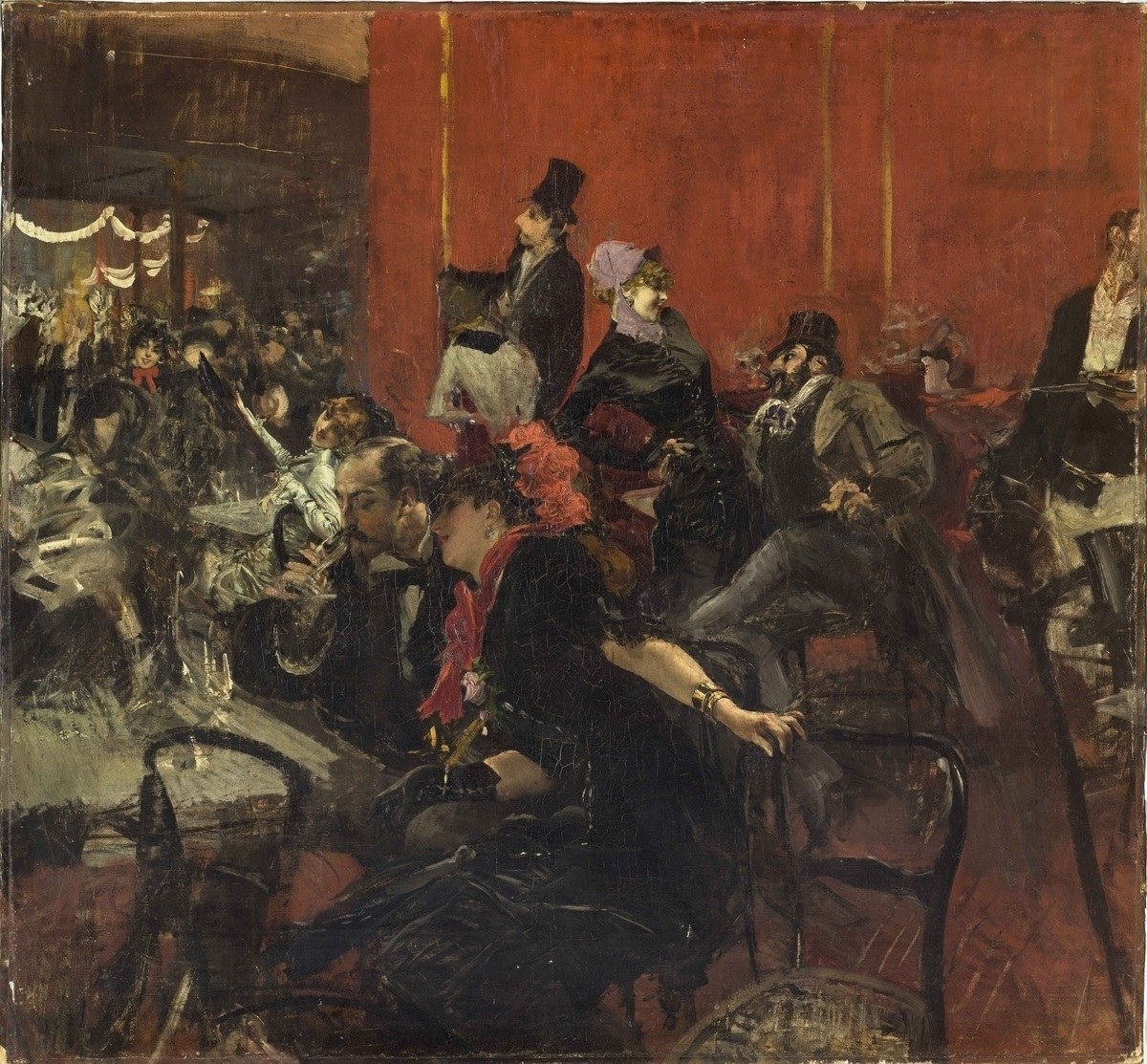
Party at the Moulin Rouge (c.1889), by Giovanni Boldini
Giovanni Boldini
- Medium:
- Oil Painting
- Era:
- Late 1800s (Victorian Ballroom)
- Source:
- Wikimedia Commons
- Rights:
- Public domain — free to use, share and adapt.
- Recorded as:
- Public Domain
The Moulin Rouge became a symbol of modern, commercialized dance entertainment and remains iconic in dance history. This painting by one of the era's most celebrated society portraitists provides a firsthand record of the venue's interior, its clientele, and the social experience of theatrical nightlife at the moment of its emergence. Understanding the context of where and how audiences experienced the can-can and other popular forms is as important to dance history as understanding the dances themselves.
What you are looking at
A crowded interior scene at what appears to be a fashionable Parisian venue, dominated by a sweeping red-brown wall that rises behind clustered figures. In the foreground, elegantly dressed men and women in dark evening clothes and pale silk gowns mingle, some seated, others standing in conversation. At left, a stage or performance area is dimly lit behind a gold-fringed drapery, where musicians or performers can be glimpsed. The composition is loose and atmospheric, with figures emerging from shadow—a woman in lavender and pale silk stands prominently center, a woman in striking red plumage at her side, surrounded by gentlemen in formal dress. The lighting is warm and theatrical, concentrated on the foreground figures while the background recedes into warm shadow, creating the impression of an evening spent in a crowded, exclusive salon or dance hall.
The dancing
The bodies are posed in the relaxed, conversational attitudes of spectators and socializers rather than dancers actively performing. Several figures stand in profile or three-quarter view, their postures upright and formal as befits evening dress. Hands gesture loosely in conversation. There is no visible hold or frame suggestive of partner dance. The scene is one of social interaction before, between, or around dancing rather than the dance itself.
The dance depicted
This is not primarily a dance scene but a social gathering in a space where dance occurs. The title references the Moulin Rouge, the famous Montmartre cabaret that opened in 1889 and became synonymous with the can-can and other forms of popular entertainment, yet the image emphasizes the spectating public, the musicians, and the fashionable setting rather than the performance or performers. No can-can dancers are clearly visible, nor any identifiable dance form. The work documents the social experience of nightlife and theatrical entertainment rather than dance itself.
How it was made
Oil painting on canvas. The technique employs loose, gestural brushwork, particularly visible in the rendering of the crowd and the atmospheric background. Boldini was known for his society portraiture and his ability to capture the energy of Parisian social life through rapid, confident brushstrokes. The warm palette of ochres, reds, and shadow creates a sense of gaslit intimacy and movement even in static poses. This scale and finish suggest a work intended for exhibition and patronage rather than commercial reproduction.
About this work
This oil painting documents the Moulin Rouge not as a performance venue but as a space of fashionable social congregation in the Gilded Age. Boldini captures the moment of gathering, conversation, and anticipation rather than the spectacle of dance itself. The work belongs in a dance gallery not because it depicts dancing, but because it preserves the social and architectural context in which new forms of popular dance—particularly the can-can—were displayed and consumed. The Moulin Rouge was revolutionary in bringing stage dance into a space of social mingling and alcohol service; this painting records that hybrid environment at the moment of its cultural dominance. It speaks to how dance and entertainment were integrated into the social life and visual culture of fin-de-siècle Paris.
How to look at it
The viewer should attend to the composition's theatricality: Boldini has organized the crowd as if it were itself a stage performance, with the lit area at the left, the prominent figures in the foreground, and the warm walls creating a sense of enclosure and spectacle. Notice how the painting emphasizes dress—the whites and pale colors of women's gowns against dark jackets, the notable red plumage of one woman—which draws the eye and conveys social status. The loose brushwork, especially in the background, conveys movement and noise without depicting dancing; this is the energy of a crowd, not of individual bodies performing.
The artist
Giovanni Boldini (1842–1931) was an Italian society portraitist and painter of Parisian life whose rapid, elegant brushwork made him one of the most sought-after artists of the Belle Époque. He specialized in capturing fashionable interiors, social gatherings, and the theatre world of Paris, often focusing on the visual pleasure and social energy of modern urban leisure. His work was celebrated for its immediacy and its flattering depiction of elegant society.
The period
The Moulin Rouge opened in October 1889, the year this painting is dated. The venue became instantly famous for the can-can, a high-kicking, rapid dance performed by women in skirts and petticoats, which had migrated from lower-class dance halls to this newly respectable cabaret setting. The 1880s and 1890s saw the professionalization and commercialization of popular dance in Paris; entertainment moved from private balls and academic stages into public cabarets and music halls where dance, alcohol, and social mingling were explicitly sold together. Boldini's work records this transformation, documenting not the dancers but the world that consumed them.
Where it lives
The work is recorded as c.1889, oil painting. The current holding collection is not recorded. The source is Wikimedia Commons, indicating it is in some public collection, but specific provenance and location are not documented here.
Questions about this work
Is this painting a scene of the can-can?
Not directly. The painting shows the audience and social setting of the Moulin Rouge, not the dancers or the can-can itself. However, the venue shown became famous for the can-can, and the painting documents the world in which that dance was performed and consumed.
Why is this in a gallery of dance art if no one is dancing?
Dance history includes not only the choreography and technique of dances themselves, but the contexts—social, architectural, economic, cultural—in which dances are performed and experienced. This painting is a primary source for understanding how and where the Moulin Rouge's audiences encountered dance entertainment.
Can you identify the specific people in the painting?
No. Boldini does not inscribe or clearly individualize the figures; they are types and silhouettes representing fashionable society. Some may have been recognizable to contemporary viewers, but the painting is not a formal group portrait.
When did the Moulin Rouge open?
October 6, 1889, the same year Boldini painted this work. The venue opened to enormous acclaim and became instantly famous as the home of the can-can and as a symbol of modern Parisian nightlife.
More dance artwork