49 works in this view — arrow keys or swipe to move between them.
Dance in Art
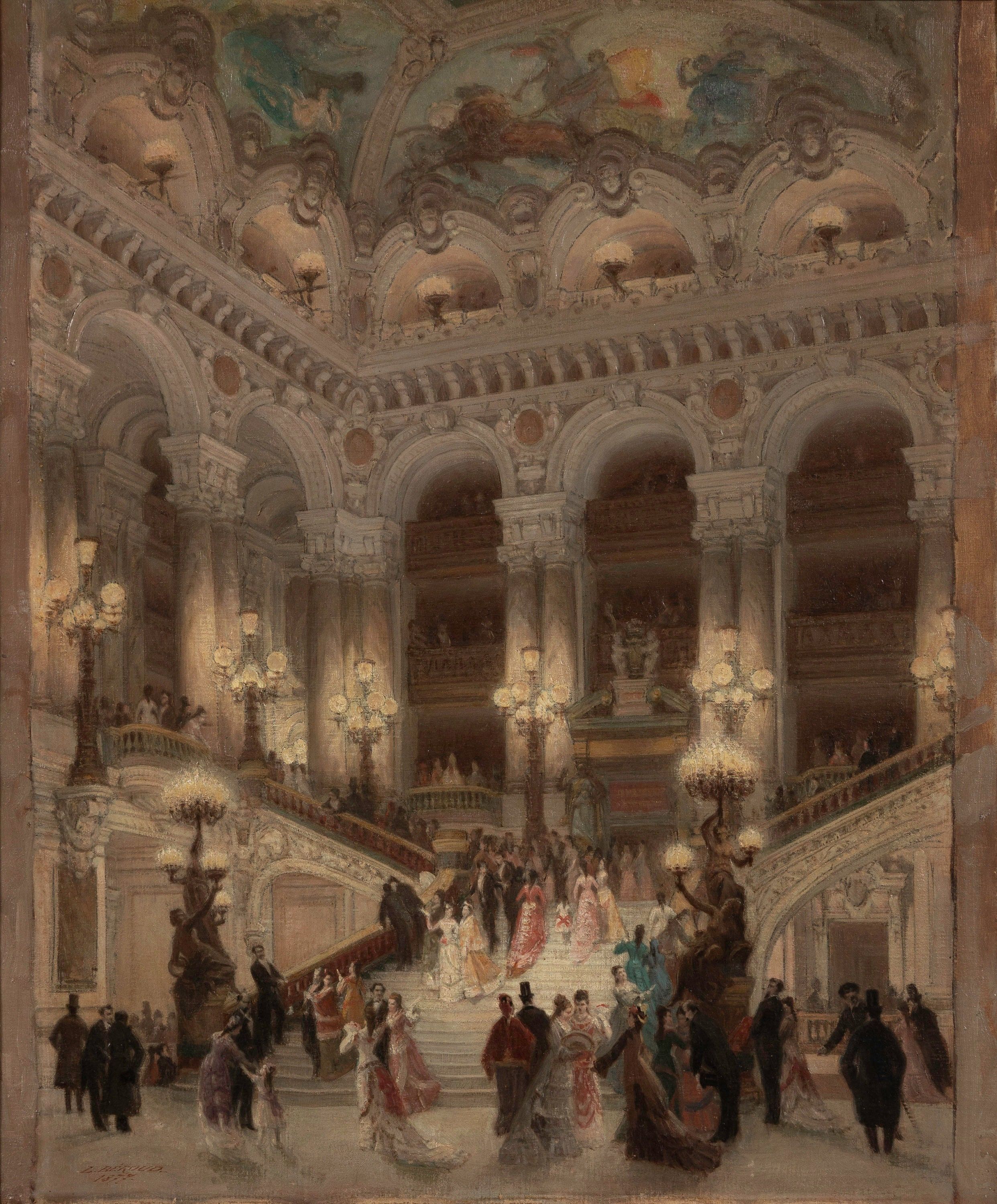
L'escalier de l'Opéra
Louis Béroud
- Medium:
- Oil on canvas
- Era:
- Late 1800s (Victorian Ballroom)
- Source:
- Wikimedia Commons
- Rights:
- Public domain — free to use, share and adapt.
- Recorded as:
- public_domain
The work documents a crucial moment in the history of the theatre building as a public institution and a locus of fashion and spectacle. While no dancing is occurring, the painting is indispensable for understanding the world in which ballet and social dance were practiced in the late 19th century: the architecture, lighting, dress, and social protocols that surrounded dance performance. Historians of opera, architecture, and social history rely on such images; for dance historians, it illuminates the context in which dancers moved and were received.
What you are looking at
A grand architectural interior, identifiable as the Palais Garnier by its distinctive ornamental vocabulary and scale, hosts an elegant evening gathering. The monumental arched colonnade recedes into deep shadow, framing figures in full formal dress scattered across a broad floor and ascending a central staircase. The composition is vertical: gaslights mounted on the columns cast a warm, theatrical glow that illuminates the cream and gilt ornamentation overhead—a coffered ceiling with sculptural details and frescoed panels—while leaving the distant depths mysterious. The crowd moves in loose formation, some ascending the stairs, others standing in conversation on the floor. Women wear pale, flowing evening gowns with trains; men are in black tailcoats and white shirts. The palette is predominantly warm earth tones and cream, with touches of jewel-coloured fabric. The moment captures neither a formal promenade nor active dancing, but rather the leisured social movement and gathering that preceded or accompanied an evening of performance or celebration.
The dancing
The figures are scattered rather than grouped in couples, their postures upright and formal. No dancers are in closed hold or recognisable ballroom frame. Most stand or walk with the bearing appropriate to formal evening dress—women with arms at their sides or slightly lifted, skirts falling straight or held gently, men in profile or three-quarter view. The composition emphasises the architectural setting over bodily gesture; the figures function partly as scale-markers for the vast interior and partly as evidence of social occasion. No footwork, weight transfer, or specific dance vocabulary is visible.
The dance depicted
This is not a depiction of dance as performance or activity. It is a gathering of people in formal dress at a moment of social assembly—the arrival or promenade at an opera or gala evening. While the setting (a grand opera house) is intimately associated with dance in the late 19th century, the figures engaged here are not dancing. They may well have danced later in the evening, or may have attended to watch performers dance within the theatre, but Béroud has chosen to show the social ritual and architectural splendour rather than choreography or technique.
How it was made
Oil on canvas in a naturalistic academic style with particular attention to light, recession, and architectural detail. Béroud's technique allows a soft, atmospheric handling of the columned space, with light pooling on surfaces and figures rendered as solids within a coherent spatial field. The work belongs to the tradition of 19th-century interior painting, where the space and its social meaning are as important as the human figures inhabiting it. The warm, diffused tonality and careful perspective suggest a work conceived for exhibition and contemplation rather than rapid reproduction.
About this work
Béroud painted the grand staircase of the newly built Palais Garnier as an emblem of Parisian modernity and leisure. The work captures a moment of social assembly on one of the most celebrated architectural interiors of the age—a space designed to showcase dress, status, and the pleasures of urban culture. Although dances were performed within the theatre (ballet being the primary offering at the Opéra), Béroud's focus here is not on choreography but on the grandeur of the stage itself and the ritual of attendance. The painting belongs to a tradition of architectural interiors and modern life painting that flourished in France in the late 19th century, documenting the spaces and practices of leisure and culture. For a gallery about dance in art, it represents an important exception: the spaces *for* dance, the social contexts that frame it, and the visual culture of an age in which attendance at the opera was a significant marker of taste and belonging.
How to look at it
Approach this as a study in light and recession rather than figure movement. Notice how Béroud uses the colonnade to draw the eye backward and upward, and how the gaslight creates zones of visibility and shadow. The sculptor figures in the ceiling ornament are almost as important as the human figures below; the architecture dominates. Look at the clothing: the cut and fabric of the women's gowns, the formality of the men's dress, the way trains and skirts move with the weight of the fabric itself. The painting is not interested in gesture or emotion but in the documentation of a social moment—the calm, orderly gathering of well-dressed people in a space designed to impress. This is how the elite of Paris moved and assembled on important evenings.
The artist
Louis Béroud (1852–1930) was a French academic painter specialising in architectural interiors and contemporary urban subjects. He was known for scrupulously detailed representations of celebrated Parisian monuments—particularly the Palais Garnier, the Louvre, and churches—often populated with elegantly dressed figures. His work is characteristic of a mode of late 19th-century painting that treated modern buildings and public spaces as symbols of progress, taste, and national achievement. Béroud's interiors are carefully composed studies of light, perspective, and social occasion, valued by museums and collectors for their documentary quality and their representation of a vanished world of 19th-century sociability.
The period
The Palais Garnier was completed in 1875, only two years before Béroud painted this canvas. It was immediately celebrated as a masterpiece of Second Empire architecture and a temple to the arts and to cosmopolitan leisure. The 1870s and 1880s saw a flourishing of ballet at the Opéra, where dancers of international renown performed to audiences drawn from the upper and upper-middle classes. The grand staircase was, and remains, one of the most photographed and painted interiors of the era—a symbol of fin-de-siècle glamour. Béroud's painting coincides with a broader European interest in depicting modern architecture and public interiors; contemporaries like Giuseppe De Nittis were painting railway stations and concert halls with similar attention to light, space, and social ritual. The painting captures the moment when the opera house had become not only a venue for performance but a destination in itself—a place to see and be seen.
Where it lives
The work is recorded in the collection of the Musée Carnavalet, Paris, an institution dedicated to the history, art, and culture of Paris. The Musée Carnavalet holds an extensive collection of paintings, prints, and objects documenting Parisian life and architecture, particularly from the 18th and 19th centuries.
Questions about this work
Is anyone actually dancing in this picture?
No. This is a social gathering—people assembled in evening dress within the grand staircase of the Palais Garnier. They are arriving, standing in conversation, and moving without choreography or dance hold. Béroud has chosen to depict the social world *around* dance and performance, not the choreography itself.
Why is this in a gallery about dance?
Because it documents the spaces, dress, and social context in which dance was performed and attended in the late 19th century. The Palais Garnier was the primary venue for ballet in Paris; understanding how it looked, how it was lit, and how audiences dressed and moved through it is essential to understanding the culture of dance in this period. The painting is less about choreography than about the theatre as a social institution.
Was the Palais Garnier really new when Béroud painted this?
Yes. The Opéra opened in January 1875, and Béroud painted this in 1877—just two years later. The building was a marvel of modern architecture and engineering, and Béroud's painting is part of a widespread effort to document and celebrate it. The newness of the space, and its grandeur, was part of its cultural significance.
What was the dress code at the opera in the 1870s?
Formal evening wear was essential. Every woman wears a ball gown with long sleeves, a fitted bodice, and a full skirt with a train; every man wears a tailcoat. This was not optional. The opera was one of the most formal occasions in Parisian social life, and dress was a crucial marker of status and eligibility. Béroud's painting documents the visual uniformity and elegance that this code produced.
More dance artwork