43 works in this view — arrow keys or swipe to move between them.
Dance in Art
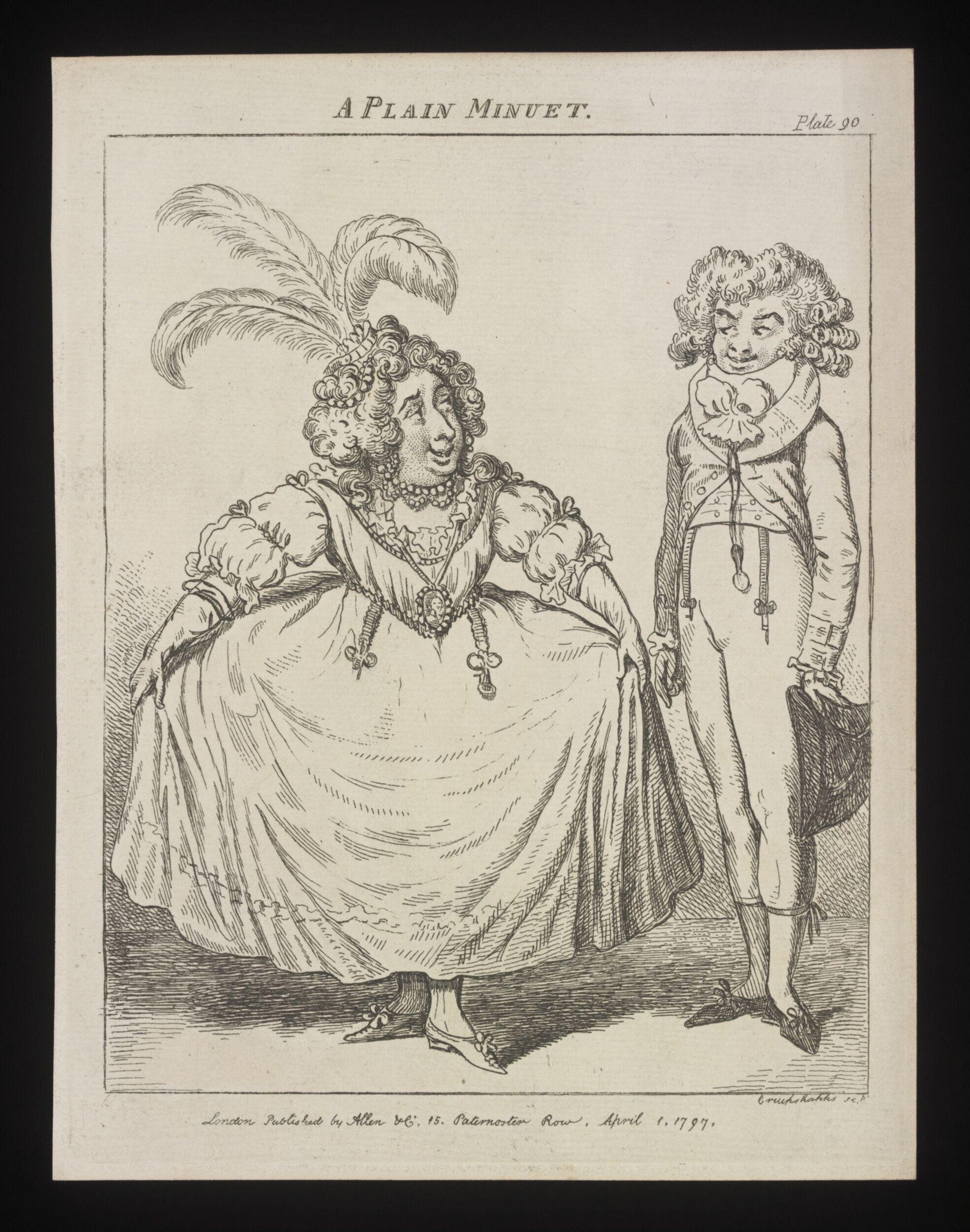
A Plain Minuet.
Woodward, George Moutard
- Dance:
- Minuet
- Era:
- 1700s (Enlightenment/Minuet Era)
- Source:
- Victoria and Albert Museum
- Rights:
- Rights vary by item — check the source record before reusing this image. Source record ↗
- Recorded as:
- Check V&A creditLine
For historians of dance and manners, this print is evidence that the minuet was not merely performed but *watched*, judged, and mocked—and that skill at the minuet was a marker of social status that not everyone could convincingly perform. The image reveals anxiety about the body in social space and the performative demands placed on women especially to display grace and youth. The print is a primary document of how dance functioned as social capital and social risk in the late 1700s.
What you are looking at
A satirical engraving presents two figures in late 18th-century dress against a plain background. On the left stands a stout woman of middle years, her body facing forward, adorned with an elaborate costume of the period: a voluminous pale gown with deep folds, short puffed sleeves, a low neckline with decorative ruffle, multiple strands of pearls and jeweled ornaments at her throat and waist, and an ostrich plume headdress. Her curled hair and heavy jewelry mark her as a woman of fashion and means. To her right stands a younger man in fitted coat and breeches, his posture stiff and his expression one of mild bewilderment or resignation. The woman's raised hands and forward-leaning torso suggest she is demonstrating or performing a dancing position; her feet are planted firmly on the ground, and her bearing conveys neither grace nor ease but rather an almost defiant display. The title *A Plain Minuet* appears above the composition in italic capitals, and the publication information below dates it to April 1, 1797.
The dancing
The woman's frame is upright but lacks the lifted carriage of trained dancers; her arms are raised to roughly shoulder height with a somewhat awkward bend at the elbows. Her feet appear to be in a relatively closed position—not the turned-out first or fifth positions of the minuet. The man stands to the side, observing or waiting, his posture suggesting detachment rather than active participation in the dance. His hold is not a classical minuet frame; there is distance between the two figures. The woman's gesture reads as performance or demonstration rather than intimate partner dance.
The dance depicted
The minuet was the principal social and theatrical dance of the 18th century, danced in couples with highly codified steps, ornamental arm movements, and turned-out positions. This print satirizes the gap between aspiration and execution. The title's irony—*A Plain Minuet*—suggests the woman is dancing badly or inappropriately, her stiff posture and ungainly frame a parody of pretension. The engraving belongs to a tradition of social satire in prints, mocking the vanity of fashionable society and the affectations of those attempting to master fashionable dance. The woman's sturdy middle-aged body and her costume's ostentatious display position the image as a critique of age attempting to masquerade as youthful elegance.
How it was made
This is a line engraving, executed with fine parallel hatching for tonal shading and worked with the precision characteristic of satirical prints of the 1790s. Engraving allowed rapid reproduction and wide circulation among London's print-buying public—this was a commercial medium for social commentary. The print's sharpness and clarity permit the artist to render both costume detail and facial expression with biting specificity, essential to satire. The publication imprint names the printseller and London address, indicating this was distributed through commercial channels as a topical jest.
About this work
This is a satirical print mocking late-18th-century fashionable pretension, specifically the attempt of an aging, overdressed woman to display minuet accomplishment. The minuet was the dance of gentility and refinement; this engraving ridicules the gap between the dance's ideals and the clumsy reality of its execution by the socially ambitious. The title's apparent simplicity is the joke—there is nothing plain about the woman's costume, yet everything about her bearing is graceless. The print documents both the centrality of the minuet to 18th-century social aspiration and the anxiety that social performance generated, particularly around the body and its fitness for fashionable display.
How to look at it
Attend to the woman's posture and the distance between the partners: this is not the synchronized elegance of minuet performance but rather an awkward display. Notice the contradiction between her costume's expense and complexity and her body's apparent inability to move with grace. The artist has chosen a standing, static moment rather than a step or turn, freezing the woman in demonstration of a position that reveals her stiffness. The man's detached, patient expression is key—he is the audience to her performance, and his mild bemusement is the viewer's cue.
The artist
George Moutard Woodward (c. 1760–1809) was a prolific English satirical artist and printmaker specializing in witty social commentary on manners, fashion, and entertainment. He contributed drawings to the *Repository of Arts* and other publications, and his work appeared in collaborative prints with other artists and printsellers. Woodward's practice belonged to the tradition of satirical printmaking established by Gillray and Rowlandson, though he worked with a lighter hand and focused on gentler mockery of fashion and social pretension rather than political invective.
The period
By the 1790s, the minuet—once the exclusive dance of courts and aristocracy—had become the standard taught to children of the gentry and middle classes as a marker of gentility. This democratization created anxiety: everyone was supposed to dance well, yet not everyone had the training or the body for it. Meanwhile, new dances (the cotillion, the boulangé) were emerging in fashionable circles, and the minuet's long reign as the supreme social dance was ending. Satirical prints of the period often targeted the vanity of the socially aspiring middle classes, whose costume and behavior were read as comically imitative of aristocratic elegance.
Where it lives
The work is held in the Victoria and Albert Museum, London. The publication imprint identifies it as a commercial print issued by a London printseller, part of the circulation of satirical prints for a mass audience of print collectors and connoisseurs of social comedy.
Dance in this work
Questions about this work
Why is this called 'A Plain Minuet'?
The title is ironic. The woman's costume is extravagant and far from plain; the satire lies in calling her attempt at minuet dancing 'plain'—that is, simple and unadorned—when her execution is clearly awkward and her display anything but simple. The title mocks the gap between aspiration and reality.
Was the minuet still fashionable in 1797?
The minuet was considered old-fashioned by the 1790s among the most avant-garde dancers, though it remained the standard dance of polite society and was still taught to children. By this date it was often the target of gentle satire, seen as the dance of the previous generation, making it a perfect subject for social mockery.
Who was the audience for this print?
Satirical prints were bought by a fairly broad urban audience—professional men, merchants, gentry, and the educated middle class who enjoyed witty social commentary. They were displayed in print shops and collected by those interested in contemporary fashion, manners, and entertainment. This print's gentle mockery made it accessible to those both inside and outside fashionable circles.
More Minuet artwork