43 works in this view — arrow keys or swipe to move between them.
Dance in Art
Minuet
Eugene, Frank
- Dance:
- Minuet
- Era:
- 1900-1920 (Ragtime/Early Jazz)
- Source:
- Victoria and Albert Museum
- Rights:
- Rights vary by item — check the source record before reusing this image. Source record ↗
- Recorded as:
- Check V&A creditLine
The minuet was foundational to the development of ballroom dance, and this image captures how it was imagined and valued by late-nineteenth-century artists and collectors. For anyone studying the history of court dance, ballroom technique, or how the past was aestheticized in the Victorian era, this work offers direct visual evidence of how the minuet was understood and represented as an ideal of feminine deportment and historical grace.
What you are looking at
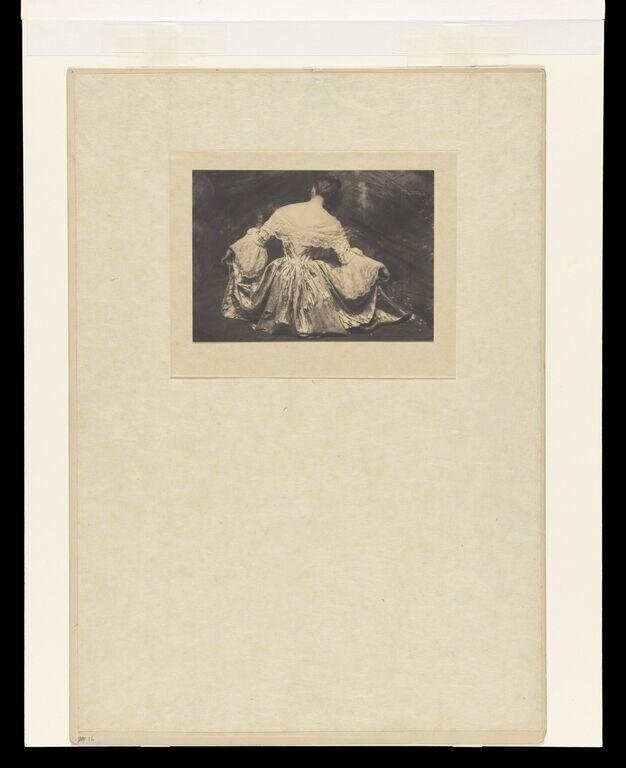
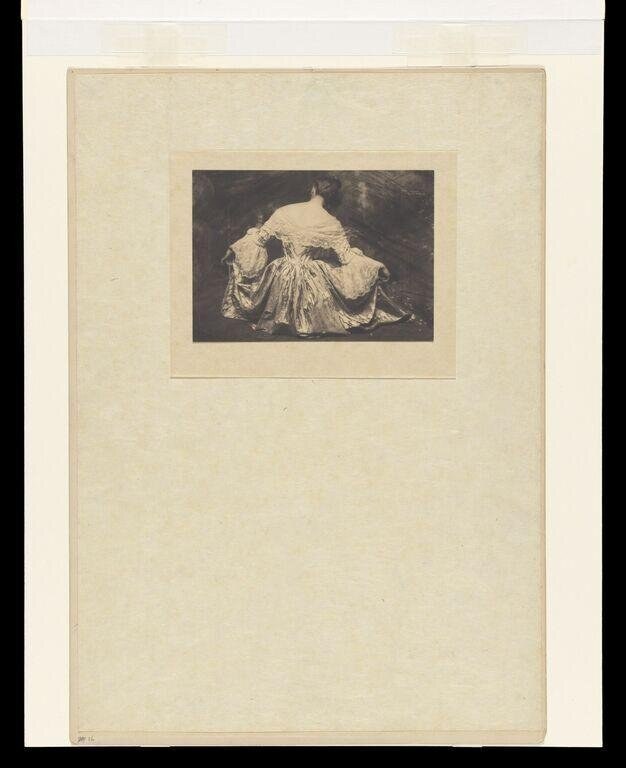
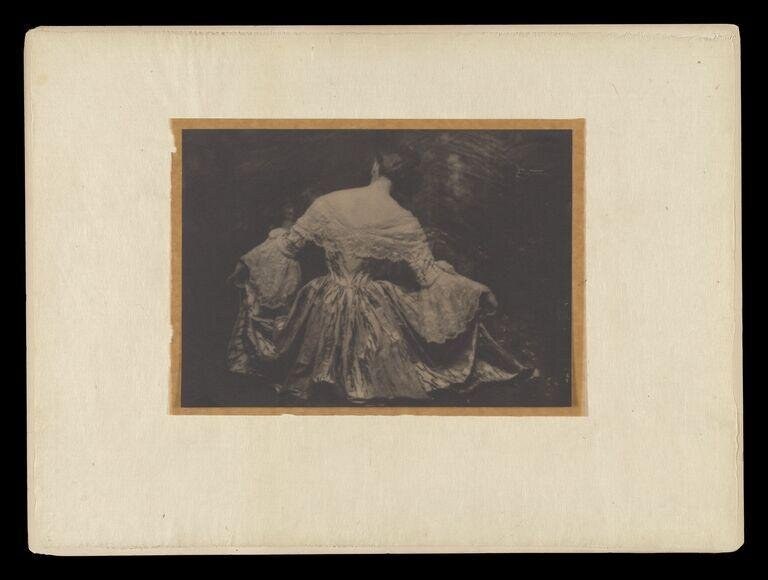
A woman in an elaborate late-eighteenth-century gown is shown from behind, her body angled three-quarter view to the left. She wears a voluminous dress with deeply gathered sleeves and a low-cut back, her shoulders bare or draped with gossamer fabric; her dark hair is piled high in the fashionable style of the period. The setting is undefined—a dark, almost theatrical background—which throws all attention onto the figure and the sculptural quality of her pose. She stands with her weight shifted, her posture composed and elongated, her head turned slightly to gaze over one shoulder. The image has the quality of a studio study, the kind made to capture a moment of choreographed grace rather than unscripted movement. The tonal range is narrow—creams and pale greys against deep shadow—which gives the work an intimate, almost intimate feeling despite its formal subject.
The dancing
A single female dancer occupies the frame. Her torso is held upright and elegant, with the small of her back subtly curved—a posture consistent with the refined carriage expected of a minuet dancer. Her arms are positioned with one extended or partially extended, the other bent; the exact position of the hands is lost in shadow, but the frame suggests the controlled, measured arm movements characteristic of baroque court dance. Her head is poised with the kind of deliberate grace—tilted, aware of being seen—that was central to the minuet's aesthetic of display and courtesy.
The dance depicted
This is almost certainly a study of the minuet, the most prestigious ballroom dance of the eighteenth century and one that persisted well into the nineteenth. The dress, the posture, the careful composition, and the title all point to a minuet rather than any other form. The minuet was a solo or partnership dance of extreme formality, characterized by measured steps, controlled upper-body carriage, and an emphasis on elegance and courtly restraint. This image captures not movement in progress but the kind of posed, held attitude that a minuet dancer would adopt—a moment of display within the larger sequence of the dance. The work treats the minuet as a subject of aesthetic contemplation rather than narrative action, which was typical of late-nineteenth-century artistic interest in historical dance.
How it was made
The work appears to be a photogravure, etching, or similar reproductive print process—the catalogue record does not specify, but the tonal subtlety, the fine detail in the drapery, and the velvety blacks and creams are consistent with photogravure or intaglio printing. The technique allowed the artist to render the fabric with remarkable fidelity and to create a soft, almost painterly quality despite the mechanical process. This places the work within a tradition of reproductive and art-historical documentation that was particularly strong among late-nineteenth-century British collectors and institutions; a work of this refinement would have circulated among educated audiences interested in historical costume and dance.
About this work
This is a late-nineteenth-century study of minuet posture and dress, presented as a formal portrait of ballroom elegance. The work sits within a broader Victorian fascination with historical dance—a period when the minuet was understood as the apotheosis of courtly refinement and as a marker of a lost era of formal beauty. The artist (Frank Eugene) has chosen to isolate the figure entirely, removing any narrative context or partnership, and to treat the pose as a study in line, fabric, and the aesthetic ideal of feminine grace. The work belongs in a dance archive because it documents not just the costume but the carriage and posture that the minuet demanded—the bodily discipline that made it a dance of rank and restraint.
How to look at it
Attend to the exact posture of the torso and the angle of the head—these embody the minuet's central aesthetic of composure and self-display. Notice how the artist has eliminated all motion: this is not a step or a turn, but a held position, which reflects the minuet's nature as a dance of pauses and controlled transitions rather than continuous movement. Look at the back and shoulders, which carry the entire visual weight of the composition; the minuet was a dance for display, and the artist has chosen the angle and pose that make the body legible as both fashionable and graceful. The darkness of the background is crucial—it forces the eye to the figure and emphasizes the isolation and formal perfection of the pose.
The artist
Frank Eugene (1856–1936) was an American photographer and artist who worked extensively in Europe and was closely associated with both photography and the pictorialist movement. He was a teacher, a founding member of the Photo-Secession, and known for his soft-focus, romantic approach to photography that drew on fine-art traditions. Eugene's work often engaged with historical and allegorical subjects, and he had a particular interest in costume, fabric, and the aesthetics of the body in motion or repose. This work sits within his broader practice of treating photography and printmaking as vehicles for artistic expression rather than mere documentation.
The period
This work was created at the very end of the nineteenth century, a moment of intense nostalgia for the eighteenth century among European and American artists and collectors. The minuet itself had vanished from fashionable ballrooms by this time—it was a historical dance, a relic of courtly culture. The late 1890s saw a revival of interest in historical dance, both as academic study and as romantic subject matter for artists. The Victorian ballroom had shifted toward the waltz and other modern dances; the minuet had become legible only as art, memory, and historical costume. Works like this one participated in that aestheticization of the past, presenting historical dance as an ideal of grace and refinement against the perceived vulgarity or crudity of contemporary forms.
Where it lives
The work is recorded as part of the Victoria and Albert Museum collection, which assembled extensive holdings of costume studies, historical imagery, and pictorialist photography during the late nineteenth and early twentieth centuries. The V&A's collecting practices prioritized objects that documented historical fashion and design, and works of this kind were understood as visual references for students of costume and design as well as art historians.
Dance in this work
Questions about this work
What is the minuet, and why does it matter?
The minuet was the most prestigious ballroom dance of the seventeenth and eighteenth centuries, danced at court and in aristocratic society as a marker of rank, education, and refinement. It was characterized by measured steps, upright posture, and an emphasis on courtesy and elegance rather than virtuosity. By the nineteenth century, it had become a historical dance, symbolizing an idealized past; this work participates in that nostalgia.
Why is the dancer shown from behind?
The back view emphasizes the posture and carriage of the body—the upright spine, the bare shoulders, the arrangement of drapery—which were central to minuet technique and to the visual ideal of feminine grace in courtly dance. It also removes the face from dominance, treating the figure as a study in formal beauty rather than as a portrait of an individual person.
Is this a photograph, a painting, or a print?
The catalogue record does not specify the medium, but the tonal qualities and reproductive nature suggest a photogravure, etching, or similar intaglio or photomechanical process. This technique would have allowed for both fine detail and soft, painterly effects, and it placed the work within a tradition of art-historical documentation.
When and where would the minuet have been danced?
The minuet was central to court culture and aristocratic ballrooms from the late seventeenth through the eighteenth century, with particular importance in France and throughout Europe. By 1900, when this work was made, it existed only in historical memory, costume collections, and artistic imagination.
More Minuet artwork