42 works in this view — arrow keys or swipe to move between them.
Dance in Art
Minuet
Paquin, Jeanne
- Dance:
- Minuet
- Era:
- 1900-1920 (Ragtime/Early Jazz)
- Source:
- Victoria and Albert Museum
- Rights:
- Rights vary by item — check the source record before reusing this image. Source record ↗
- Recorded as:
- Check V&A creditLine
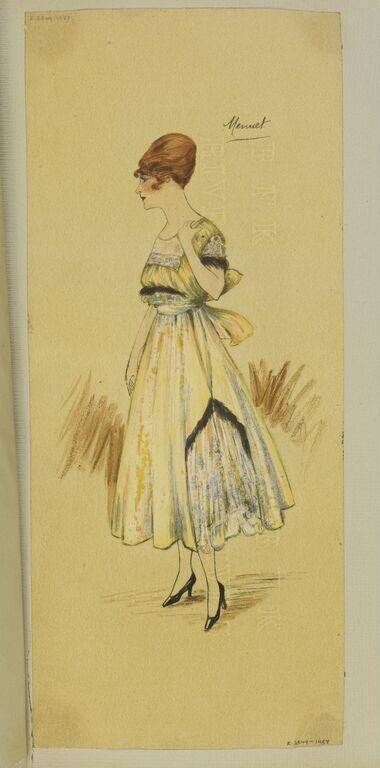
Jeanne Paquin was one of the most celebrated fashion designers of the early 20th century, and this work demonstrates how dance—or the idealized presentation of dance—functioned in fashion and costume design of the era. The image reveals how the minuet, centuries out of practice as social dance, persisted as a cultural reference and a visual language for expressing formality, elegance, and historical refinement.
What you are looking at
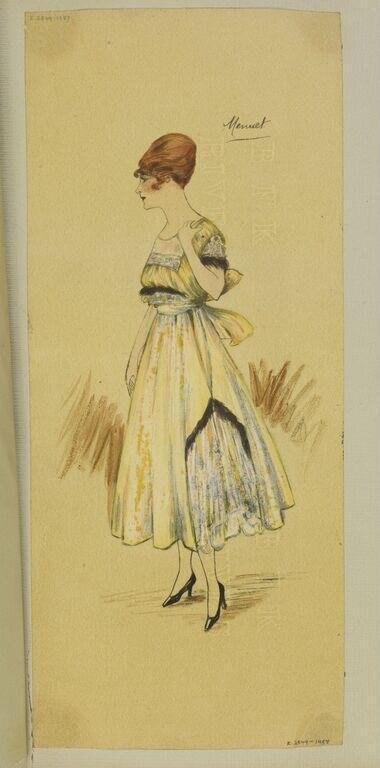
A fashionably dressed woman stands in a three-quarter pose against a pale yellow ground, her body angled to the right. She wears a pale yellow dress with a high waistline and a full skirt gathered at the hem, the silhouette characteristic of 1910s fashion. Dark trim or embroidery decorates the bodice and sleeves. Her reddish-brown hair is pinned up in the style of the period. The artist has rendered the fabric with delicate cross-hatching in ink, creating texture and depth, particularly in the skirt's folds and in the background, where loose strokes suggest movement or atmosphere. The figure is poised as if mid-gesture, with one arm positioned at her side and the other subtly raised, the posture suggesting either a moment of social presentation or a formal dance position. The composition is spare and elegant, focusing entirely on the figure's silhouette and dress.
The dancing
The woman stands in an upright, formal posture typical of early 20th-century deportment. Her weight appears evenly distributed, her frame composed and still rather than in motion. The positioning of her arms—one at her side, the other slightly raised—suggests the restrained, controlled positioning of ballroom or social dance of the period rather than active movement. There is a single figure only, presented as an isolated study of dress and carriage rather than as part of a coupled or group dance.
The dance depicted
The title identifies this as a minuet study. The minuet was a formal court and ballroom dance in triple time, characterized by small, restrained steps and an emphasis on elegance and decorum. By 1915, the minuet was no longer an active social dance but a historical or theatrical reference, often revived in costume balls, historical pageants, or theatrical performances. The artist has depicted not active minuet choreography but rather the formal posture and presentation expected of a minuet dancer—an idealized figure in period dress embodying the grace and restraint the dance demanded. This is a fashion illustration in the tradition of theatrical or historical costume study rather than a record of dance in motion.
How it was made
This is a watercolor and ink drawing on paper, rendered with a combination of fluid brushwork and fine linear detail. The artist has used transparent washes for the yellow dress and background, then overlaid the composition with pen work for definition and shading, creating a refined, illustrative style suited to fashion and costume design. The technique allows for both the soft modulation of fabric and the precise rendering of decorative detail. This approach is consistent with early 20th-century fashion plate and costume design practice, suggesting the work was created as either a fashion illustration or a costume design study for theatrical production.
About this work
This is a fashion and costume study titled *Minuet*, created by Jeanne Paquin in 1915. It depicts a woman in fashionable 1910s dress posed in the formal, restrained manner associated with the historical minuet. Rather than depicting the minuet as an active dance, the work presents it as a historical reference and an exercise in elegant deportment and costume. The image sits at the intersection of fashion illustration, theatrical design, and historical revival—a moment when the minuet existed not as living social practice but as a symbol of aristocratic refinement and past elegance. The work documents both the 1910s understanding of historical dance and the period's fascination with historical and theatrical costume.
How to look at it
Attend to the pose: the woman is not in motion but in presentation, displaying both her dress and her deportment. The restrained arm positions and upright frame embody the controlled, economical movement the minuet required—a dance of small steps and formal positioning rather than large, expansive gestures. The cross-hatching and linear work in the skirt create a sense of the fabric's weight and fall, emphasizing the elegance of the silhouette. Notice how the artist has chosen stillness over movement, focusing on the idealized presentation of the minuet dancer as a historical and aesthetic figure rather than as an active performer.
The artist
Jeanne Paquin (1869–1936) was a French haute couture designer and one of the first women to establish herself as a major fashion house proprietor in Paris. Her designs were celebrated for their elegance, technical refinement, and theatrical sophistication. Paquin designed costumes for theater and opera as well as couture for high society, and her practice encompassed both garment design and the broader visual presentation of the fashionable body. Her designs were influential in shaping early 20th-century silhouettes and in establishing the relationship between theater, fashion, and social performance.
The period
In 1915, Europe was at war, but the haute couture industry and theatrical production continued, albeit under changed circumstances. The decade saw a revival of historical and romantic themes in theater and costume design, partly as escapism and partly as a genuine interest in historical reconstruction. The minuet, as a symbol of ancien régime elegance and aristocratic refinement, held particular appeal for designers and audiences invested in historical fantasy and the aesthetic idealization of the past. The 1910s were also a period of active experimentation in fashion silhouettes; Paquin's designs of this era are notable for their combination of historical reference and contemporary style.
Where it lives
The work is held in the Victoria and Albert Museum, a major repository of fashion, design, and theater history. It appears to be catalogued as a fashion illustration or costume design study rather than as fine art, reflecting its original function and context within design practice rather than gallery exhibition.
Dance in this work
Questions about this work
Was the minuet still danced in 1915?
No. The minuet had ceased to be a living social dance by the late 18th century. By 1915, it existed primarily in historical revivals, costume balls, and theatrical productions. This work reflects the minuet as a historical and aesthetic reference rather than as current practice—it is a study in the idealization of past elegance.
Why would a fashion designer illustrate a dance?
Fashion and dance were intimately connected in early 20th-century design. Costume design was a major part of haute couture practice, and the theatrical or social context in which garments would be worn was integral to their design. This illustration likely served as a costume study, either for theater production or as part of Paquin's broader exploration of how garments present and frame the body in motion.
Is this a portrait or a fashion illustration?
Neither precisely. It is a costume and posture study—a formal exploration of how the idealized minuet dancer should present herself, combining fashion illustration technique with choreographic reference. The focus is on the ensemble of dress and deportment rather than on the individual identity of the figure.
What is the significance of the title?
The title *Minuet* is explicit identification of the dance being referenced. It signals that this is not a contemporary social dance but a historical one, and that the formal, restrained posture and costume are intended to evoke a specific historical and aesthetic ideal.
More Minuet artwork