41 works in this view — arrow keys or swipe to move between them.
Dance in Art
Minuet dancer
William Duesbury & Co.
- Dance:
- Minuet
- Era:
- 1700s (Enlightenment/Minuet Era)
- Source:
- Victoria and Albert Museum
- Rights:
- Rights vary by item — check the source record before reusing this image. Source record ↗
- Recorded as:
- Check V&A creditLine
For historians of eighteenth-century dance, this figurine is a rare direct record of how a minuet dancer was dressed and posed—information that survives in few other forms with such precision and color. For historians of material culture and gender, it documents the labor and expense involved in elite female appearance, and how femininity itself was constructed as an object to be looked at rather than an agent in motion. For curators and scholars of dance iconography, it raises a key question: what does a static three-dimensional representation tell us about a dance that was fundamentally about movement, timing, and spatial geometry?
What you are looking at
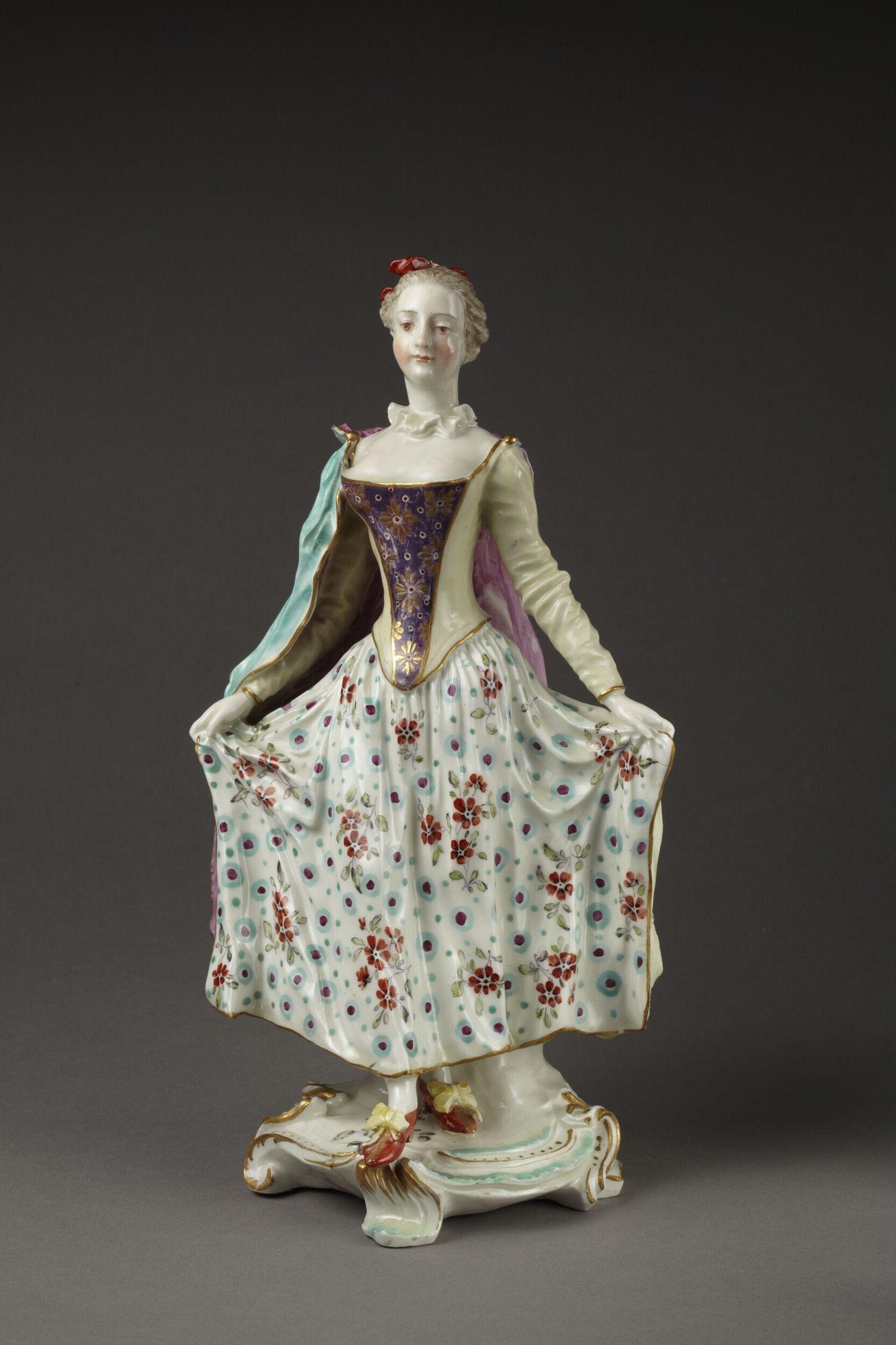
A porcelain figurine of a young woman in mid-eighteenth-century dress stands alone against a dark ground. She wears a cream linen shift with a high neckline and long sleeves gathered at the wrist, over which is laced a deep purple stomacher embroidered with small gold flowers. Her skirt, which dominates the composition, is a voluminous cream silk printed with a scattered pattern of small red flowers and blue dots; she holds it up at the sides with both hands, the fabric billowing outward in a graceful sweep that demonstrates the fullness typical of elite women's dress of the period. A pale blue-green silk mantle or shawl drapes from her shoulders. Her hair is styled in the fashion of the 1750s–60s, powdered and curled, with a small red ribbon or ornament at the crown. She wears white stockings and small gold-heeled shoes. The figure stands on an ornate Rococo base of white porcelain with gilt accents, the asymmetrical scrollwork characteristic of mid-century taste. Her posture is upright and poised, her gaze directed slightly downward in a modest, graceful manner.
The dancing
The figure's weight appears evenly distributed on both feet, with the body held in an elegant but relatively static posture. Her arms are raised and bent at the elbows, hands positioned at mid-thigh level as if holding or displaying the skirt fabric—a gesture that would have been inherent to the minuet, where women's skirts were often managed with the hands to create visual effects and balance. The pose conveys refinement and control rather than dynamic movement; there is no indication of a specific step or weight shift, but rather a moment of repose or presentation.
The dance depicted
The inscription 'Minuet dancer' in the catalogue and the entire visual language of this figurine—the elite dress, the formal posture, the careful display of the skirt—all point to the minuet, the most prestigious social and theatrical dance of the eighteenth century. The minuet was danced primarily by aristocratic couples in a slow, elegant style characterized by turnout, precise footwork, and careful spatial geometry. This figure likely represents an actress or professional dancer performing the minuet on stage, or an idealized image of an elite woman dancing it in a domestic or court setting. The porcelain medium and the care lavished on the costume suggest this was aspirational imagery—a record of how a minuet dancer should look, not how she moved.
How it was made
This is a hand-painted hard-paste porcelain figurine, likely Meissen or from a Meissen-inspired manufactory, dating to around 1760. The technique allows for fine modeling of the face and hands, and the application of colored glazes and gilt decoration to suggest the silks, embroidery, and precious materials of the costume. Hard-paste porcelain figurines of this type were expensive luxury goods, produced in limited quantities for wealthy collectors. Their circulation was restricted to courts and aristocratic collections, making them vehicles for the dissemination of elite taste and fashion. The static, display-like quality of the pose is typical of the medium: porcelain figurines favored clarity of silhouette and costume detail over the suggestion of movement or narrative.
About this work
This porcelain figurine depicts a young woman dressed for and posed as if performing a minuet, the most refined and technically demanding social dance of the eighteenth-century European aristocracy. Created around 1760 by William Duesbury & Co., likely at their Derby factory, it represents a moment when the minuet was reaching the height of its prestige both in the ballroom and on the professional stage. The figurine is as much a record of fashion as of dance: the elaborate dress, with its heavy silk skirt, decorative stomacher, and carefully arranged hair, commands the viewer's attention, while the pose—modest, controlled, with the skirt held at the sides—encodes both the physical requirements of the dance and the ideal of refined femininity that the minuet embodied.
The work belongs in a gallery of dance imagery because it documents the material and social world of eighteenth-century courtly dance. Unlike a painting or engraving of a minuet, which might capture a moment of action, the figurine offers something different: a static, three-dimensional model of how a minuet dancer should present herself. It is aspirational imagery, likely owned by people who either danced the minuet themselves or aspired to the status and refinement it conferred. Porcelain figurines circulated within elite European courts and collecting circles, shaping taste and maintaining visual standards for propriety, elegance, and class identity.
How to look at it
Look first at the costume: the wealth of materials, the precision of the tailoring, the care taken to render the printed pattern of the skirt in colored glazes. Notice how the skirt is held—not gathered up in a bunch, but displayed at the sides with the hands, a gesture that would have been visible to spectators during an actual minuet and that required practice and control. Observe the posture and facial expression: the body is upright, the face is modest and composed, the gaze downcast. There is no suggestion of strain or effort; the pose conveys an ideal of effortless elegance. The asymmetrical rococo base completes the image of refinement and luxury. What the figurine does not show—and what no static image can show—is the minuet's defining feature: the slow, precise, measured steps that moved couples across the floor in a prescribed geometric pattern. To understand the minuet from this image, you must add motion to the stillness.
The artist
William Duesbury & Co. operated the Derby Porcelain Works from 1756 onward, one of the major English hard-paste porcelain manufacturers of the late eighteenth century. The factory produced table wares, ornamental vases, and figurines in the prevailing rococo taste, often decorated with naturalistic flowers, pastoral scenes, and fashion figures. Duesbury's figurines, which drew on Meissen prototypes, were aimed at the luxury market and often represented contemporary dress, profession, or social type. The factory's success depended on its ability to satisfy the aesthetic and social aspirations of the English and European nobility and gentry.
The period
The minuet reached its apogee in the mid-eighteenth century, after more than a century of development from its origins in seventeenth-century France. By 1760, it was the standard opening dance at any aristocratic ball or court ceremony, and it was also a staple of theatrical performance, especially in opera and ballet. The dance required years of training and embodied the values of aristocratic culture: grace, precision, emotional restraint, and visual beauty. At the same time, the minuet was beginning to face competition from newer, more energetic dances like the German cotillion and the English country dance, which allowed for more social mixing and less formal choreography. The porcelain figurine, with its emphasis on dress and static pose, captures the minuet at a moment of cultural dominance, even as its reign was beginning to wane.
Where it lives
The figurine is part of the Victoria and Albert Museum collection in London, one of the world's largest repositories of decorative arts. It is catalogued as a work by William Duesbury & Co., dating to around 1760, and is typical of Derby porcelain production of that period. Its presence in a major public collection ensures its preservation and accessibility.
Dance in this work
Questions about this work
Did real minuet dancers wear clothes like this?
Yes, the dress shown here—silks, embroidered stomacher, full skirt—is consistent with elite women's costume of the 1750s–60s, whether for ballroom dancing or theatrical performance. However, real minuet dancers would have worn even more elaborate versions, with heavier fabrics, more jewels, and more ornament. The figurine shows the essential elements but is somewhat simplified.
How do you dance in a skirt that full?
The minuet required a specific technique: small, gliding steps with turned-out legs, careful weight management, and precise use of the arms and hands to balance the body and frame the skirt. The full skirt was an asset, not a hindrance—it created a visual display of movement and required dancers to maintain control and precision. The gesture shown here, of holding the skirt at the sides, would have been used during certain figures of the dance to emphasize the movement or to manage the fabric.
Why is this a porcelain figurine rather than a painting?
Porcelain figurines were luxury collectibles that circulated within elite European courts and aristocratic homes. They were expensive, prestigious, and prized for their technical perfection and detail. A figurine could be displayed on a mantelpiece or in a cabinet, serving as a visible marker of the owner's wealth and taste. For the minuet, a three-dimensional representation allowed collectors to appreciate the dress and pose from all angles.
What can this tell us about how the minuet was actually danced?
A static figurine cannot show movement, so it tells us very little about the actual steps and dynamics of the minuet. What it can tell us is how dancers were expected to look: the posture, the dress, the restraint, the refinement. It documents the visual ideal and the material investment in elite appearance. To understand how the minuet was danced, we need other sources: dance manuals, notations, and descriptions by people who saw it performed.
More Minuet artwork