39 works in this view — arrow keys or swipe to move between them.
Dance in Art
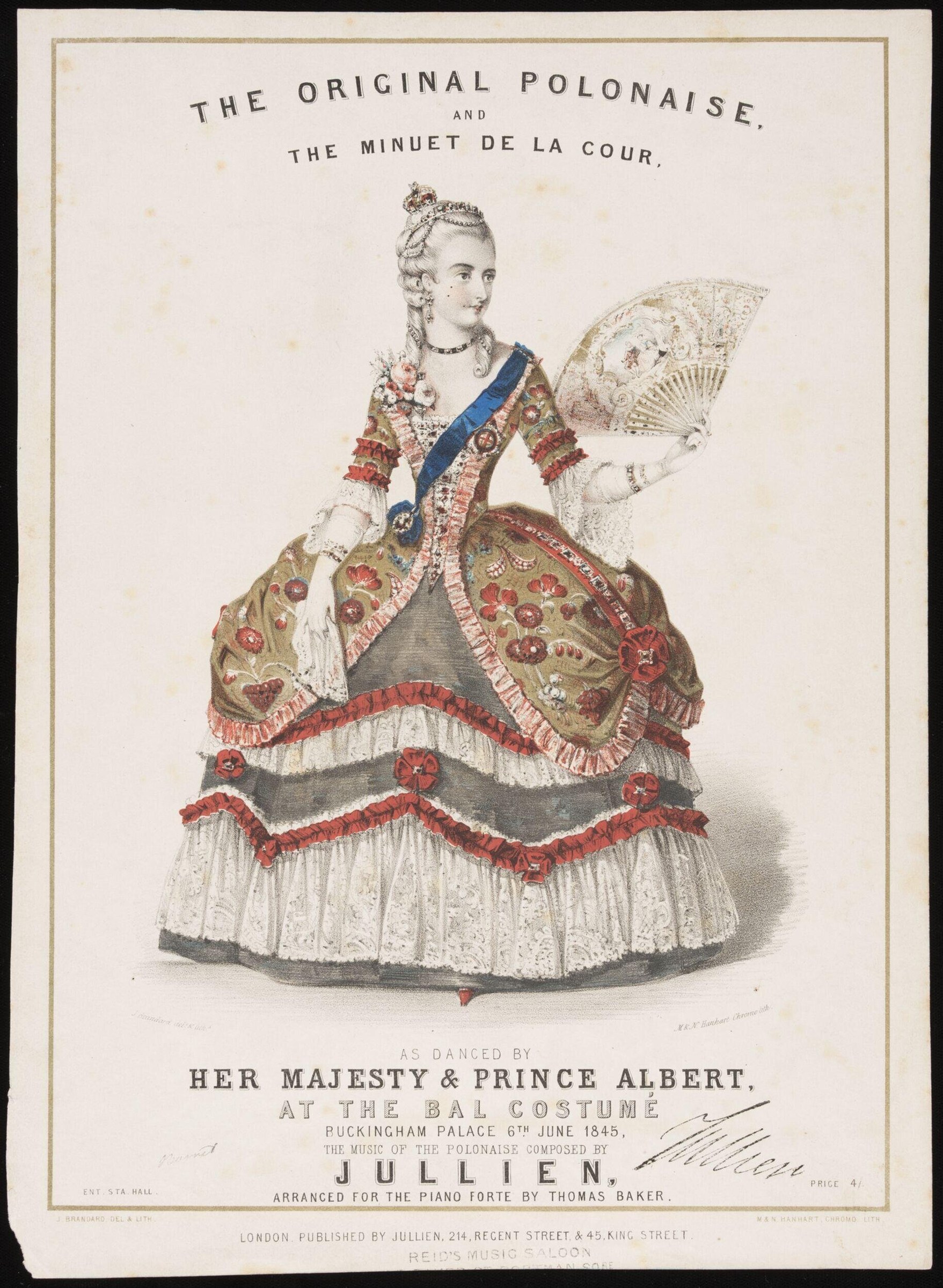
The Original Polonaise and the Minuet de la Cour
Brandard, John
- Dance:
- Minuet
- Source:
- Victoria and Albert Museum
- Rights:
- Rights vary by item — check the source record before reusing this image. Source record ↗
- Recorded as:
- Check V&A creditLine
This print records a specific royal performance and costume, making it a primary document of 19th-century court dance revival. It shows how the polonaise and minuet were understood and presented to a broad public through commercial print culture, embedding dance in fashion, courtship, and royal authority. The explicit connection to Queen Victoria and Prince Albert's participation lends historical weight to the image as evidence of how these dances functioned in Victorian court life.
What you are looking at
A full-length portrait of a woman in elaborate 18th-century court dress, shown in a three-quarter view against a plain background. She wears a heavily decorated gown with a pale underskirt and an overdress of olive-green silk embroidered with red flowers and scrollwork; the overskirt is looped up to reveal the white petticoat beneath and trimmed throughout with red ribbon and ruffles. Her bodice is ornate, with red embroidered panels and white lace trim at the sleeves. She wears a blue sash across her torso—the mark of royal status—and carries a large, intricately painted fan in her right hand. Her hair is elaborately styled and powdered, crowned with jewels and ribbons. The figure is composed and serene, presented as if for a portrait sitting rather than mid-movement, though the slight tilt of her body and the positioning of the fan suggest the bearing and deportment expected of a courtly dancer.
The dancing
The woman stands in an upright, elongated posture typical of court etiquette, with her weight balanced and her frame composed for formal presentation. Her right arm is raised and slightly bent to display the fan, a crucial prop in the vocabulary of court dance and courtly behavior. The posture is dignified rather than dynamic, with no indication of active motion; this is a costume portrait rather than a dance-action image. The elongation of the figure and the emphasis on the vertical line of the body suggest the aesthetic ideal of court dance, where verticality and control were paramount.
The dance depicted
This is a costume plate documenting the dress and deportment associated with the polonaise and the minuet de la cour, the two most formal dances of 18th-century European courts. The title and inscription explicitly state these dances and note that the costume was 'as danced by Her Majesty & Prince Albert at the Bal Costumé' at Buckingham Palace on 6 June 1845. The image records not the action of dancing but the formal presentation of a dancer in court dress—the essential visual identity of these dances. The polonaise was characterized by a processional, stately walk with an upright carriage and controlled dignity; the minuet was a geometric, formal social dance requiring precise footwork and courtly bearing. Both demanded exactly the composed, upright posture shown here.
How it was made
This is a hand-colored engraving or lithograph, typical of the commercial dance and theater print industry of the 1840s. The technique allowed for wide circulation of costume and choreographic information through subscription or retail sale. The color is applied by hand—visible in the careful rendering of the embroidery, the blue sash, and the painted fan—indicating this was a luxury object for affluent collectors interested in court fashion and theatrical dress. The publication imprint (Jullien, London) identifies it as a commercial entertainment and fashion print, likely part of a series documenting the costumes worn at the 1845 Buckingham Palace ball.
About this work
This is a costume plate from a commercial dance print series, documenting the formal court dress and bearing associated with the polonaise and minuet de la cour as danced at Buckingham Palace in 1845. It records not a moment of dancing but the visual identity and deportment required of participants in these dances: upright, dignified, formally composed. The work sits at the intersection of dance history, court fashion, and theatrical print culture, capturing the aesthetic and social values embedded in 18th-century court dance as they were revived and celebrated in the early Victorian period.
The print is valuable precisely because it documents the external appearance and expected bearing of these dances rather than their footwork or motion. For historians and dancers, it provides material evidence of how court dances were understood, performed, and celebrated in the 19th century—including the royal participation that gave them cultural prestige.
How to look at it
Attend to the posture and the formal composition: the artist chose to present the figure in stillness and dignified repose rather than in motion, emphasizing the upright carriage and composed bearing required by court dance. Notice the prominent display of the fan—a crucial prop in both the minuet and the polonaise, central to courtly communication and deportment. The elaborate embroidery, the blue sash (marking royal status), and the careful rendering of lace and ribbon all signal the expense and formality of court dress. The image is a costume document first and a dance image second: it tells you how these dances looked to the eye, not how the feet moved.
The artist
John Brandard was a prolific engraver and lithographer active in London during the 1840s–1860s, specializing in theater, dance, and fashion prints. His work appeared in commercial print series aimed at a middle-class audience interested in theater, costume, and high society. Brandard worked for publishers including Jullien and was part of the print industry that made choreographic and costume information widely available through hand-colored engravings.
The period
The polonaise and minuet were 18th-century court dances that, by the 1840s, had become historical and ceremonial forms, preserved primarily in formal court contexts. The 1845 Buckingham Palace ball was a notable event in which Queen Victoria and Prince Albert revived these dances as part of a fashionable, nostalgic engagement with court ceremony and historical costume. This fell within the broader 19th-century Romantic movement's fascination with historical dress and courtly revival. Commercial dance prints like this one documented and disseminated these court performances to a public that could not attend, making court dance and fashion visible to middle-class collectors and theater-goers.
Where it lives
This is a commercial dance and costume print published by Jullien of London in 1845. It belongs to the Victoria and Albert Museum's collection of theatrical and dance prints, part of the broader 19th-century documentation of theater, ballet, and court spectacle. Such prints were sold to the public as single sheets or in bound volumes, making choreographic and costume information widely accessible.
Dance in this work
Questions about this work
What were the polonaise and minuet de la cour?
Both were formal court dances of the 18th century: the minuet was a geometric, couple-based social dance known for precise footwork and courtly bearing; the polonaise was a stately processional dance emphasizing upright posture and dignified walking. By the 1840s, both were historical forms, preserved in court ceremonies and formal balls rather than as living social dances.
Why did Queen Victoria and Prince Albert dance these old dances in 1845?
The revival of historical court dances was part of 19th-century Romantic culture's fascination with the past and with courtly ceremony. The costume ball at Buckingham Palace in 1845 was a fashionable event designed to celebrate historical costume and court tradition, allowing the royal couple to present themselves as custodians of courtly refinement and historical culture.
What is the blue sash the figure wears?
The blue sash is a riband of rank or order, indicating royal or noble status. Its presence in the costume reinforces the image's connection to the royal performance and suggests that the wearer of this costume was of high social standing.
Why is the fan so prominently displayed?
The fan was essential to court dance and courtly behavior, used to regulate movement, signal courtesy, and manage the elaborate skirts of formal dress. In the minuet and polonaise, the fan was a central prop that structured both the aesthetic and the social meaning of the dance.
More Minuet artwork