29 works in this view — arrow keys or swipe to move between them.
Dance in Art
Quadrille pool
unknown
- Dance:
- Quadrille
- Era:
- 1700s (Enlightenment/Minuet Era)
- Source:
- Victoria and Albert Museum
- Rights:
- Rights vary by item — check the source record before reusing this image. Source record ↗
- Recorded as:
- Check V&A creditLine
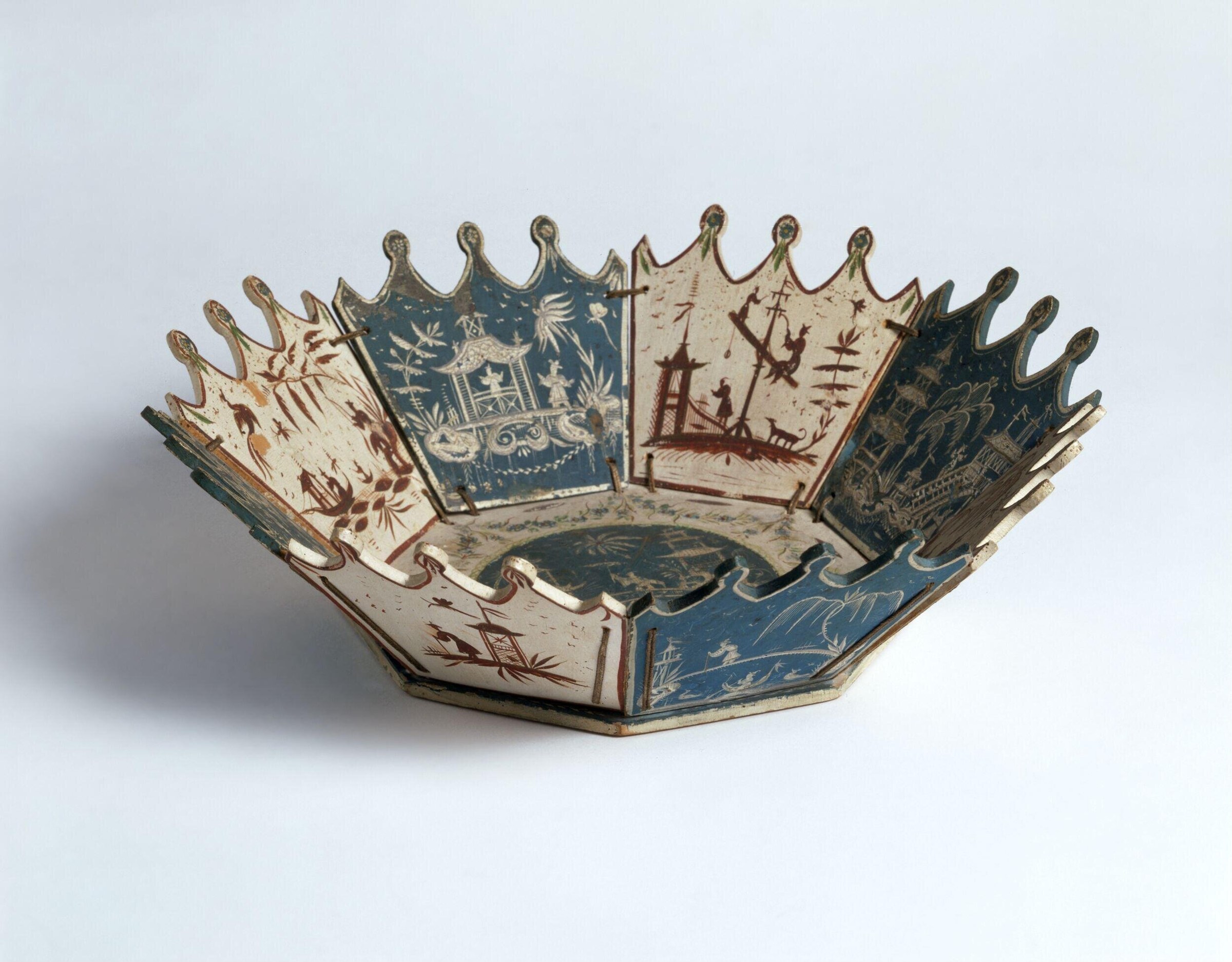
This object demonstrates how easily the title or documentation of a historical artwork can become detached from its actual visual content, and how such misattributions can persist in collecting institutions. For anyone studying the visual history of quadrille in art, it is a cautionary example: the title promises dance, but delivers only a decorative vessel whose connection to the dance form is unclear or perhaps erroneous.
What you are looking at
This is a decorative lacquered box or vessel with a scalloped, crown-like rim, shown in three-quarter view against a white background. The object appears to be made of wood or papier-mâché with a cream or off-white ground decorated in dark blue and rust-red lacquer. Eight flared panels fan upward from the broad, shallow bowl, each depicting different scenes in the Chinoiserie style: architectural vistas with pagodas, willow trees, figures in landscapes, birds, flowering branches, and mountainous terrain. The panels are separated by narrow gilt-edged divisions. The interior surface visible at the base is also decorated with blue lacquer and landscape motifs. The palette throughout is restricted to blue-black, rust-red, cream, and gilt, applied with fine brushwork. The object sits on a simple base and casts a soft shadow, suggesting it was photographed under controlled museum lighting.
The dancing
Human figures appear within the landscape panels in miniature scale, scattered among architectural and natural elements rather than grouped as dancers. They wear what appears to be 18th-century dress. In several panels, small figures are positioned in or near buildings, gardens, or beside water features. The scale and context do not suggest choreographed movement or the unified ensemble action characteristic of dance representation.
The dance depicted
The title 'Quadrille pool' is puzzling in relation to the visual content. A quadrille is a set-dance or ballroom form dating to the 18th century, typically depicted with clearly identifiable couples in dance hold or formation. This object shows no such arrangement. The small decorative figures do not appear to be engaged in a coordinated dance, nor do they display the formal positioning or proximity that would characterize a quadrille representation. The work may be a collector's vessel whose European owner chose a fanciful or whimsical title, or the title may refer to something not visibly evident in the lacquer work itself—a set of four (quadrille) panels, perhaps, though the object has eight.
How it was made
This is a lacquered wooden or papier-mâché object, almost certainly of European manufacture or European interpretation of East Asian lacquerwork technique, dating to the 18th century. The finely applied blue and red lacquer with gilt accents suggests skilled hand-painting over a cream ground. Objects of this type were highly fashionable among European collectors and decorative arts patrons from the 1650s onward, as Chinoiserie design dominated applied arts. Such pieces were typically used as tea caddies, boxes, baskets, or ornamental vessels. The technique and material—laborious hand-painted lacquer—marked these as luxury goods, usually commissioned or acquired by the wealthy.
About this work
This is a decorative lacquered vessel or box from the 18th century, shaped like a stylized crown or scallop shell, with eight panels depicting imaginary Chinoiserie landscapes populated with small figures. It is catalogued as depicting a quadrille, the fashionable 18th-century social dance, but the visual evidence does not support this identification: no figures are arranged in dance formation, hold, or the formal spatial relationships the dance would require. The object is instead a specimen of European luxury taste in the age of Chinoiserie, when lacquered wares in Asian-inspired style were highly prized decorative objects for wealthy households. The apparent mismatch between title and image makes it a valuable puzzle piece for understanding how titles were assigned to artworks in historical collections, and how European patrons and curators interpreted or misinterpreted the objects they commissioned or collected.
How to look at it
Examine each of the eight panels as a separate landscape vignette, noting how the artist has arranged architectural and natural elements to suggest depth and atmosphere typical of imagined 'Chinese' scenery. Notice the scale of the figures: they are tiny within their landscapes, rendered in silhouette or outline, with no suggestion of coordinated movement or dance posture. Trace the outline of the vessel itself—its fan-like, crown-like or scallop form—and consider whether this unusual shape might be the 'pool' referenced in the title, or whether the title refers to something else entirely. The gold edges and fine brushwork are typical of luxury European lacquerwork from this period.
The period
The 18th century saw an explosion of European fascination with East Asian design, particularly Chinese and Japanese lacquerwork, porcelain, and landscape painting. This taste, known as Chinoiserie, was not a faithful study of Asian art but rather a fanciful, imaginative interpretation: European artists and decorators created objects that referenced, imitated, or playfully adapted Asian motifs and techniques for European patrons. Lacquered boxes, trays, and furniture were among the most sought-after Chinoiserie objects. Simultaneously, the quadrille was emerging as one of the dominant social dances of the European ballroom, particularly after 1760. The overlap between these two fashions—Chinoiserie objects and quadrille dancing—created a cultural moment in which decorative arts and dance competed for the attention of wealthy elites.
Where it lives
The object is part of the Victoria and Albert Museum collection. Objects catalogued with minimal documentation are common in historical collections, particularly decorative arts where titles, dates, and attributions were often assigned long after acquisition, sometimes based on guesswork or brief contemporary notes.
Questions about this work
Is this actually a quadrille scene?
Probably not. The title suggests a dance representation, but the visual content—tiny figures scattered in landscape vignettes—does not match what a quadrille would look like in visual art. The quadrille involves organized couples or lines of dancers in formal hold or formation. This object shows no such arrangement. The title may be a later attribution, a collector's fancy, or may refer to some aspect of the object's original use or design that is no longer clear.
What is this object?
It appears to be a decorative lacquered box, caddy, or vessel—possibly for holding tea, spices, or other valuables. Its unusual scalloped crown shape suggests it may have been made as a collector's curiosity or ornamental piece for display rather than everyday use. The craftsmanship and precious materials indicate it belonged to a wealthy household.
Who made this and when?
The catalogue record lists it as from 1780 and of unknown artist, but provides no other details. From visual analysis, it appears to be European-made lacquerwork in the Chinoiserie style, a technique and aesthetic that was at the height of fashion from roughly 1650–1800 in Britain, France, and Germany.
Why is the image so hard to match to the title?
This is a common problem in museum collections, especially for objects acquired long ago. A collector might have named an object based on incomplete information, personal interpretation, or simply guessed. If the original documentation was lost, the title persists in the record even if it is incorrect. This object is a good example of why visual analysis matters: the image contradicts what the title claims.
More Quadrille artwork