30 works in this view — arrow keys or swipe to move between them.
Dance in Art
French Quadrille
Jullien, Louis Antoine
- Dance:
- Quadrille
- Source:
- Victoria and Albert Museum
- Rights:
- Rights vary by item — check the source record before reusing this image. Source record ↗
- Recorded as:
- Check V&A creditLine
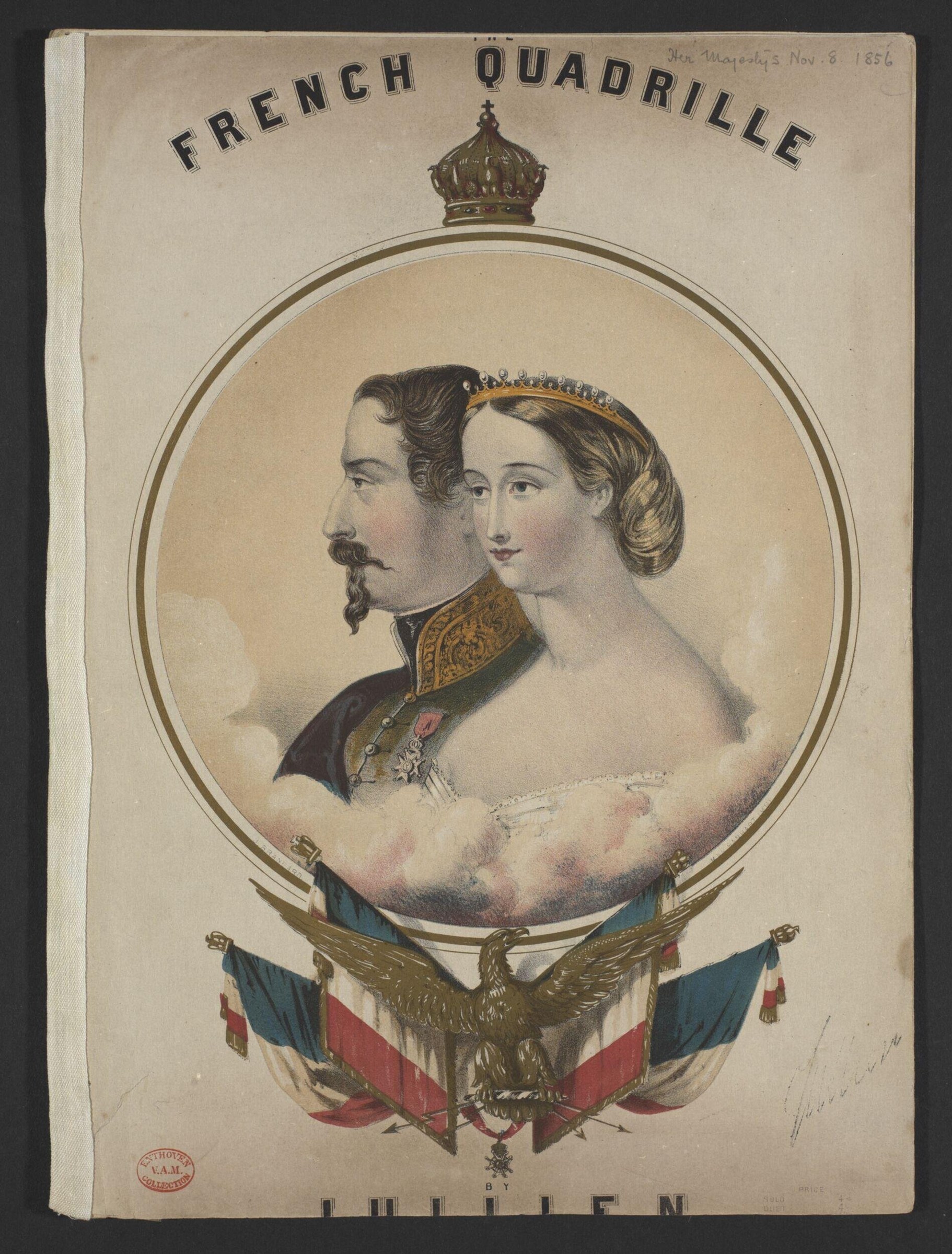
This work is a reminder that quadrille imagery in the 19th century served cultural and political functions beyond choreographic documentation. The pairing of a formal portrait with a reference to the quadrille—one of the era's most important social dances—suggests the dance's centrality to court and ceremonial life, even when the artwork itself does not represent movement.
What you are looking at
A formal portrait of a couple set within an ornate oval frame topped with a crown. The man, shown in left profile, wears an elaborate military dress uniform with a jeweled collar and medals, his dark hair styled with a center part and facial hair including a mustache and small beard. The woman, facing slightly toward the viewer, wears an elegant tiara and her fair hair is arranged in period waves. Her bare shoulders and the delicate rendering of her upper body suggest formal evening dress. Below the oval frame hangs a decorative arrangement of draped flags—the French tricolor prominent among them—with a gilt eagle at the center, establishing the patriotic and ceremonial nature of the image. The entire composition is rendered in hand-colored lithography with refined detail, the figures isolated against a neutral background within the framing device.
The dancing
No dance movement is depicted. The two figures are presented in static, formal poses within a portrait frame rather than in active gesture or bodily engagement. The man's profile and the woman's three-quarter view are typical of state portrait conventions. Neither figure displays the frame, hold, arm position, or weight distribution characteristic of any dance form.
The dance depicted
This is not a dance image. The title 'French Quadrille' refers to the quadrille, a group dance popular in 19th-century European ballrooms, but the artwork itself is a formal state or ceremonial portrait, not a depiction of the dance itself. The quadrille is mentioned only in the title; the visual content is heraldic and commemorative rather than choreographic.
How it was made
This is a hand-colored lithograph, a reproductive printing process that allowed rapid and relatively inexpensive circulation of formal portraits to a wide audience. The refinement of detail in the uniform, tiara, and facial features, combined with the careful hand-coloring, indicates production by a skilled lithographic workshop. The technique was ideal for disseminating royal or state images in the mid-19th century, reaching both official and popular markets.
About this work
This is a formal heraldic portrait presented within a decorative frame, not a choreographic artwork. The title refers to the quadrille social dance, but the image itself depicts two figures of apparent state or royal significance in ceremonial dress, framed by French national emblems. The work belongs to the tradition of 19th-century state portraiture rendered in mass-produced lithography. It appears in a dance collection only because the quadrille was named in its title; the visual content is portraiture and heraldry, not dance documentation or illustration.
How to look at it
Observe the formal conventions of state portraiture: the profile and three-quarter poses, the precision of military dress and jewels, the centered and symmetrical composition. The decorative frame and national emblems elevate this from a personal portrait to an official or commemorative image. The hand-coloring technique—note the restraint and precision in rendering skin tones, fabric, and medals—was the standard for mass-produced portraits of this era. The framing device itself, with its crown and flags, is the visual argument of the piece: authority, ceremony, and national identity.
The artist
Louis Antoine Jullien (1812–1860) was a French conductor, impresario, and composer famous for his orchestral concerts and promenade concerts in both Paris and London. While best known for his musical direction, he was also involved in the theatrical and social dance world; his name appears on a range of commercial lithographic prints of the era, likely produced in collaboration with print workshops rather than executed by Jullien himself. This portrait suggests his involvement in or association with state and ceremonial contexts.
The period
The mid-19th century saw the quadrille at its height as the dominant dance form of European ballrooms and state functions. Simultaneously, lithographic portraiture—especially of public figures and nobility—became the primary medium for distributing official and semi-official images. The combination of a state portrait with the quadrille in its title reflects the dance's cultural prominence during this period. The formal heraldry and French national symbols indicate production during or shortly after a moment of French ceremonial or political significance, likely relating to the Second Empire or a major state occasion.
Where it lives
The work is held in the Victoria and Albert Museum collection. It is catalogued as a lithograph, likely a commercial or semi-official print produced in Paris or London in the mid-19th century. The 'va' source designation indicates acquisition or cataloguing by the V&A.
Questions about this work
Why is a portrait called 'French Quadrille'?
The title likely refers to the quadrille social dance, which was central to French court and ballroom culture. The print may commemorate a specific state ball or ceremonial event at which the quadrille was performed, or the title may be a commercial or archival reference to the cultural context. Without additional provenance, the exact connection cannot be determined.
Is this a dance instruction or documentation image?
No. This is a formal portrait rendered as a lithograph. While it is titled with reference to a dance, it does not depict dancers, choreography, or any active movement. It belongs to the category of state portraiture, not dance notation or instruction.
What does the military uniform tell us?
The elaborate jeweled collar, medals, and formal military dress indicate that the male figure holds official or court rank. The precision and cost of rendering this uniform in hand-colored lithography suggests the portrait was commissioned to circulate an official image, likely during a specific historical moment or ceremonial occasion.
More Quadrille artwork