32 works in this view — arrow keys or swipe to move between them.
Dance in Art
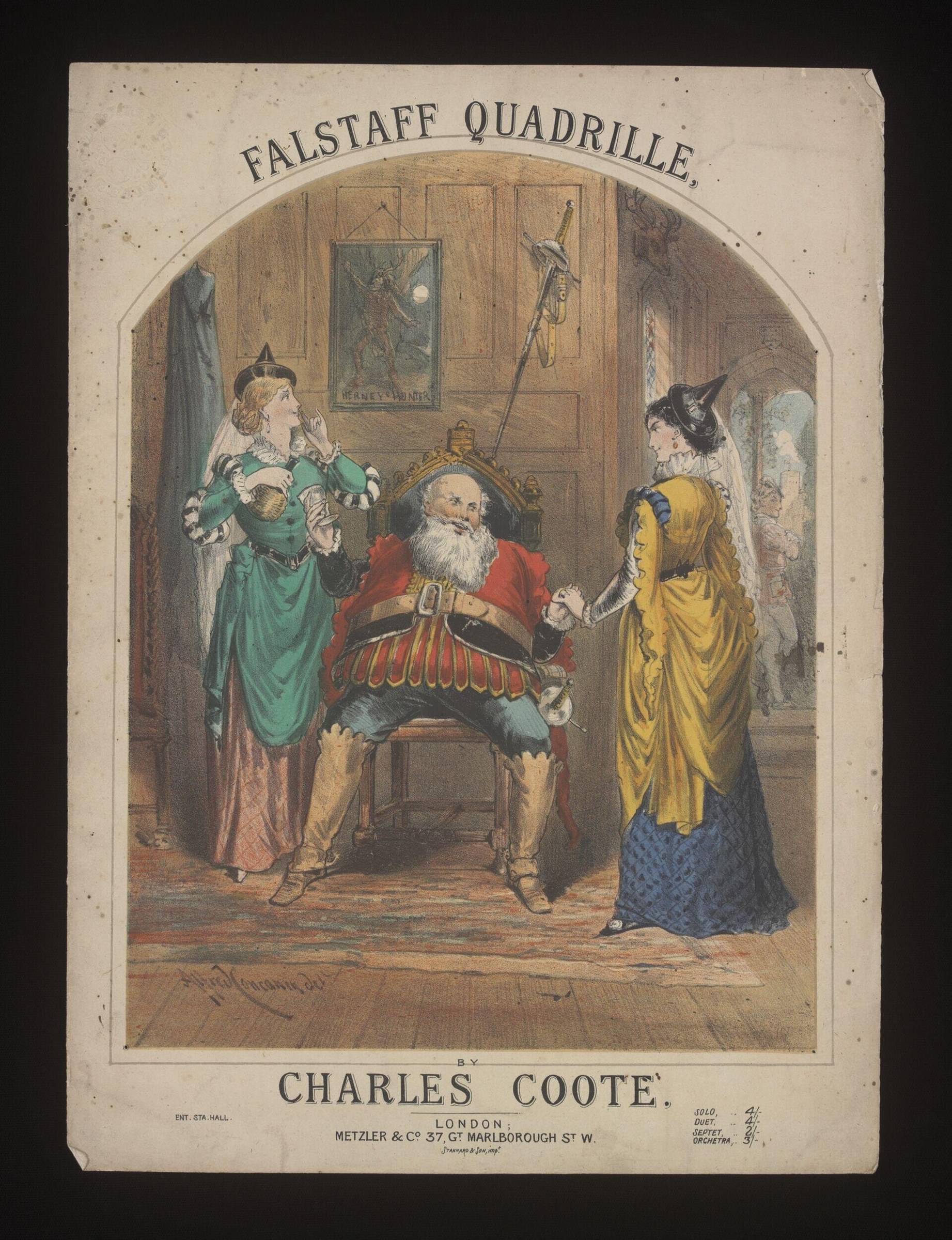
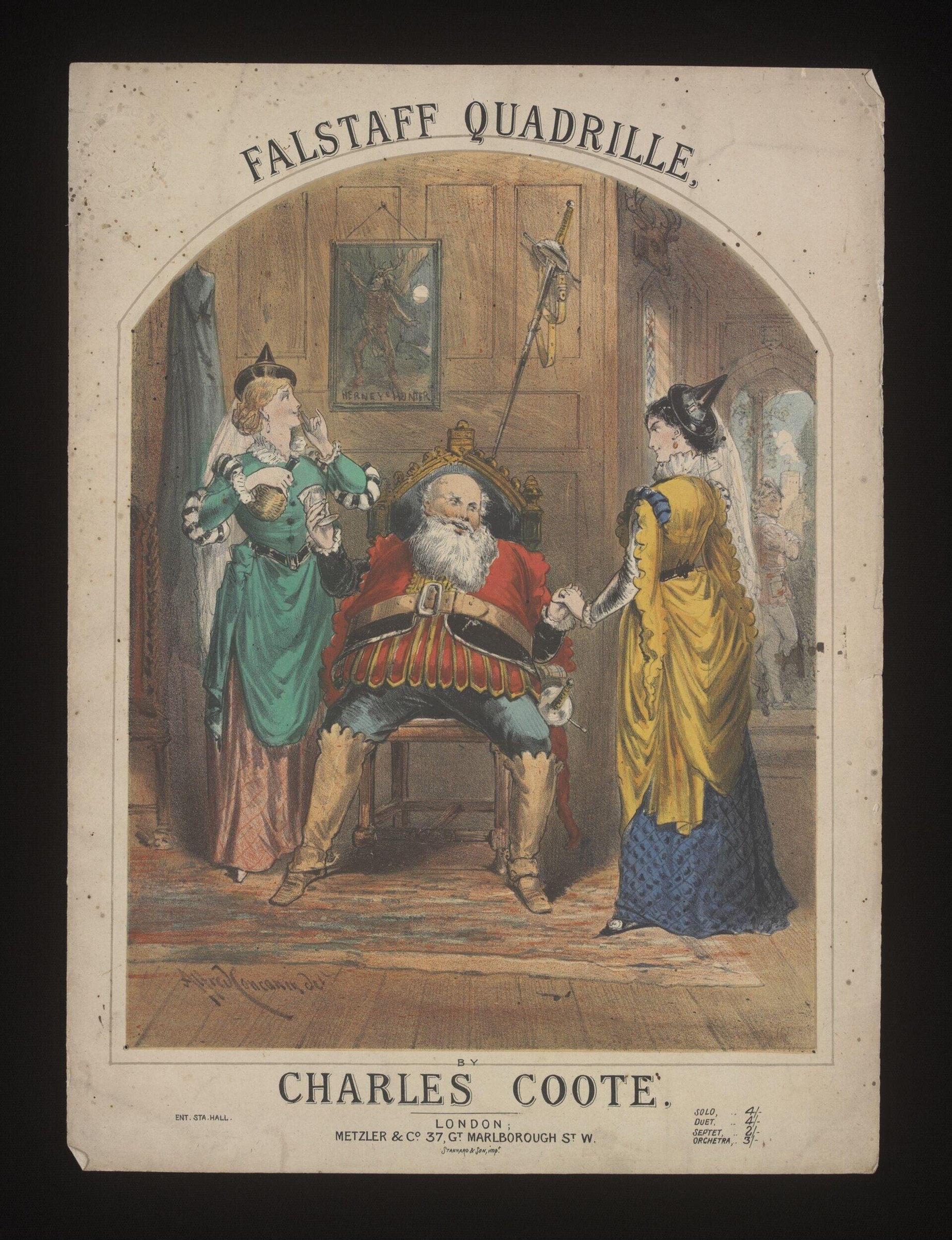
Falstaff Quadrille
Coote, Charles
- Dance:
- Quadrille
- Era:
- Late 1800s (Victorian Ballroom)
- Source:
- Victoria and Albert Museum
- Rights:
- Rights vary by item — check the source record before reusing this image. Source record ↗
- Recorded as:
- Check V&A creditLine
The work reveals how the quadrille—a formal social dance—evolved into theatrical costume entertainment in the Victorian period, where named 'quadrilles' based on literary characters became fashionable diversions at balls. For dance historians, it illustrates the porous boundary between social dance, masquerade, and amateur theatricality in the 1860s–1880s, when ballroom culture adopted narrative frameworks and literary reference.
What you are looking at
A seated military figure in a red doublet and ornate armor dominates the center of this wood-paneled interior. He holds a goblet and gestures expansively, attended by two women in contrasting dress—one in green with a white collar on the left, one in yellow drapery on the right, both wearing distinctive period headdresses. The setting is domestic and intimate: wooden wall panels, a portrait hanging above, a sword and other objects suspended from the walls. The central figure's posture and relaxed demeanor suggest he is regaling his companions with a story or jest. The composition is staged as a theatrical tableau, lit to emphasize the rich colors of the costumes against the muted wood tones.
The dancing
The central seated figure occupies the focal point with his legs spread and body leaning back in a posture of ease and authority. His raised arm holding the goblet and his open mouth suggest speech rather than dance. The two standing women flank him in complementary positions: the woman on the left leans slightly forward with one hand raised to her face in an attitude of listening or amusement, while the woman on the right stands more upright and reserved. None of the three figures are in contact or in any recognizable dance hold. Their positioning is conversational and theatrical rather than kinetic.
The dance depicted
This is not a depiction of dance. The title *Falstaff Quadrille* references the Shakespeare character and promises association with the quadrille, a social dance popular in the 19th century, but the scene itself shows a static dramatic moment—a character in repose, entertaining companions with narrative and wine. The 'quadrille' in the title likely refers to a costume dance entertainment, a theatrical performance based on a literary character rather than an actual quadrille formation or footwork. This is a narrative tableau vivant or theatrical illustration rather than a record of choreography or dance movement.
How it was made
This is a color-printed engraving or lithograph, evidenced by the fine linear detailing in the architectural and fabric elements, the carefully modulated color separation, and the characteristic registration visible in places where colors overlap. The technique allowed for mass reproduction and distribution as theatrical ephemera, likely a playbill or program illustration. The quality of hand-coloring or chromolithographic printing suggests this was marketed to a broad audience interested in theatrical performance and character entertainment during the mid-to-late 19th century.
About this work
Charles Coote's *Falstaff Quadrille* is a theatrical illustration documenting a staged costume entertainment based on Shakespeare's Sir John Falstaff. Rather than depicting actual quadrille dancing, it captures a narrative moment: the fat knight in his tavern surrounded by admiring or bemused female attendants. The work belongs in a dance gallery not because it shows dance but because the 'quadrille' was a titled social entertainment—a fashionable vehicle for theatrical costume and character play in the Victorian era. Such illustrated quadrilles were genteel amusements at balls and masquerades, where named themes and literary characters replaced pure choreography with theatrical spectacle. This image documents how dance terminology was borrowed for non-choreographic performance and how 19th-century ballroom culture intersected with theatrical culture.
How to look at it
Observe first that no one is dancing: the composition is frozen in a moment of conversation and display rather than movement. The seated Falstaff occupies the power position—central, elevated, gesturing—while the women are arranged as audience and attendants. Notice the theatricality of the pose: the spread legs, the goblet held high, the open mouth, the backdrop of domestic interior furnishings that suggest a stage set. This is costume drama staged as tableau, the 'quadrille' element residing in the fact that such entertainments were performed at balls as themed diversions, not in the footwork or formation shown here.
The artist
Charles Coote was a London-based artist and illustrator active in the mid-to-late 19th century, working primarily in theatrical and entertainment subjects. He produced costume designs, playbill illustrations, and chromolithographic prints for the entertainment industry, contributing to the visual documentation of Victorian theatrical practice and popular amusements.
The period
The quadrille dominated European ballroom culture from the 1840s through the 1880s, displacing the waltz as the primary social dance at formal events. By the mid-Victorian period, named or 'character' quadrilles had become fashionable entertainments at masquerades and balls: themed sets performed by costumed dancers in formation, often based on literary characters, historical periods, or national types. These were distinguished from simple quadrilles by their narrative or visual concept. The Falstaff Quadrille sits within this tradition, offering a theatrical elaboration of a Shakespeare character as ballroom amusement. Coote's illustration documents this hybrid form, part dance, part costume drama, that flourished in genteel Victorian social life.
Where it lives
The work is catalogued in the Victoria and Albert Museum collection and was accessed via the 'va' source. It is a color-printed theatrical ephemera object, likely a playbill, program illustration, or promotional print for a theatrical entertainment or social event.
Questions about this work
Is this actually showing a quadrille dance?
No. The image shows a static theatrical scene, not dance movement or a quadrille formation. The 'Quadrille' in the title refers to a Victorian social entertainment—a themed costume performance at a ball based on a literary character or historical period. These were named diversions at formal events, borrowing dance terminology for theatrical purposes rather than pure choreography.
Who was Falstaff and why did he inspire costume entertainments?
Sir John Falstaff is Shakespeare's comic knight from the Henry IV plays and *The Merry Wives of Windsor*—a figure of excess, wit, and bravery. His outsized personality and distinctive appearance made him popular as a character for costume masquerades and theatrical entertainments in the 19th century.
What were Victorian quadrilles?
The quadrille was a formal group dance performed by four couples in a square formation, with set figures and music. By the mid-19th century, named or character quadrilles had become fashionable at balls: thematic versions with costumes, narrative, and literary references, performed as spectacle rather than pure social dancing. These were often illustrated in theatrical prints and playbills.
What does this tell us about 19th-century ballroom culture?
It shows that Victorian ballrooms were not purely about dancing but about theatrical amusement, costume, and narrative. The boundary between social dance, masquerade, and amateur theater was fluid; balls featured themed entertainments that mixed movement, costume, and character play. This blending reflects the genteel amateur theatricality and literary interest of Victorian society.
More Quadrille artwork