37 works in this view — arrow keys or swipe to move between them.
Dance in Art
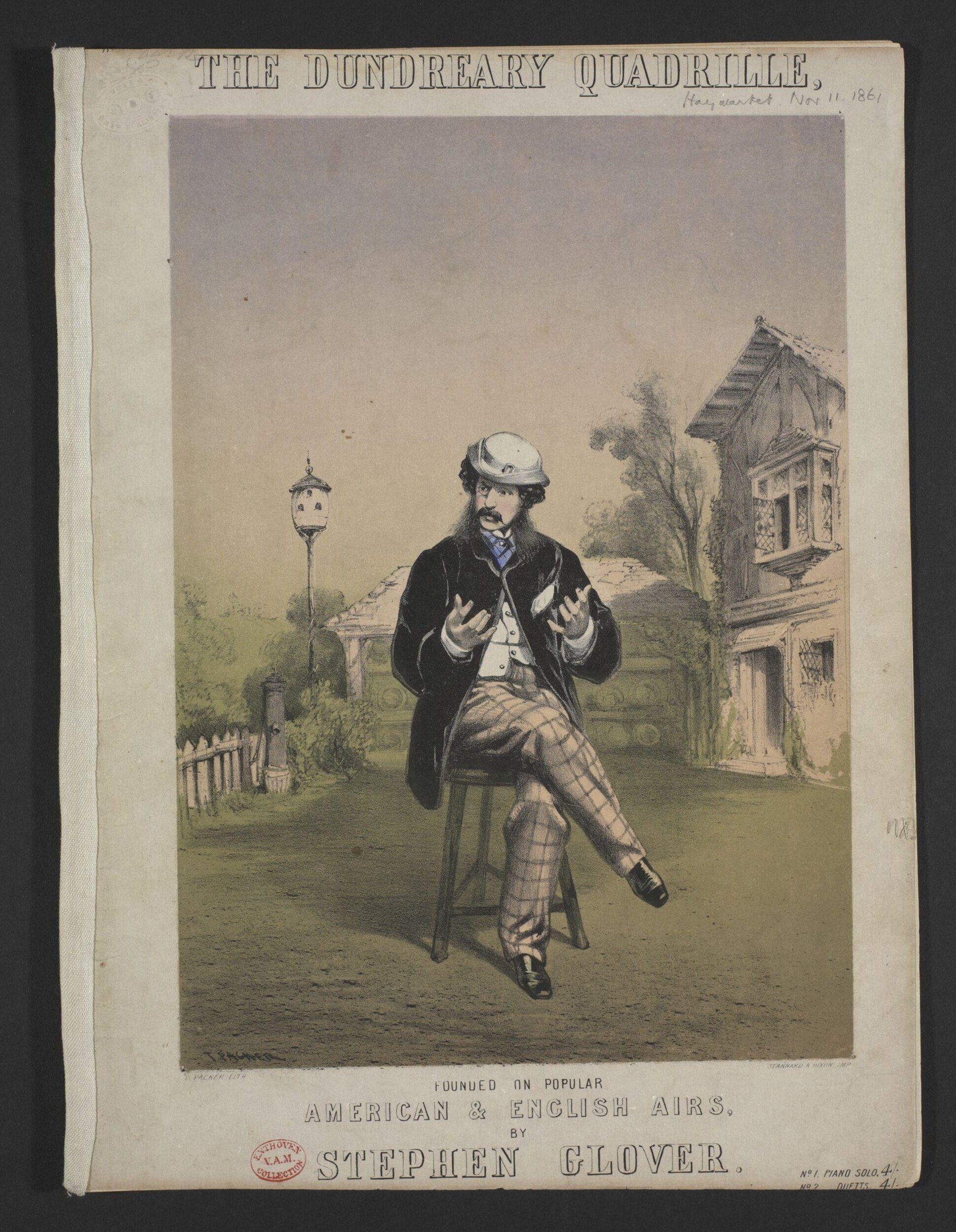
The Dundreary Quadrille
Packer, Thomas
- Dance:
- Quadrille
- Era:
- Mid 1800s (Polka Era)
- Source:
- Victoria and Albert Museum
- Rights:
- Rights vary by item — check the source record before reusing this image. Source record ↗
- Recorded as:
- Check V&A creditLine
This print documents the repertoire and performance style of Victorian music-hall dance, a living tradition of comic, athletic, and character-based solo performance that has been largely overshadowed by the history of classical ballet. The image shows that structured social dances like the quadrille were not only danced in formal ballroom contexts but also re-imagined, parodied, and performed as entertainment in theatrical and variety settings, revealing how popular dance forms circulated and transformed across social and performance contexts.
What you are looking at
A well-dressed man stands alone in a stylized Victorian street scene, captured mid-gesture in an exuberant pose. He wears a white bowler hat, a dark tailcoat jacket, a checked waistcoat, and plaid trousers; his arms are raised and spread wide in an expansive, celebratory gesture. His weight is shifted to one leg while the other is lifted and bent, suggesting dynamic movement. The setting is a refined promenade or park: a white picket fence appears on the left, ornamental street lamps mark the space, and substantial townhouses with shuttered windows and decorative details frame the composition on the right. The foreground is rendered in greens and tans suggesting manicured lawns; the sky is hazy and atmospheric. The overall tone is one of theatrical exuberance rather than naturalism—this is a portrait of a moment of infectious joy or comic performance, rendered in the chromolithographic style popular for theatrical prints of the 1860s.
The dancing
A single male figure dominates the composition. His posture is open and expansive, with both arms extended outward and upward at roughly shoulder height, palms facing up or forward in an inviting, expressive gesture. His torso is lifted and twisted slightly; his right leg carries his weight while his left leg is raised and bent at the knee, foot lifted from the ground. The overall impression is of someone mid-stride in a buoyant, almost skipping movement, caught at the apex of an athletic or comic leap. The gesture reads as performative rather than balletic—the frame and arm carriage are consistent with music hall and variety theatre conventions rather than classical dance technique.
The dance depicted
This appears to document a solo performance from the Victorian music hall or theatrical tradition, most likely linked to a popular stage character. The title references the Dundreary Quadrille, a dance tune that was fashionable in the 1860s, though the figure shown is performing a solo entertainment piece rather than a partner quadrille. The gestural vocabulary—wide arm spreads, lifted leg, emphasis on comedy and character over technical precision—is consistent with the 'character dance' and comic sketches performed in British variety theatres of this era. The image likely captures a specific celebrated performer or a type character associated with this music.
How it was made
This is a chromolithograph, a colour lithographic print made by drawing on separate stone plates for each colour and overprinting them in sequence. The technique allowed vivid, saturated colours and subtle tonal gradations, visible here in the atmospheric sky, the softly rendered grass, and the carefully differentiated fabric textures. Chromolithography was the dominant technology for theatrical and music-hall publicity prints in Britain from the 1850s onwards, enabling mass production of high-quality images for posters, playbills, and illustrated periodicals. The print's refined execution and hand-lettered title suggest it was created for a commercial theatrical publisher and distributed to audiences as a souvenir or publicity image.
About this work
This is a chromolithographic theatrical print from 1861 documenting a celebrated Victorian music-hall character or performer associated with the Dundreary Quadrille dance tune. The single figure is captured in an exuberant, comic solo performance, frozen at a moment of infectious joy and athletic levity. The work belongs to the tradition of theatrical character-dance prints that recorded and celebrated the comic entertainers, physical comedians, and character actors who populated British variety theatres and music halls during the high Victorian era. It is as much a portrait of theatrical personality as it is a record of actual choreography—the image preserves not a formal dance step but the emotional and physical signature of a specific performer or performance type.
How to look at it
Attend to the specificity of the gesture: this is not a classical dance position but a moment of comic, uninhibited physical expression. The raised leg and spread arms suggest a moment of exultation or comic surprise rather than technical mastery. Notice how the artist has rendered the fabrics—the checked waistcoat and plaid trousers—with enough detail to suggest that costume and character are central to understanding this performance. The manicured setting emphasizes the refinement and social aspiration of mid-Victorian entertainment, even in its comic dimensions.
The artist
Thomas Packer was a chromolithographic printer and publisher active in London during the mid-nineteenth century. He was among the producers of theatrical and variety entertainment prints that flourished during the Victorian era, working in the commercial tradition of music-hall publicity and souvenir imagery. These prints were typically based on designs by other artists but executed and published by printers like Packer, who controlled the lithographic technology and distribution networks.
The period
The 1860s were the heyday of the British music hall and variety theatre, a form of entertainment distinct from opera and ballet that celebrated comic performance, physical comedy, and character-based entertainment. The quadrille itself—a French contra-dance adapted for Victorian ballrooms—had become so embedded in popular culture that it was subject to comic variation and parody. Chromolithographic printing technology had just matured, making high-quality colour theatrical prints affordable and desirable for a broad middle-class audience. This democratization of theatrical imagery meant that music-hall performers and their acts could be widely celebrated and circulated in visual form.
Where it lives
The print is held in the Victoria and Albert Museum collection, part of their holdings of nineteenth-century theatrical and entertainment ephemera. It is catalogued as a chromolithograph and dated to 1861. The museum's acquisition details and provenance history are not recorded in the current catalogue entry.
Dance in this work
Questions about this work
Was the Dundreary Quadrille an actual dance or a joke?
The Dundreary Quadrille was a real dance tune associated with a character or performers of that name, but this print suggests it was performed as character entertainment and parody as much as a formal quadrille. The term 'Dundreary' may itself derive from theatrical characters or comedic personas.
What was music-hall dance in the Victorian era?
Music halls were variety theatres that staged short turns by comedians, singers, acrobats, and character dancers, distinct from the formality of opera or classical ballet. Dancers performed character roles, comic pieces, and re-imaginings of popular social dances. This print documents that tradition.
Why would a social dance like the quadrille appear in a music hall?
Popular social dances were often adapted for comic or satirical performance on the stage. Music-hall audiences enjoyed seeing familiar dances parodied, exaggerated, or transformed into character entertainment, blurring the line between ballroom and theatrical performance.
How were these prints used?
Theatrical prints like this were sold as souvenirs, playbill illustrations, or publicity images in and around theatres. They celebrated popular performers and acts, allowing audiences to take home a memento and helping theatres advertise their attractions.
More Quadrille artwork