41 works in this view — arrow keys or swipe to move between them.
Dance in Art
Quadrille Historique
Leduc, Alphonse
- Dance:
- Quadrille
- Era:
- Late 1800s (Victorian Ballroom)
- Source:
- Victoria and Albert Museum
- Rights:
- Rights vary by item — check the source record before reusing this image. Source record ↗
- Recorded as:
- Check V&A creditLine
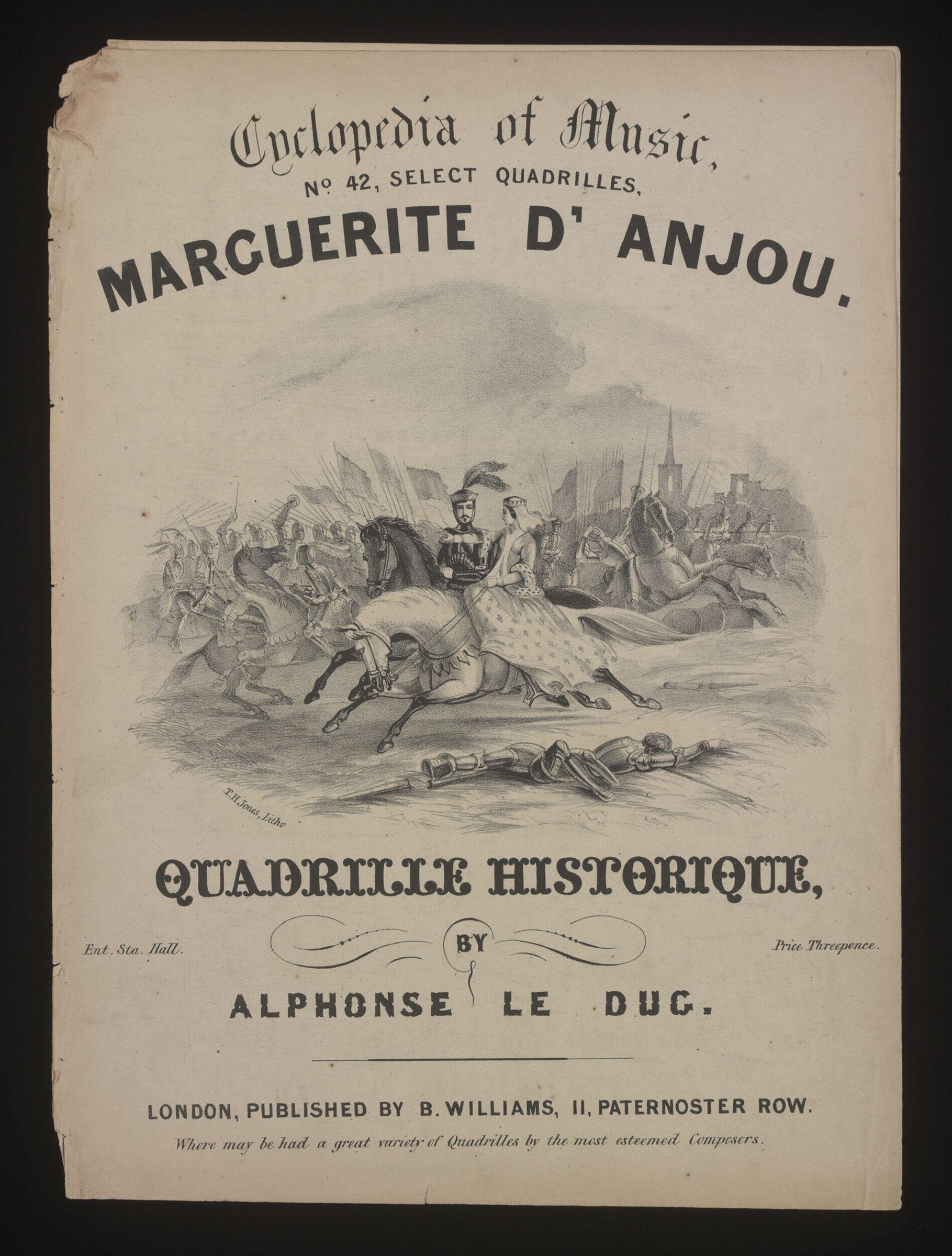
The quadrille historique was a significant 19th-century dance and music phenomenon that transformed the formal ballroom quadrille into a vehicle for narrative drama and spectacle, often performed at balls and public entertainments. This engraving shows how such pieces were marketed and consumed as multimedia events—the music, the dance steps, and the historical narrative were inseparable. Understanding this genre helps explain how ballroom dance in the Victorian era was never merely technical or social, but deeply invested in theatrical storytelling and visual spectacle.
What you are looking at
A dramatic military scene unfolds across the composition, dominated by a mounted figure in the centre—a woman in an elaborate patterned dress mounted side-saddle on a rearing horse. She is surrounded by uniformed soldiers on horseback and foot, their lances and weapons raised in chaotic movement. The foreground is scattered with fallen weapons and what appear to be casualties. In the middle distance, a fortified city with spires and walls rises behind the melee. The entire scene is rendered in fine engraved lines that create a heroic, dynamic sense of action and combat, with the mounted woman at the compositional apex commanding attention against a crowd of military figures rendered in smaller scale around her.
The dancing
The central figure sits upright on her horse in a sidesaddle position, her body oriented toward the viewer with arms raised or held in an expressive gesture that suggests command or exhortation. The surrounding soldiers lean, turn, and thrust with their bodies weighted forward in the moment of combat. While this is not a depiction of social dance, the compositional arrangement of bodies in space—the interlocking of figures, the rhythm of raised limbs, the relationship between the central mounted figure and the surrounding crowd—demonstrates an artist's attention to the organisation of moving bodies in a dramatic tableau.
The dance depicted
This is not a dance composition, but rather a historical or legendary military scene—likely a Marquerite d'Anjou, as the title indicates—depicting a moment of battle or command rather than ballroom or social dance. The image appears to be a narrative illustration accompanying a historical account (as suggested by the subtitle "Quadrille Historique"), not a representation of the actual dance form mentioned in the title. The dance reference in the title appears to be ironic or poetic—a common convention in 19th-century popular prints where dramatic historical scenes were packaged as "quadrilles" or "gallops," giving titles as if they were choreographic sequences.
How it was made
This is a steel or copper engraving, identifiable by its fine parallel hatching lines, precise linear detail, and the formal print aesthetic. The medium allowed for mass production and wide circulation, which is consistent with its publication by B. Williams in London and its inclusion in the "Cyclopaedia of Music" series as no. 42. The technique required skilled hand-engraving to create the illusion of depth, movement, and dramatic light through line density alone—the clustered parallel lines building shadow and form in the horses, the city walls, and the crowd of soldiers. This was a popular format for historical illustrations and narrative prints aimed at middle-class Victorian audiences.
About this work
This is a narrative engraving published as part of a popular music cyclopaedia series in the mid-to-late 19th century, accompanying a piece titled "Marquerite d'Anjou: Quadrille Historique." The term "quadrille historique" refers to a fashionable genre of ballroom music and dance that dramatised historical or legendary events, allowing dancers to move through a sequence of scenes or tableaux set to orchestrated music. The image itself is not a depiction of dancers or the social dance, but rather a romanticised historical scene—likely a battle or moment of female military command—that would have provided visual narrative context for listeners and performers of the musical piece.
The work belongs in a gallery of dance in art because it demonstrates how 19th-century dance culture was embedded in a much larger culture of historical spectacle, music, and visual narrative. The quadrille historique was a theatrical and social phenomenon that blurred the boundaries between concert music, social dance, and visual storytelling. The engraving testifies to the visual appetite of Victorian audiences for dramatic historical narratives, and to the way musical performance was always also a visual and narrative event.
How to look at it
Look first at the composition: the woman on the rearing horse is positioned at the apex of a pyramid of action, her stillness and elevation in contrast to the movement and chaos surrounding her. This compositional choice suggests authority and centrality, making her the narrative focus. The viewer should notice how the engraver has used line density and hatching to create atmosphere and depth—the foreground is detailed and chaotic, while the city walls in the distance fade through lighter engraving. For a historian of dance, the image demonstrates how narrative and visual spectacle were integral to the quadrille historique, which was never merely a pattern of steps but a complete theatrical experience. The chaos and drama of this scene—the rearing horses, raised weapons, fallen soldiers—would have been transformed into choreography and gesture by dancers interpreting the music in a ballroom.
The artist
Alphonse Le Duc (also recorded as Leduc) was a prolific engraver and music publisher active in mid-19th-century London. He specialised in illustrative material for music publications, particularly popular and theatrical music. His work represents the commercial music publishing industry's engagement with visual culture—engravers like Le Duc were essential to the marketing and circulation of sheet music and musical narratives among Victorian audiences. While little is documented about his life, his output suggests he was a skilled craftsman working at high volume for mass-market publishers.
The period
The quadrille historique emerged in France during the 1830s-1840s and became fashionable in English ballrooms by the 1850s-1870s. It was part of a broader Romantic fascination with historical costume, legend, and dramatic narratives. During this period, Victorian visual culture was saturated with historical imagery—dramatic engravings of battles, legends, and literary scenes were cheaply reproduced and widely consumed. The quadrille historique allowed ballroom dancers to participate in this visual and narrative culture; a quadrille might dramatise a historical battle, a romantic legend, or a literary episode, with each of the four sections of the dance corresponding to different scenes or moments. The music cyclopaedia series in which this was published reflects the growth of a new kind of middle-class leisure consumer interested in music, dance, and illustrated narrative.
Where it lives
This engraving is part of the "Cyclopaedia of Music" series published by B. Williams of Paternoster Row, London, and is held in the Victoria and Albert Museum collection. It is one of a numbered series (no. 42) of popular music illustrations, suggesting it was one of dozens of similar works produced for a subscription or series audience. The price is marked as "Threepence," indicating it was affordable mass-market product.
Questions about this work
What is a 'quadrille historique'?
A quadrille historique was a narrative musical composition and social dance popular in the 19th century, particularly in Victorian ballrooms. It transformed the formal quadrille—a set dance for four couples arranged in a square—into a vehicle for dramatic storytelling, with each section of the dance accompanying a different scene or moment from history, legend, or literature. Orchestral music provided the narrative and emotional framework, while dancers performed stylised movements and formations that interpreted the dramatic content.
Why is this engraving of a battle scene published with a dance title?
The engraving provided visual context and narrative framing for the musical and choreographic piece. Dancers and audiences would have understood the musical composition as narrating this historical or legendary moment—in this case, apparently the life or a dramatic episode involving Marguerite d'Anjou. The image sold the narrative to potential buyers and performers, making clear that this was not merely a formal dance pattern but a complete theatrical experience.
Who was Marguerite d'Anjou?
Marguerite d'Anjou (1429–1482) was Queen of England by marriage, known for her political power and her dramatic involvement in the Wars of the Roses. By the 19th century, she was a popular figure in historical romances and dramatic narratives, and her story provided the kind of intense, historically resonant drama that appealed to Victorian audiences. The specific scene depicted in this engraving is not clearly identifiable from the image alone.
What does the fine engraving technique tell us about this work's audience?
The steel engraving was a time-intensive and skilled craft, but it allowed for affordable mass reproduction once the plate was finished. The price of threepence indicates this was meant for middle-class consumers—not luxury goods, but quality products for people who could afford regular purchases of music and illustrated material. The inclusion in a numbered cyclopaedia series suggests it was collected and accumulated by subscribers interested in music, dance, and visual narrative.
More Quadrille artwork