42 works in this view — arrow keys or swipe to move between them.
Dance in Art
The Olivette Quadrille
D'Albert, Charles
- Dance:
- Quadrille
- Era:
- Late 1800s (Victorian Ballroom)
- Source:
- Victoria and Albert Museum
- Rights:
- Rights vary by item — check the source record before reusing this image. Source record ↗
- Recorded as:
- Check V&A creditLine
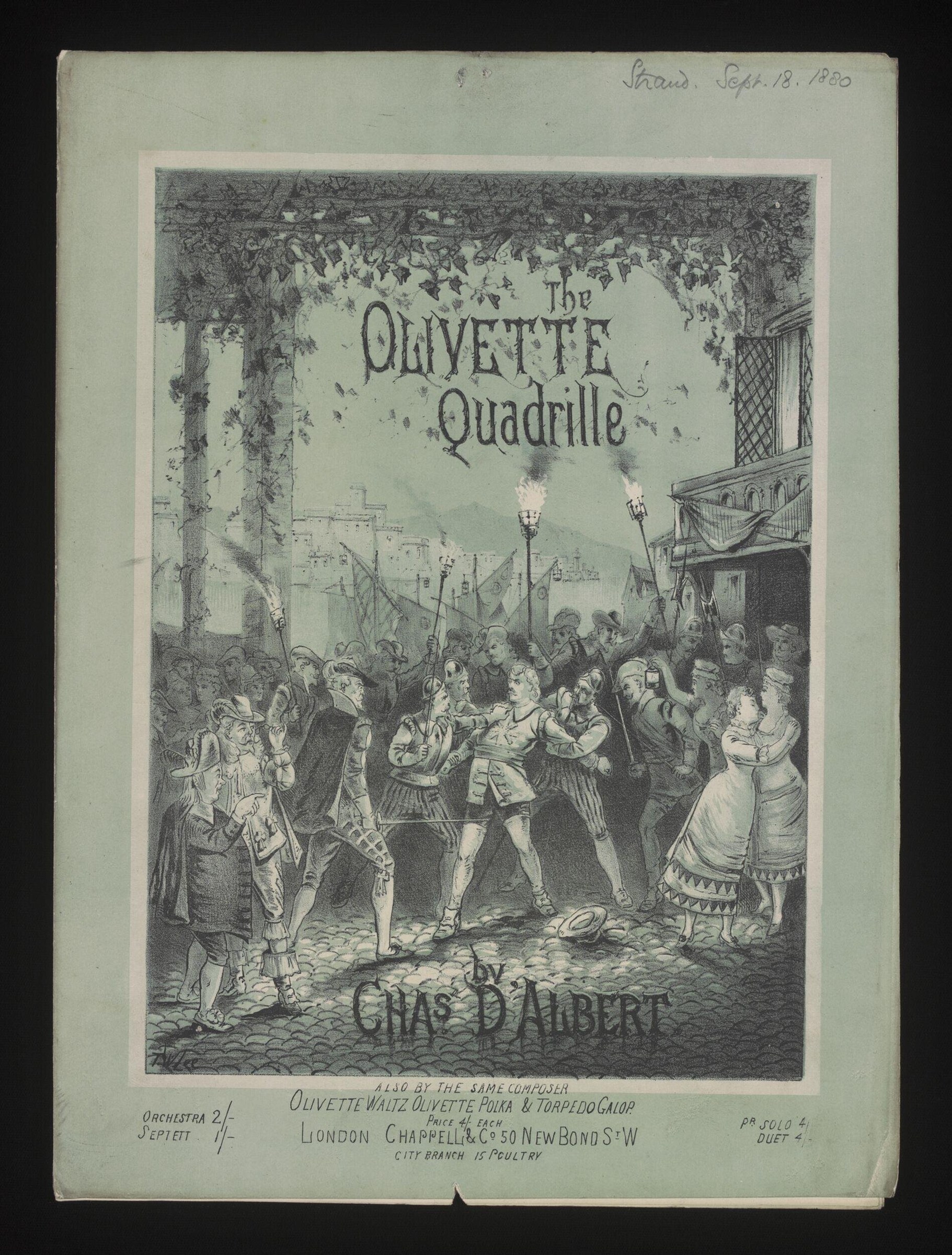
This image records the quadrille at the height of its popularity and provides rare visual evidence of how the dance actually looked in the street—the hold, spacing, and figure work frozen mid-performance. For dancers and historians, it is a primary source showing costume, music publishing practice, and the social staging of dance outside the ballroom.
What you are looking at
A crowded street scene set in what appears to be a European town square or marketplace, rendered in black and white engraving. Figures in 19th-century dress—women in long skirts and bonnets, men in military or formal attire—cluster around a central space where four couples are engaged in the quadrille. The composition is framed by an ornamental vine border at the top and sides, suggesting this is a title page or cover illustration. Gas lamps illuminate the scene, and townspeople watch from the sides and background. The setting captures the quadrille as a public spectacle, not a ballroom affair, with the dancers occupying the street itself and onlookers pressed close on all sides.
The dancing
Four couples are visible in the dance space, positioned in the characteristic lines of a quadrille. The dancers stand in closed partnering positions—men and women facing each other or side-by-side—with upright posture and formal carriage consistent with 19th-century ballroom protocol. The women's long skirts are animated by the movement, caught mid-turn in several figures. The men wear military dress or formal evening coats. The spacing and alignment suggest the dancers are executing one of the quadrille's standard figures, though the angle and crowding make precise footwork invisible.
The dance depicted
This is unquestionably a quadrille, the most fashionable social dance of the Victorian era. The inscription at the base identifies it as 'The Olivette Quadrille,' likely a titled variation or musical arrangement of the form that was performed in ballrooms and, as this image shows, in public spaces. The quadrille was danced by four couples in square formation, executing a sequence of figured movements to music in 2/4 time. Its popularity extended from elite ballrooms into middle-class and street culture, making it a symbol of respectable social dancing. The engraving documents the quadrille not as a refined parlour activity but as public entertainment.
How it was made
This is a steel or wood engraving, printed as a cover illustration or broadsheet title page. The fine linear detail, achieved through careful cross-hatching and parallel lines, creates tonal depth and texture—the ornamental vines have real botanical specificity, and the crowd's density is rendered through accumulated marks. Engraving's precision and durability allowed this image to circulate widely and be reprinted. As a commercial illustration advertising a musical composition, it would have been produced in quantity, making it accessible to amateur musicians and dancers purchasing sheet music or attending public performances.
About this work
Charles d'Albert's engraved title page for 'The Olivette Quadrille' captures the quadrille at a pivotal moment in its social history—when it had migrated from exclusive ballrooms into public celebration. The work is both a dance document and a commercial artifact: it advertises music for performance while documenting the dance as a lived social practice. The quadrille was the ballroom dance that defined the Victorian era, and d'Albert's choice to set it in the street rather than indoors, surrounded by a mixed crowd of onlookers, suggests the dance's penetration into popular culture. The engraving's fine detail and public circulation made it a window into how the Victorians danced.
How to look at it
Notice the four-couple square formation and the formal upright posture of all the dancers—this is ballroom decorum made visible, even in the street. The artist has frozen the dancers mid-figure, allowing the women's skirts to billow and animate what would otherwise be a stiff arrangement. Look at the crowd's reaction: onlookers are engaged and close, but they do not interrupt the space; the dance occupies a defined square within the public space. The ornamental frame, rendered in fine vine work, elevates a street scene to the status of high art, suggesting that even popular dance deserves serious visual attention.
The artist
Charles d'Albert was a 19th-century music publisher's artist and engraver working in London. Little is recorded of his individual biography, but his work appears on multiple dance-related sheet music covers of the 1850s-1880s, making him a documenter of Victorian dance culture through commercial illustration. He worked for the London publisher Chappell & Co., one of the major music houses of the era, suggesting his engravings reached a broad amateur and professional audience.
The period
The quadrille dominated European and American ballrooms from the 1820s through the 1880s, reaching its peak in the 1850s-1870s. By mid-century, the dance had become so widespread that it appeared in street celebrations, public gardens, and working-class entertainment venues. The 1850s-1880s saw an explosion of published quadrille music, each with a distinctive title and slight variation on the basic figures. D'Albert's engraving dates to this moment of mass popularity. Simultaneously, the Victorian ballroom was codifying its protocols—the quadrille represented order, propriety, and symmetry, values reflected in the formal arrangement and the public's orderly observation.
Where it lives
The work is held by the Victoria and Albert Museum, which houses the world's largest collection of theatrical and dance-related prints and designs. As a title page from a published musical composition, it is one of thousands of similar commercial engravings produced by London music publishers in the 19th century. The inscription identifies it as published by Chappell & Co., 50 New Bond Street, London.
Dance in this work
Questions about this work
What is a quadrille and why was it so popular?
The quadrille was a social dance performed by four couples in a square formation, with a set sequence of figures danced to instrumental music. It was popular across Europe and America from the 1820s through the late 1800s because it was lively, choreographed enough to be elegant but simple enough for amateurs, and suitable for any social occasion from royal balls to street celebrations. It was also economical—you needed only four couples and a musician.
Why is this dance illustrated as a street scene rather than a ballroom?
By the mid-to-late 19th century, the quadrille had become so widespread that it was danced everywhere—not just in ballrooms but in public gardens, at street fairs, and in working-class venues. This image documents that democratization. It may also be that the artist chose a lively street setting to make the cover more visually dynamic and commercial appeal broader.
What does the ornamental frame suggest?
The elaborate vine border elevates the image beyond mere illustration—it frames the street scene as a work worthy of artistic attention, suggesting that social dancing, even in public, was worth documenting carefully. It is a common device in 19th-century commercial graphics, signaling quality and respectability to potential buyers of the sheet music.
More Quadrille artwork