38 works in this view — arrow keys or swipe to move between them.
Dance in Art
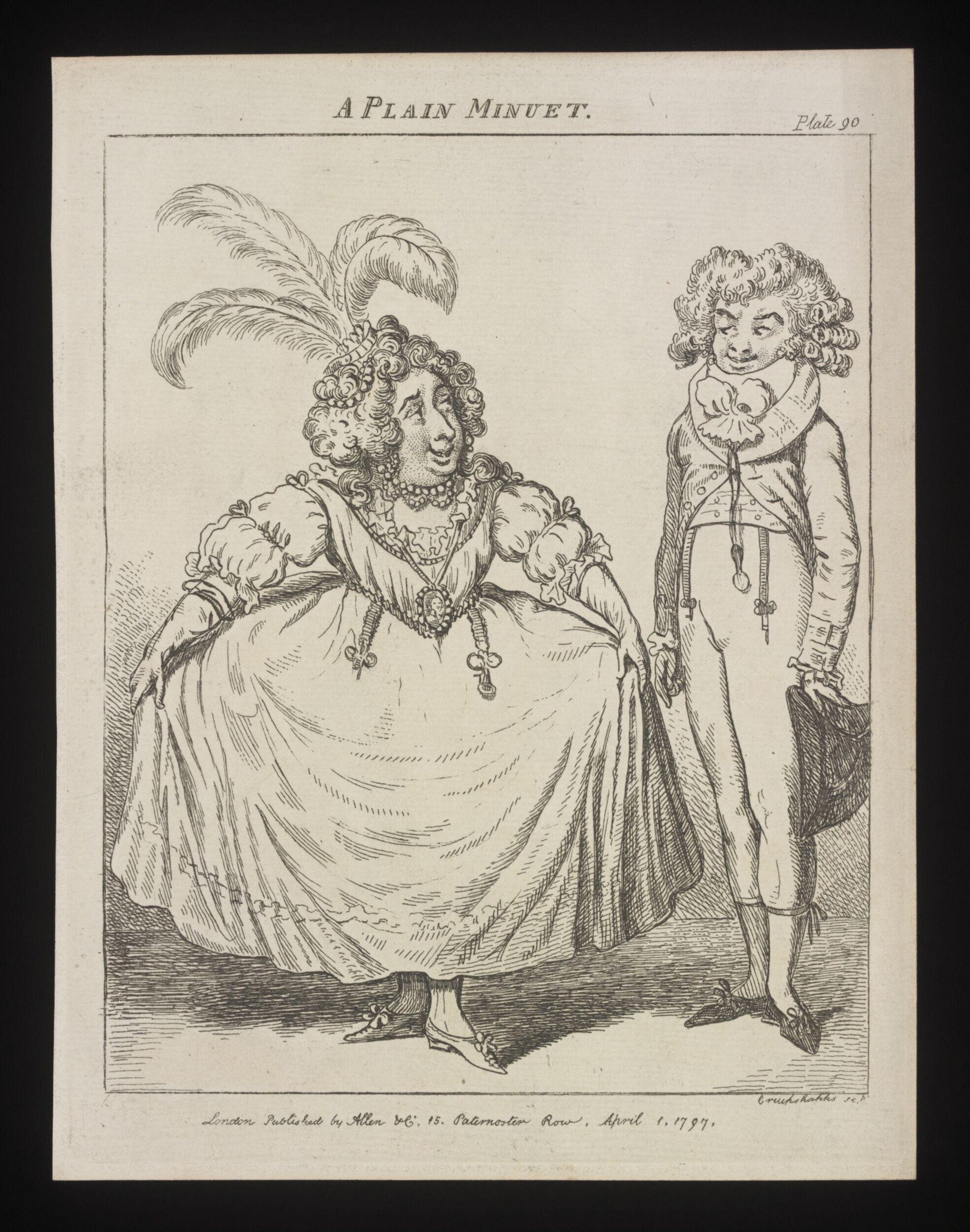
A Plain Minuet.
Woodward, George Moutard
- Dance:
- Minuet
- Era:
- 1700s (Enlightenment/Minuet Era)
- Source:
- Victoria and Albert Museum
- Rights:
- Rights vary by item — check the source record before reusing this image. Source record ↗
- Recorded as:
- Check V&A creditLine
The minuet was the primary social and theatrical dance of the entire 18th century, and this engraving captures a crucial moment in its history—the point at which the dance's elegant reputation and its execution in increasingly absurd fashion had become a target for satirists. For anyone studying the minuet, Regency-era dress, or the role of satire in visual culture, this image reveals how the dance was understood and mocked by contemporary observers.
What you are looking at
A satirical engraving depicting a woman and youth in fashionable late 18th-century dress. The woman, the focal point, wears an elaborate gown with voluminous skirts supported by panniers, her bodice adorned with jewels and laces, her hair piled high in elaborate curls topped with ostrich plumes. She holds a fan and sports multiple necklaces and decorative chains. Beside her stands a young man in fitted breeches, coat, and stockings, his own hair styled in fashionable ringlets. The two figures occupy a plain stage or interior setting with minimal background detail, suggesting this is a theatrical or social commentary piece rather than a documentary record. The engraving's title, "A Plain Minuet," appears ironic given the ornate display of the figures—the satire lies in the contrast between the minuet's supposed simplicity and grace and the extravagant, overdressed bodies supposedly executing it.
The dancing
The woman stands with weight shifted to one side in a posture suggesting a dance position—her body angled, one arm raised holding a fan in an elegant gesture, her chin lifted. The young man beside her maintains an upright posture with arms at his sides or in a composed position appropriate to partnered dancing. Neither figure is captured mid-step; instead, both are presented as static display, which heightens the satirical intent. Their proximity and the woman's orientation suggest they are partners, though there is no physical contact between them.
The dance depicted
The work depicts or references the minuet, the most fashionable social dance of the 18th century and a staple of both aristocratic gatherings and the theatrical stage. The title's irony—"A Plain Minuet"—mocks the gap between the dance's supposed elegance and restraint and the ornamental excess of the dancers' dress and presentation. The minuet was danced by a single couple in formal dress, with carefully controlled arm positions, precise footwork, and a measured tempo. This engraving captures not the movement itself but the theatrical, almost grotesque spectacle of executing such a refined dance while dressed in the exaggerated fashion of the 1790s.
How it was made
This is an engraving, executed with fine cross-hatching and precise line work. The technique allows for sharp detail in the rendering of fabric folds, jewelry, and facial features, essential to the satirical purpose—every absurd detail of the costume is clearly legible. The signature visible in the lower right appears to be Cruikshank's mark. Engravings of this type were produced for publication and circulation as satirical prints, affordable enough for middle-class consumption and designed to be widely distributed, framed, or bound into collections. The title and publication information inscribed at the bottom indicates this was a commercial print, part of a series or bound collection.
About this work
This is a satirical engraving of a fashionable couple executing, or preparing to execute, a minuet in the height of 1790s fashion. The minuet was the quintessential refined dance of the 18th-century elite, taught to all well-bred young people and performed in both ballrooms and on the theatre stage. The engraving uses the contrast between the dance's formal restraint and the visual chaos of contemporary dress to mock both the fashion and the pretension of polite society. It belongs in the dance collection as a document of how the minuet was performed and understood at the end of the 18th century—not as a record of actual movement, but as a commentary on the social performance of gentility.
How to look at it
Attend to the stillness of the figures and the exaggeration of their costume. There is no action frozen mid-movement; instead, the couple is posed as though for a portrait or a fashion plate. The satire operates through visual excess rather than through distorted anatomy: the figures are anatomically reasonable, but their dress is overwhelming. Notice how the woman's skirts dominate the composition, and how her jewels and plumes accumulate. The minuet, in contrast, was understood as a dance of restraint and small, precise steps—the joke is that such refinement is rendered invisible or impossible by the sheer visual noise of fashionable dress. The plain background intensifies this effect, forcing the viewer to focus entirely on the figures' spectacular presentation.
The artist
George Moutard Woodward (c. 1760–1809) was a prolific satirical artist and caricaturist, known for his hand-coloured or printed engravings of fashionable London life, military subjects, and social follies. He worked in the tradition of Rowlandson and Gillray, producing prints for commercial sale and publication. His output was large and his work circulated widely among London's middle and upper classes. Woodward's style combined sharp observation of fashion and behaviour with caricature, exaggerating distinctive features for comic effect. His prints often targeted the vanity and pretension of fashionable society.
The period
By the 1790s, the minuet had been the dominant courtly and ballroom dance for over a century, but its social meaning was shifting. The French Revolution and changing tastes in dance—particularly the rise of the cotillion and country dances—were beginning to displace it from its supreme position. In the theatre, the minuet remained a standard element of ballet and comic opera, but among the fashionable public it was becoming more of a marker of old-fashioned formality. The exaggerated fashions Woodward depicts—the woman's towering coiffure and panniers, the man's finical dress—were themselves becoming targets of satire as the neoclassical silhouette began to emerge. The engraving captures a moment when both the minuet and the fashion that accompanied it were ripe for mockery.
Where it lives
The work is held in the Victoria and Albert Museum, a major London collection of decorative arts and design. It is part of the museum's holdings of 18th- and early 19th-century satirical prints, which include works by Rowlandson, Gillray, and their contemporaries. The publication line at the bottom ("London: Published by Alen Wis. 15 Palermoster Row, April 1. 1797") indicates it was issued as a commercial print.
Dance in this work
Questions about this work
Why is it called 'A Plain Minuet' if the people are dressed so elaborately?
The title is ironic. The minuet was supposed to be a 'plain' or restrained dance—formal, elegant, with small precise steps and controlled arm movements. Woodward's satire is that executing such a refined dance while wearing such grotesquely exaggerated fashion was farcical. The title mocks the gap between the dance's supposed simplicity and the visual chaos of fashionable dress.
Is this showing an actual dance, or just a portrait in fancy dress?
It is a satirical commentary rather than a record of actual movement. The figures are posed, not caught mid-step. Woodward's point is social and sartorial rather than choreographic. However, the work does document how the minuet was understood at the end of the 18th century—as a dance performed by the fashionable elite, now looking increasingly ridiculous.
Who was George Moutard Woodward?
Woodward (c. 1760–1809) was a London satirical artist and caricaturist who produced hand-coloured and printed engravings of fashionable life, military subjects, and social foibles. He was prolific and commercially successful, working in the tradition of Rowlandson and Gillray. His prints circulated widely and were collected by middle- and upper-class Londoners.
Why should I care about a dance print from 1797?
The minuet was the dominant social and theatrical dance of the entire 18th century, and this engraving captures a moment when its reign was ending and it had become a subject for satire. It is valuable evidence of how the minuet was understood, performed, and perceived by contemporary society—and how fashion, dance, and social status intersected.
More Minuet artwork